" "

The Sequestering Approach and Personal Kanban

JimBenson_02 Jul. 17 23.53

Personal tasks are often repetitive or open-ended. Daily phone calls with your kids, an on-going email thread with your college roommate, or follow-up with potential clients are tasks that need to be carried out, but that don’t fit neatly into a kanban. If you have a CMS and need to check in with 3 customers on a daily basis, putting a card on your kanban every day that says “check in with 3 customers” is foolish. Repetitive tasks like this - while they may create value - can also be seen as overhead.What you can do with these types of tasks is sequester them in a “repeating tasks” category.  On the white board you can list these in a sequestered box, simply checking them off when complete. Then, erase the checkbox when they need to be done again.Why bother having the sequestered elements on your board at all?  Because the kanban helps visualize your overhead, which your brain will use as input when you are prioritizing and scheduling. Like it or not, the recurring elements are part of your personal work and they do provide value. One of the main goals of kanban is to kill off out-of-sight-out-of-mind management. It behooves you to visualize as much as you can on your personal kanban.

The Subproject Approach to Personal Kanban in Detail

The subproject approach to Personal Kanban

image

image

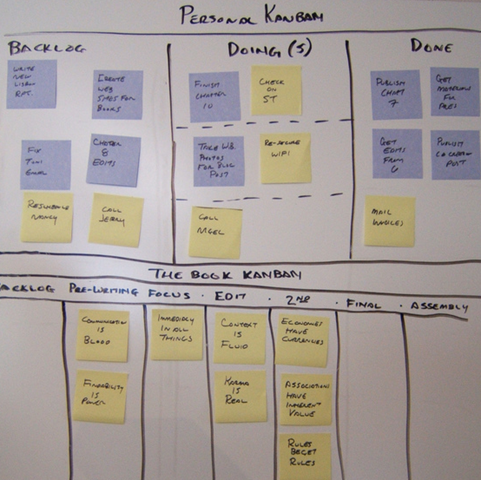
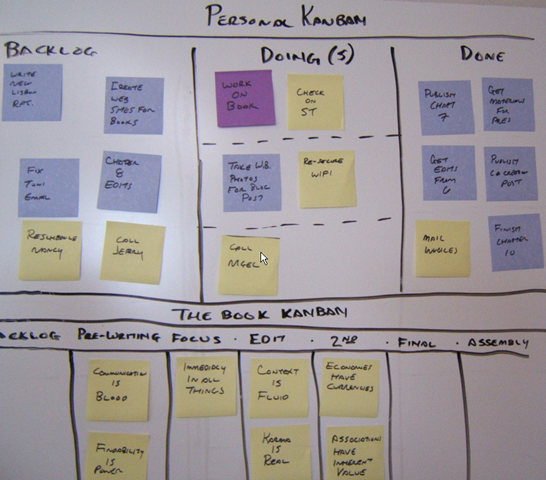
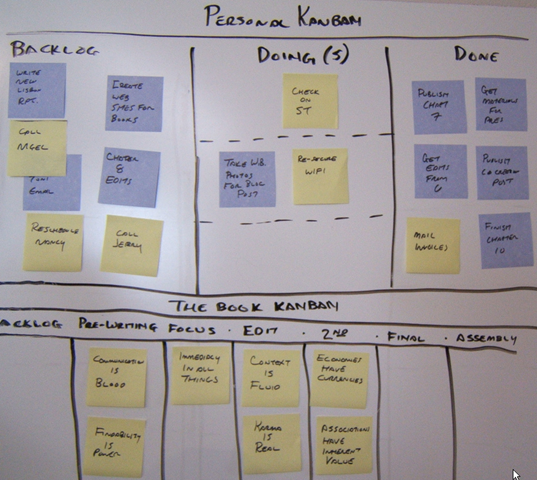
Problematic for personal kanban is that its task-based nature undermines lean’s value-tracking goals. Kanban, not even personal kanban, is not a to-do list.  Personal kanban tracks tasks because that’s primarily how individuals measure work and value.Your personal kanban can have multiple swim lanes, and they in no way need to be coordinate.  A task based swim lane can rest above one or more subproject swim lanes with a full value stream.This allows you to see your current work simultaneously in both a task view and a project view.The more you can move large projects into work-flow based subprojects, the more control you will have over them, and the more insight you will have into their flow.You have some choices with the subproject approach when its combined with the personal kanban.Roll Up: The subproject approach can be a roll-up task, tracking the progress of the large project while individual tasks still move through your personal kanban. This lets you see how quickly value moves through your subproject when you are working on other things. Here the roll-up task is the purple ticket that refers to the subproject.Active Engagement: The subproject is actively used as part of your WIP. If the nature of your work is that you are paying even small amounts of attention to the subproject each day, making tags in your subproject part of your overall WIP may be more honest. This conceptually integrates all your subprojects into your daily routine.  This integration could lead to more meaningful introspection.In this photo, there are 5 tasks in the WIP.  Three are in the top part of the kanban under “doing”, the other two active for me personally would be under “pre-writing” in the project area.

Making Waste Explicit

Reducing waste can save more than time.
Making Mochi Naturally in Ecotopia
Wade Measures Food Waste
Making Waste Explicit

Noticing waste serves no purpose. Understanding it does. Whether we seek to manage waste or attempt to eliminate it entirely, we need to know how much of it exists and what form it takes - what's its volume, its shape, its weight.  So we monitor it. We watch it. We learn from how it grows, how it spreads, and what its impacts are.On an idyllic spring day on Bainbridge Island near Seattle, in the crisp fresh air I stood rapt as people heated rice over an open fire. With huge mallets they furiously pounded the grains in a mortar, turning the hot steaming mass into a glutinous paste that is life’s most perfect confection - what the Japanese call "mochi." With apparently heat-resistant hands, they grabbed and worked the steaming paste, transforming it into the fluffiest mochi balls imaginable.This scenario took place at the 2008 Mochi Festival at IslandWood. IslandWood is an educational facility situated in the heart of a forest in the middle of an island in Puget Sound.  In their carbon-neutral environment, IslandWood's stunning 255 acre campus embodies an ideal. In this setting, students of all ages can spend a few days or even an entire university term studying sustainability and culture.Me? I was there simply for the mochi.While waiting in line, however, I passed IslandWood's own low-tech waste monitoring system.It's name is "Wade."Wade measures IslandWood's food waste. Diners place their meal remains into one of three buckets for weighing: Non-compostable food (like meat), compostable vegetable, and liquid waste. Wade's goal is simple: leave diners cognizant of the amount of food waste they create, even if it is going to be composted.The added benefit of Wade is the visual control of waste. At all times, the amount of waste from previous meals is visible. This keeps diners mindful of the goal and conscious that their actions impact it.This message translates well for setting up a personal kanban. Whether it is for one person, a family, or an entire group at work, keep in mind that once a type of waste is identified, over time it will continue to need managing and we will continue to need reminding.

Why Retrospectives?

Small adjustments can make all the difference.

In both Agile and Lean management there are points called "retrospectives," regular and ritualized moments where a team stops to reflect. Checking processes for only a few minutes lets you re-orient the course of your work. These retrospectives allow a team the opportunity not only to celebrate or bemoan accomplishments or setbacks, but likewise to serve as a constructive way to create and direct their course.  A retrospective shows us that things either went well or they didn’t, understanding that either way, there is always room for plotting the effectiveness of future work.

Over the past few months, I've spoken with many people who've begun to use personal kanban. During the course of this thread, many of them have shared how they've started to deploy Kanban as a collaborative tool, using it to plan, prioritize, and do work both at home and in their place of business. Now we have to go that last step - we have to think about what we’ve done.

Whether it’s on our own, with our families, or with a team, a retrospective is vital in being able to identify, elucidate, and enact positive change. Retrospectives can take place at whatever intervals you are comfortable with, and for whatever period of time. Again, I’m not writing a how-to manual here, these tools should help you or your group manage tasks in a way that works best for you.

We can - and will - discuss a range of options for what a retrospective might look like.  But just like a kanban can reside on a white board, a piece of paper, a computer screen, or even a kitchen appliance, a retrospective is what works at the time.  If you are just finishing a project in the garage or on day 4 of hurricane disaster relief, checking your processes for only a few minutes will let you improve what you're doing

You don’t have to fly to Pluto to gain from small course corrections. You want to always be fine-tuning your workflow and your work management. In upcoming posts, I’ll talk about a variety of retrospective styles – some that are thought exercises and others with statistical rigor. Whatever you prefer, there should be one for you and your team.

Note: When Kanban is working really well, and you have an intimate understanding of your work, then you will achieve what Lean calls a "kaizen state,"  a culture of continuous improvement. At that point, you are constantly doing retrospectives simply because you are so aware of your actions, and a such, a separate retrospective may not be necessary.

NewHorizons2015 is NASA’s Pluto Mission – which requires both course corrections and a whole lot of delayed gratification.
" "