" "

The Time Capsule Personal Kanban in Detail

image

whiteboards 051

Timecapsule

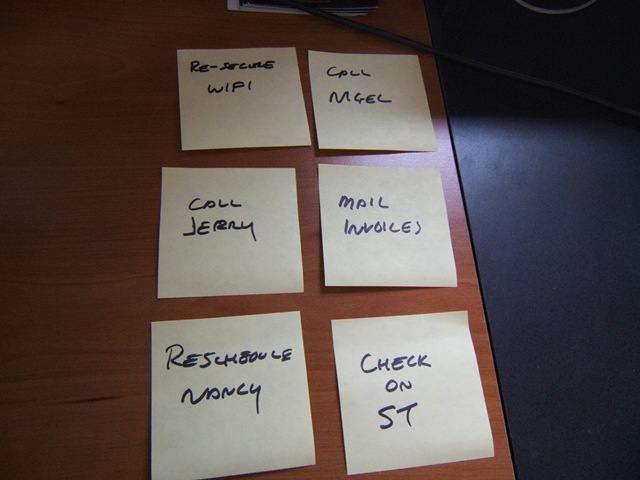
Individual work is a real PITA. Over time, we invariably amass a lot of small tasks that are necessary but not urgent.  We end up with a number of things that aren’t high priorities but, the longer we put them off the more they will eventually eat up a lot of our time.  Such tasks are waste-in-waiting. They are the five minute nuisances you never got to, that in the end will cost you 10 minutes to apologize for not doing.The Time Capsule approach is to approach the kanban, notice that there are a multitude of little tasks, pull them all off the board, go to your desk, and start doing them until they’re done or your day is over.  And if you have 8 hours of small tasks, well, that’s a learning event for you.Move them across the desk through 3 stations. Backlog, In Process, and Done.This is now a speed tasking exercise. Don’t spend a lot of time prioritizing, you already know your backlog.  Prioritize on-the-fly. You will most likely game the system by doing some or all of the following:Sweat the small stuff: Very small tasks can be done very quickly.  Doing 20, five minute tasks quickly fills up the “done” column with a satisfying number of post-its.Launch all missiles: Tasks that require a quick email are easy to get into the “active” column. Today, completion is the goal. Having many active tasks is okay, so long as you know it’s moving toward completion. Remember: You are the only judge of the effectiveness of the time capsule.Play for Pay: You want to move those tickets to the done side of your desk. Screw convention, screw the Agilistas, screw the WIP monsters – you are only interested in those tickets moving to the right.Focus after Fast: Tasks that require a bit of your time and focus should be done after the fast things and after the missiles are launched.  While those emails are out-reaping rewards, you can work on the more delicate tasks.Rememberthis is a strategy for coping with clutter in your backlog. The mess will happen from time to time because personal tasks are unruly. If you find yourself de-cluttering more than once a month, then it’s likely you have too many commitments, or aren’t prioritizing well.

The Throughput Approach to Personal Kanban in Detail

image

In the previous posts we looked at the Time Capsule workaround to having a backlog cluttered with small tasks of varying importance.  This throughput approach might help mitigate the need to use that approach.Kanban tends to have swim lanes – or lanes through which value flows. In your personal kanban, it is possible to have a WIP that takes into account varying sizes of tasks?Let’s say you set a WIP of 5 items: two of these can be large tasks, while three are small.In the throughput approach, the small items are placed daily, and addressed first. The larger items can be handled throughout the day, and will remain on the board as long as it takes to remove them.The goal here is to make sure that at least a minimum amount of small tasks are done regularly, to help avoid the pain of a marathon Time Capsule day.When I’ve done this, I’ve tried to take into account that there will be “flares” – tasks that arise and are completed during the course of a day that don’t make it onto the board. Say your lawyer calls and asks you to track down an email and send it to her. That takes you maybe 15 minutes, but it never makes it onto the board.This is why I don’t move completed tasks off a throughput board until the end of the day.  If you keep moving them and placing new tasks up there, you really haven’t limited your WIP.  You aren’t maximizing for throughput in the number of cards you are moving with the throughput approach, as much as you are maximizing your productivity.With this approach, you will get a number of small tasks done but also devote time to the larger tasks and, hopefully, have the bandwidth to deal with flares.

The Sequestering Approach and Personal Kanban

JimBenson_02 Jul. 17 23.53

Personal tasks are often repetitive or open-ended. Daily phone calls with your kids, an on-going email thread with your college roommate, or follow-up with potential clients are tasks that need to be carried out, but that don’t fit neatly into a kanban. If you have a CMS and need to check in with 3 customers on a daily basis, putting a card on your kanban every day that says “check in with 3 customers” is foolish. Repetitive tasks like this - while they may create value - can also be seen as overhead.What you can do with these types of tasks is sequester them in a “repeating tasks” category.  On the white board you can list these in a sequestered box, simply checking them off when complete. Then, erase the checkbox when they need to be done again.Why bother having the sequestered elements on your board at all?  Because the kanban helps visualize your overhead, which your brain will use as input when you are prioritizing and scheduling. Like it or not, the recurring elements are part of your personal work and they do provide value. One of the main goals of kanban is to kill off out-of-sight-out-of-mind management. It behooves you to visualize as much as you can on your personal kanban.

The Subproject Approach to Personal Kanban in Detail

The subproject approach to Personal Kanban

image

image

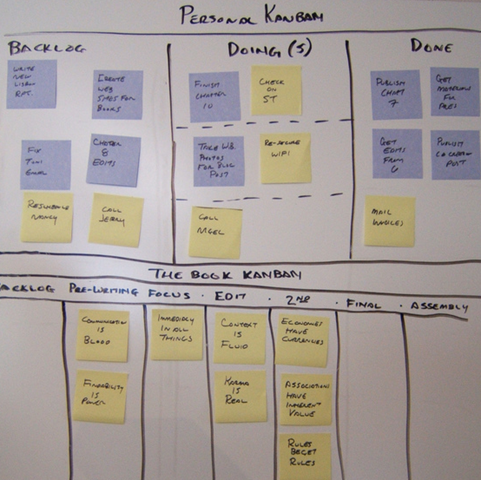
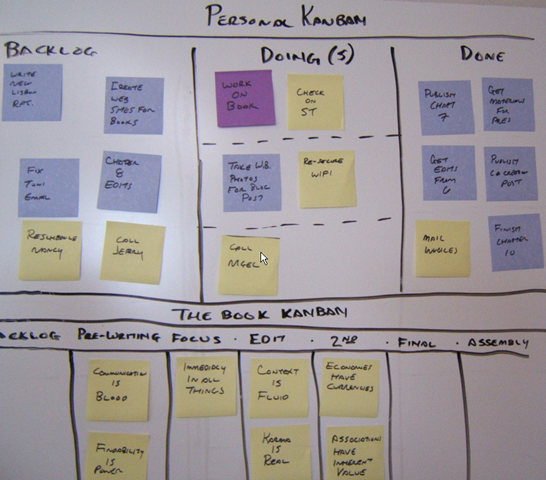
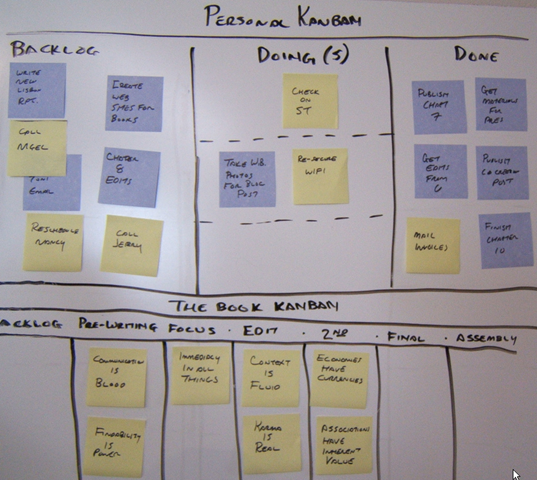
Problematic for personal kanban is that its task-based nature undermines lean’s value-tracking goals. Kanban, not even personal kanban, is not a to-do list.  Personal kanban tracks tasks because that’s primarily how individuals measure work and value.Your personal kanban can have multiple swim lanes, and they in no way need to be coordinate.  A task based swim lane can rest above one or more subproject swim lanes with a full value stream.This allows you to see your current work simultaneously in both a task view and a project view.The more you can move large projects into work-flow based subprojects, the more control you will have over them, and the more insight you will have into their flow.You have some choices with the subproject approach when its combined with the personal kanban.Roll Up: The subproject approach can be a roll-up task, tracking the progress of the large project while individual tasks still move through your personal kanban. This lets you see how quickly value moves through your subproject when you are working on other things. Here the roll-up task is the purple ticket that refers to the subproject.Active Engagement: The subproject is actively used as part of your WIP. If the nature of your work is that you are paying even small amounts of attention to the subproject each day, making tags in your subproject part of your overall WIP may be more honest. This conceptually integrates all your subprojects into your daily routine.  This integration could lead to more meaningful introspection.In this photo, there are 5 tasks in the WIP.  Three are in the top part of the kanban under “doing”, the other two active for me personally would be under “pre-writing” in the project area.

" "