" "

Personal Kanban: Tangible Tasks Produce Prioritization

Planning and prioritizing is a wicked problem that has plagued humankind since time immemorial. – Corey Ladas
image
image
image

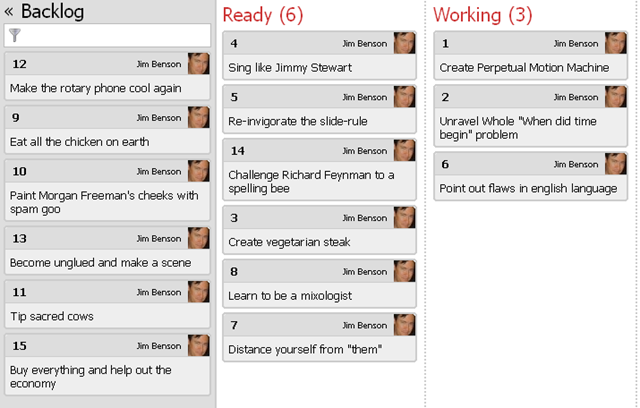
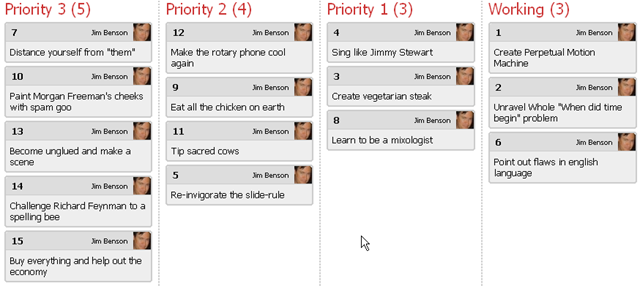
Human beings want three things in life: sex, money and effective prioritization.There appears to be a logical and linear three-stage process of better prioritization as you become familiar with kanban. The process follows the three main characteristics of the cardwall and how they insidiously work their way into your psyche.Stage One: The VisualSimply viewing the tasks on the kanban cardwall makes them conspicuous. The tasks on the card wall have a shape or a volume. They consume space on your board and you can only fit so many on at a time.  Your brain sees this and suddenly, perhaps for the first time, your workload has a coherent form.  It may be overwhelming, but you can now see it.A necessary drive for prioritization stems from this physical form.  You want to only fit tasks in that finite space that are going to do the most for you. At this point, you’re most likely to do this by sight, as you complete one task you’ll grab the next one that “looks best”. Let’s call this immediate gratification prioritization.  It’s better than letting fate guide you and an excellent start.Stage Two: The PermanentThe cardwall is on the wall and it is permanent. You don’t put it in a box at night. You don’t hide it when the boss stops by. The cardwall is your professional superego. It is reminding you of what you are doing, why it benefits society, and what will happen to you if you don’t finish. If you have colleagues, they can see what you are doing. if your personal kanban is shared they may even have a stake in your task completion. In this case, you may want to start having some logical prioritization that might resemble Corey’s Priority Filter.  Corey’s Priority Filter creates “buckets” with limited capacity that show tasks trickling down from your backlog into your ready-queue.  Here, you are starting to plan for future prioritization. At any time, you can rearrange things, but the priority filter lets you set up a prioritization that shares the same permanence as the kanban itself. Each part of the ready-queue Let’s call this progressive filtration.Stage Three: The TactileThe cardwall is tactile. You have to reach up and grab something and move it around. As it moves, it has a flow. You begin to see how you collect, collaborate on, and complete different kinds of tasks. Even in the most chaotic of situations, there are rhythms to types of work. What is happening now? You are constantly doing work and therefore constantly physically interacting with the board. At this point, prioritization itself begins to get a flow. You recognize that as tasks enter your backlog, some will seem more important on some days that others. Some have higher value to the team than others.Corey and Eric Willeke asynchronously put their heads together and came up with Perpetual Multivote. This process recognizes that good decision making has both temporal and social components. As context changes over time for people, what seems important also changes. Perpetual multivote places backlog items on a visual board. Voters get a certain number of tokens and can vote any time and as much they want for the upcoming backlog items until they run out of tokens. They can reallocate their tokens whenever they want as well. They see how their peers vote and can make their decisions based on that context. In the picture above each line is a backlog item and each dot is a vote from a team member.Perpetual multivote clearly represents the tactile nature of the cardwall.  It might be called contextual prioritization.Do You See What’s Happening Here?Right now some of the most popular games for portable platforms like the Nintendo DS are games like Brain Age that help you train your brain. They’re like the antidote for cage fighting. These games work not so much by teaching you math or algebra, but by getting your brain to react to certain stimuli that promote attentiveness, appropriate response and retention.Your brain can learn to think “better” simply by being sensitized to the actions of better thinking.Kanban does this as well by creating a physical space (the cardwall) in which these concepts (tasks) can live - where the human brain can grasp and manipulate them better. As people, we learn in different ways. Some of us are visual learners, others are auditory, some contextual, some literal…. Vive la différence, sure – but for those who have tried to manage la différence … history is filled with managerial pain and anguish.Cardwalls tend to equalize varying learning styles by presenting information with a logical flow and cadence. Everyone from your scattered ADHDer to your hyperfocused Asperberger can grasp a kanban – because it does have elements of context for all learning styles.Like Brain Age, kanban starts to train our brains to see work in a new way. Not as an unfocused pile of tasks and subtasks and subsubtasks, but as a set of tasks with very real impacts on our lives. As we begin to see the form and flow of these tasks, our abilities to prioritize can improve.This is post four in my personal kanban series.Kanban examples built in AgileZen, review coming soon.Multivote image from Corey’s Multivote blog post. (why mess with perfection?)
Retrospectives and Kanban Evolution in Action

2009-09-16 personal task board small

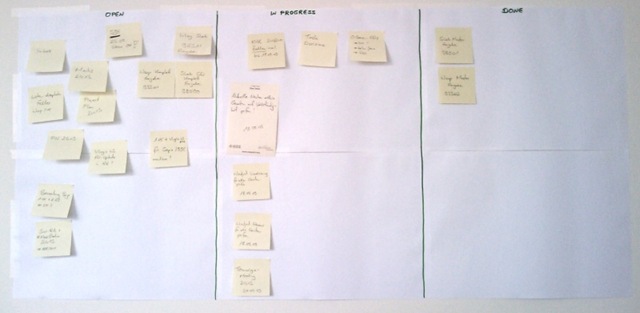
Marc Bless has a great post about his personal scrum board evolving into a personal kanban. His personal retrospectives showed him a need to limit WIP, so he created a special section for WIP, while not losing track of his tasks awaiting the actions of others.Marc Says:

After a while I recognized the repeating problem of too many thing in progress. After a short personal retrospective I decided to improve my focus on the "in progress" lane. It seemed obvious to limit the number of things to work on in parallel. I splitted the "in progress" lane in two parts:a) an "on hold / wait" part for all the things that have been started but need external helpb) a "working on" part with focus on all the things in progress. This part now is a Kanban box with a limit of two tasks.

Recursive Kanban – A Visual Control for Rapid Knowledge Work

Visual Controls Help Guide Team Success

Recursive Kanban in Action

Recursive Kanban for Small Groups

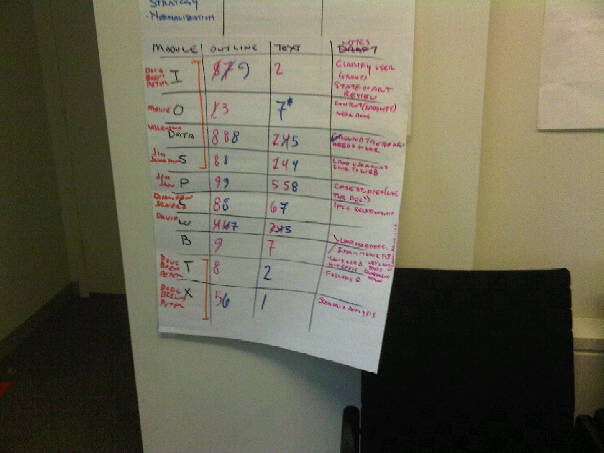
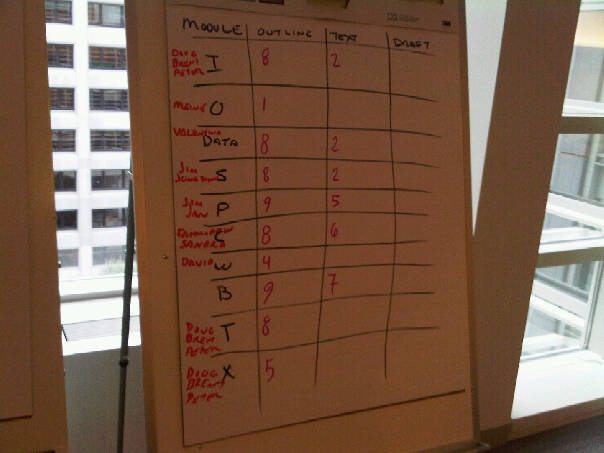
A visual control is anything that allows a group to see their progress, and understand its relative importance. To be sure, a kanban is a visual control, but there are nevertheless some limitations to it.  The biggest limitation to a kanban is that it is linear.  Work, especially knowledge work, is not always linear.At a recent WriteShop Tonianne and I ran at the World Bank, we set out to run the process with a kanban.  It quickly became apparent that the linear flow of the kanban was not going to work with the rapid and recursive iterations of this particular project.This project set out initially to create a document in five days that was made up of several modules. When we started, each module was in a different state of completion. The original assumption was that there would be a workflow that went something like “concept,” “components,” “outline,” “draft,” and “final,” and we’d make a mission-based kanban for each module.What ended up happening was very different. Scientists from around the world sat down on Monday and, fully aware they were not ready to write, instead began to talk. Those discussions redefined what exactly was needed for each module. That was good.What was even better was the evolution – the discussion became a product development discussion. Who was the client? What did they really need? What could this group produce by the deadline?And suddenly we had a spreadsheet model the clients could use for doing the analysis described in the document. That model, in turn, drove an entire, organic, and rapid rethinking of the layout of the entire document.  Suddenly we had coherence.Then … it was time to write. We set up a visual control that was deceptively simple. The control has 4 columns: “Module,” “Outline,” “Text,” and “Draft.” This was because we knew that the workflow was not going to be linear. As text was written in the document, it informed what else needed to be in the document. Therefore, some outline would be written, then some text, then the outline augmented, then more text, then some discussion, then more outline, and so on.This means there was no “pull” from outline to text.  So we used numbers to mark a 1 to 10 level for “complete” and checked back a couple times a day, crossing out the old numbers and entering new ones.The “Draft” column quickly changed to an “Issues” column. This allowed us to have very detailed stand-up meetings (short 10 to 20 minute discussions) about status twice daily.At each stand-up, the numbers would be entered for each stage. Sometimes they would go down. If you look closely, you can see 8s go to 7s.  The group found that amusing, but what was happening was they were learning more and more about what “Complete” in this particular context meant. Clarity for the deliverable was rising on a daily basis, even if the estimation of complete was falling.Some days the “text” ranking would go up, even as the ranking for the same module’s outline fell. People were writing text, discovering new needs, then noting that they weren’t yet incorporated in the outline.The visual control allowed us to build a type of kanban that we might call a “recursive kanban” - a visual control that allowed for the productive loops in knowledge work.  Linear kanban has a hard time dealing with productive loops like this.

Managing and Working Through That Ever Growing Reading List

Books are Life

generalreadingpersonalkanban

If you are anything like me, you will have a monster reading list.  Do you manage it?  Do you focus on a few books at a time?  If not, maybe you should, to better enjoy that fiction or help manage your reading based learning?Problem - Too Many Books, Not Enough Time & Bad HabitsI have a lot of books waiting to be read thanks to a nasty '1-click' habit with Amazon, I also have a decent amount of quality reading time due to a lengthy commute, yet I just can't read them all soon enough, and the list keeps growing.  Part of the problem is that until recently I had a bad habit of picking up books, reading a few hundred pages, getting distracted by another book,  and before I know it I have five books on the go, which is plain silly.  The result was a load of books I have finished, and a load I have touched on, yet not fully focused upon and completed.  I asked myself - "If only I could drop this wasteful habit and focus on completing a few books at a time, the NET result would be different, namely, more books read and better understood over any period of time, with less wasteful unfocused reading and rereading".Solution - Enter the 'General Reading Personal Kanban'Funny name for this pattern right?  Why not just "Reading Personal Kanban"?  Well, I'm going with this one on the basis that I think  there are two types of reading we do, an end-to-end style (General Reading), and for those that use various learning techniques, like a SQ3R, a 'SQ3R Personal Kanban' pattern is in the works, so expect a post soon.  In the meantime, 'General Reading' can encompass anything factual or fictional, and I personally tend to carry one of each type of book with me.The root of the problem is one of focus and priority.  If there is one thing I have learnt about Kanban is it can be used, amongst other things, to address these two subjects simply and directly.  Below is an example based on my current reading list, using a great tool called AgileZen:How does this give focus and priority?  Quite simply.  The Kanban describes the process from left to right of first prioritising the reading, reading and then finishing books.  Each step, bar the backlog and the completed step, has a work in progress limit (WIP).  This WIP limiting is the aspects that enables the narrowing of the prioritisation, then tight focus on the act of reading - I like a WIP of two so I can have a factual and a fictional book on the go.  To complete a book, we pull a book off the backlog through the process to add to the flow of books being read over time.  You can read more on Kanban in general and why it works elsewhere on this site under Primers.My own General Reading Personal Kanban forms part of my overall productivity system, which I am writing about here.

Every Task is Sacred

One of the primary goals of a kanban is to make value explicit. When you spend your time doing something, the reward should be observable. Even if the task is vegging out, the reward is relaxation. You should engage in no task that is valueless. When a task does not provide value, it is considered waste.

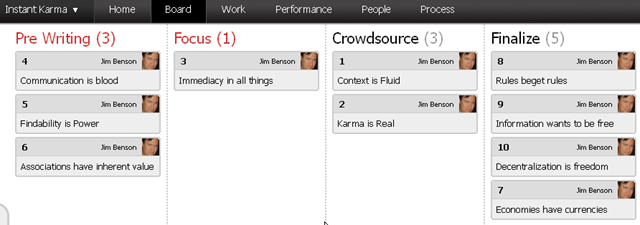
Kanban has two main states: a "station,” where value is created, and a “transition,” where the work item is moved from one station to the next. In the kanban below, we see the flow of work for my upcoming book, Instant Karma: 10 Principles of Social Media for Business. In the pre-writing phase, I am creating the initial text for a chapter. When that’s done, and my editor is ready to look at it, she pulls a completed section from my pre-writing section and places it in her “focus” state. There she and I edit and re-edit that chapter until we think it is ready to send off to the crowdsourcers. I was creating value in the pre-writing state, when that value was realized it then went on to the next state of focus, where it remains until that value is realized.

image

In the kanban above we see that what is moving is not tasks – but the actual chapter. In a work-flow kanban tasks are the mechanics that create value, not the value itself. The value is explicit in the work-flow. Thus, in a kanban, the work-flow is also called a value-stream.

image

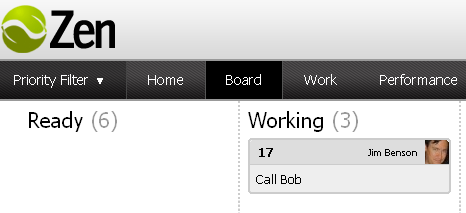
Here we have a task based kanban where I have the task of “Call Bob.”  It’s going to run through my simplistic Backlog | Doing | Done kanban.  But, let’s think about this a bit.  Regardless of my feelings for Bob, does calling Bob ever give me actual value?  No. "Call Bob" is merely a task, a mechanical action that should create value.

Later, if I am going over completed tasks and trying to figure out what makes me successful and what does not, “Call Bob” is a lousy artifact for judgment. There simply isn’t enough information there to let me make a decision.

So why not make the value explicit?

image

Here my reason for calling Bob is made more explicit.It could be anything you want from “talk about football” to “catch up.” Remember: Kanban isn’t making value judgments of your actions, it's simply reporting the value of what you accomplished. If you really like Bob, and want to call him just to shoot the breeze, that’s value to you. It’s fine. What you want is to discover tasks that don’t provide value and eliminate them, so you have more time to do what makes your life better.

Images created in Agile Zen, which I am loving.

" "