" "

Urgent and Important: Incorporating your existing tools into Personal Kanban

We’ve devised Personal Kanban to adapt to any system you might currently use (unless of course your preferred  system is utter chaos). The only two rules are visualize your work and limit work-in-progress (WIP). PK's main goal is to get you to write things down and begin to watch how and what you complete.Last week, Eva Schiffer of Net-Map wrote me and said:

I have just erased my to do list and transformed it in something kanban-like. My own to do list format, that always worked well for me, had 4 categories:Important and urgentImportant, less urgentLess important, urgentLess important, less urgent.That helps me a lot because I normally love the less important, less urgent tasks, and while they often lead to really interesting creative outcomes, it is important for me to keep procrastination at bay and make sure that I don't just impress myself with the number of tasks performed, but also do those things that are most urgent and/or important.
priority_filter_personal_kanban_jim_benson
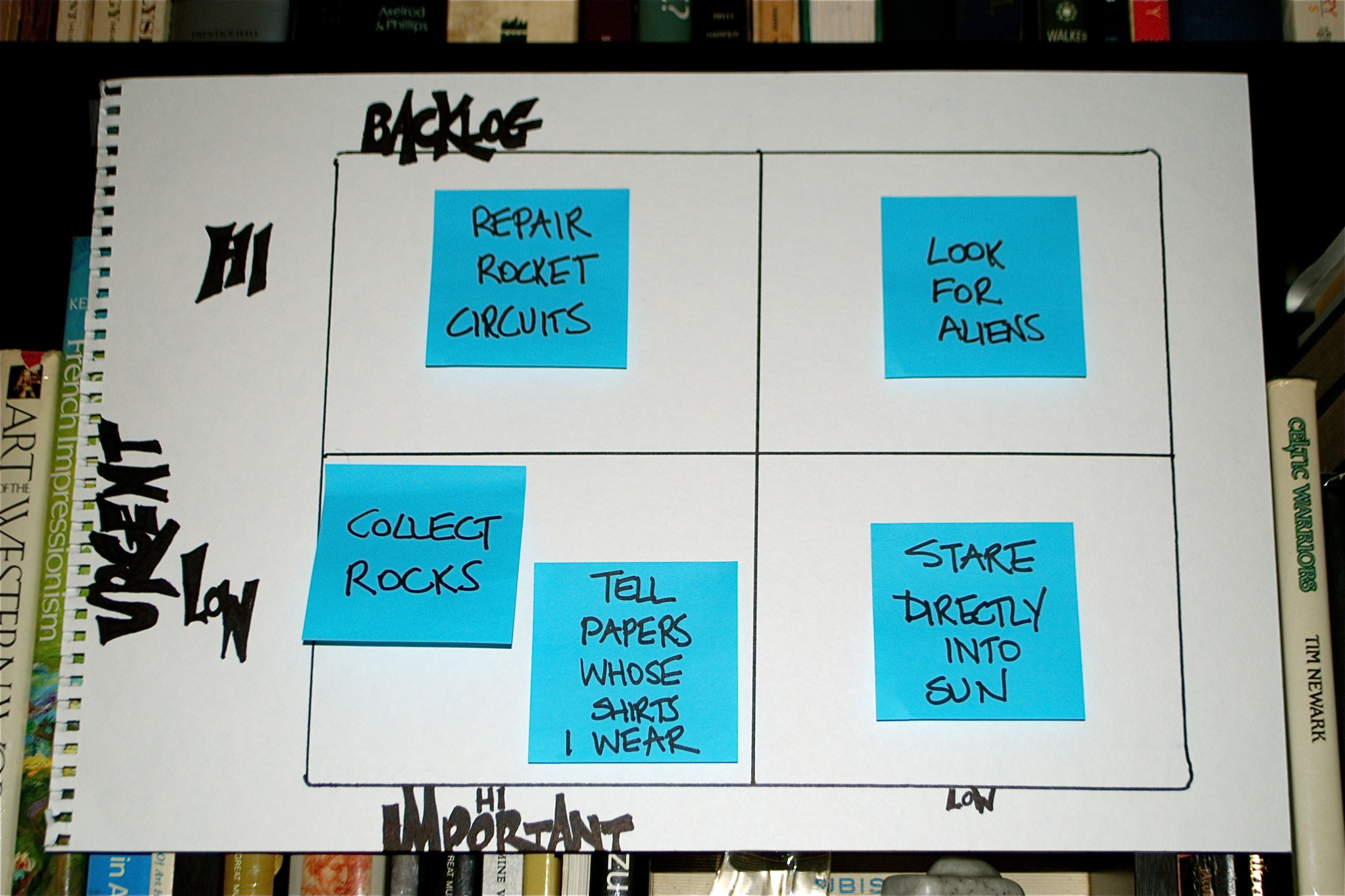
Major Tom's Backlog

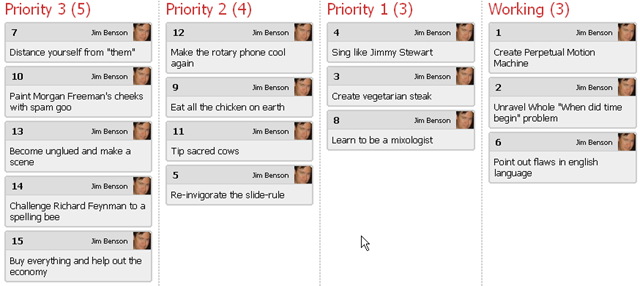
This got me thinking about the relationship between productivity and effectiveness. Eva recognized that simply increasing her throughput was not enough, that was mere mindless productivity.What Eva was searching for was effectiveness.At Modus, we do dynamic prioritization using a priority filter that looks like this:For Tonianne and myself, this works wonders. We constantly have a short list of items that need doing, and as they move from 3 to 2 to 1 they become more important. However, prioritization is a contextual exercise that varies from moment to moment. As we can see here, “Eat all the chicken on earth” is Priority 2, but that could suddenly change to Priority 1 if suddenly I were in a place where all the chicken on earth was accessible.Eva, like many organized people, uses a matrix to ascribe values of urgency and importance, which results in something like this:In the case of Major Tom, he has been sent into space to find out what’s there. He’s a celebrity and everyone is watching him. There are a variety of things he could be doing up there, but he has a a backlog that varies between levels of urgency and importance.So for example, the papers want to know whose shirts he wears. That’s important both to his individual fame and to the space program in general because after all, it’s being good to the press. But at the moment, he’s in space so he can get to that later.If the press scores an interview while he’s up there, though, it can become relevant and therefore is something to complete.So we reach Major Tom here in the middle of his work day. He’s already managed to tell his wife he loves her very much, and he's stepped outside the capsule. He’s put his previously active conversation with ground control on hold because at the moment, he's working on other things. And he’s now floating in a most peculiar way (and noticing how different the stars look).Major Tom is still limiting his WIP and he’s still visualizing, even if his backlog is drawn as a matrix rather than columns. The matrix is a familiar organizational tool for him, and it should be preserved. (Although he probably should have checked his instruments.)So Eva’s concern is very real - we stand a real risk of becoming mindless production units, grinding tasks out at hyper-speed without assessing their value. The key with Personal Kanban is to assess the value of what you are doing – however it is that you define value.We’re all individuals – quality, value and growth are different for us all.Not only that but quality, value and growth are also contextual. Today, home repair might be very low on your list. After a tornado, however, it's probably going to be pretty high. Did you put it there? No. Life did. Context shifted. For that reason, just-in-time dynamic re-prioritization is key for workload management.So be like Eva. Find the way you define your work - visualize it, and thoughtfully examine how you can best be effective.

Boosting Productivity and Learning with Spikes

71878930_02a27afb1b_m

Is there something you don’t know?Almost everyday it seems we are faced with having to learn something new. Some of those things are trivial and easy to accomplish, while others are important and a more than a little daunting to master.There are some easy steps to make learning less overwhelming.On the Lean Agile Machine blog, there have been two consecutive, thought-provoking posts on Personal Kanban and productivity. One describes how to set up a Personal Kanban for research and writing production. The second describes how to set up short bursts of research and quickly evaluate the results.

SPIKE

n. A short burst of work to create a sample version of something

In agile programming, savvy developers will quickly cobble together a prototype, something merely to demonstrate the idea is feasible. Spikes make sure that assumptions about selected technologies and implementation are sound.In short, a spike is a burst of work that makes sure that further work is warranted.Learning is a great way to do this because there will always be things we do not know. Every field of study has nuances and developments that even ardent devotees can’t keep up with. So, when we suddenly need to bone up on say, deck waterproofing methods, we really don’t want to have to become a master carpenter.So, you do a Spike.You set aside 15 to 25 minutes (perhaps with your Pomodoro timer) and blast through as much research as you can. You Google, you Wikipedia, you save some links, you find some review sites. At the end of your spike, you have one of three outcomes:

  1. You have learned as much as you need;

  2. You have a good idea where to get information and how much longer it will take; or

  3. You have learned that asking an expert is a better idea.

Now learning is easy. The spike gives you a predictable amount of time to spend to get results that tame the learning beast.(Please do read the two posts from Lean Agile Machine.)Photo by Shavar Ross

Rapture – Training Your Mind for Completion

Don’t strain your brain, paint a trainYou’ll be singing' in the rain…- Blondie

466866299_a78acb1584_m

Your brain is a muscle. As we repeat certain actions, our “muscle memory” becomes comfortable with those actions, and programs itself to anticipate them. As it trains itself to anticipate them, it optimizes for them. This is the basis of kaizen, continuous improvement. Your brain gets used to your workflow, it becomes an subconscious process, and so it looks for ways to do things better.Smoother.Faster.You get sensitized to completion. Sensitized to waste.So using Personal Kanban on a regular basis, through its visual and tactile interactions, sensitizes you to the building blocks of success.

Tell me and I forget. Show me and I remember.Let me do and I understand.- Confucius

Simply put: your brain responds very well to doing. The active nature of Personal Kanban is what your brain wants. Confucius figured this out 1700 years ago.Managing your workload with static lists, while they can help you organize, doesn’t have the same brain-training impact as having a visual tool like Personal Kanban. Lists don’t involve motor skills or elements of flow.Lists merely “tell you.”Personal Kanban both shows you, and lets you do.Image by Rob Web

Save the Date! Jim Benson Featured Guest on Yi-Tan Call

374641215_6d6d72fde3

Save the date! Monday, January 4th at 10:30 PST/1:30 PM EST for the weekly 40-minute Yi-Tan Tech Community call hosted by Jerry Michalski and Pip Coburn.The topic?Personal Kanban, of course!Call, listen, and chat with Jim Benson (@ourfounder on Twitter) as he discusses:

  • Why we stress over the tasks we are confronted with;

  • What we can learn from the nature of our work; and

  • Why visualizing our work with Personal Kanban helps create the clarity necessary to keep control of our lives.

The discussion will assume the format of a conference call, allowing anyone to join the conversation (or just listen) at any point.For an invite, please sign up at  Yi-Tan here, or contact Tonianne for more information.Photo by: David

Tools Talk: Julia Child Understood the Nature of Work

IMG00348-20091227-1904

IMG00345-20091227-1901

IMG00337-20091227-1859

IMG00349-20091227-1912

Julia's Knives

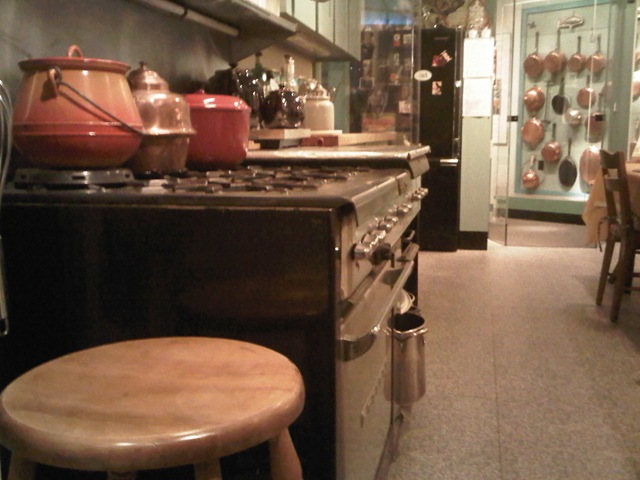
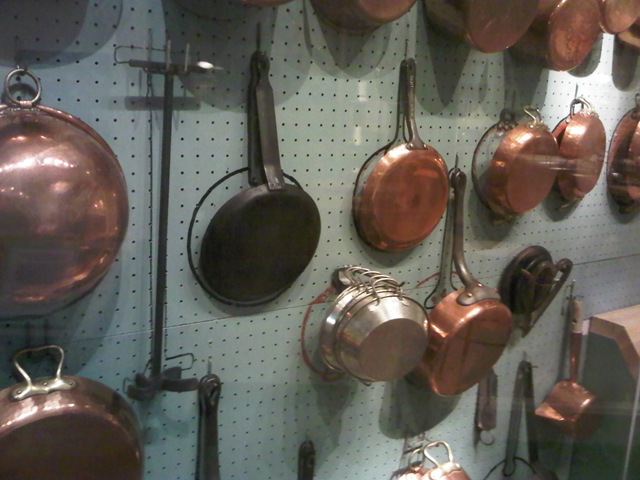
While expertise, good humor, humanity, and care are words that immediately come to mind when describing Julia Child, the iconic chef personified something else - she understood the nature of her work. She recognized the role it played, the value it brought, the actions involved in creating it, and the opportunity costs in choosing certain methodologies over others.That is why we are canonizing her as our Personal Kanban saint.Yesterday I had the good fortune to spend some time at the Smithsonian's National Museum of American History contemplating her kitchen.  Where Martha Stewart’s kitchen is the epitome of OCD tidiness, Julia Child’s kitchen looks as if the instruments of her craft were shaped only slightly differently than if she’d be making furniture or refitting a 1952 Studebaker.That's because Julia Child’s kitchen was her workshop.Julia Child could have had the most cutting-edge kitchen in the world, and most likely she could have had it for free. Surely any appliance company would have paid handsomely to say they custom-fit her kitchen with their latest product line.But instead she chose to used the same range for 40 years.Her arsenal of cutlery was mismatched, "unsexy" by today's standard. Her pans hung from every available surface - from walls, doors, wherever they would fit. Each knife, each pan had its place, fitting perfectly within a designated spot or outline. It wasn't a mess, but it wasn't streamlined, either.Julia Child said things like,“I am a knife freak.”and“Life itself is the proper binge.”and“Everything in moderation, including moderation.”Her demeanor and her actions seamlessly integrated her passion for food with everything else in life. She understood her work and as such, it ceased to be work.It became life.She was organized without being compulsive. She was meticulous but retained her humor. She had little to prove, but everything to share.To the right we see, unsurprisingly, Julia Child’s Wine Kanban. Every bottle, as it ages, is tracked to the point of drinking.We have pots and pans on a visual control, knives on a visual control, wine on a visual control. For Julia, her stuff didn’t just go places, it was a marker for the nature of her work. If a 6 quart sauté pan was missing from its place on the wall, it meant it was in use.Her tools told her story.Her tools represented her creation of value.The take-away here is that visual controls are always graphic markers of how we work. The more seamlessly we can integrate visual controls into how we actually work and live, the less time they take to maintain.  Especially for specific projects, where we are already focused and updating, a literal kanban may take more time than is necessary – creating elegant visual controls that stem from the actual activity can really help give the task an internal coherence and make it easier.Take a page from Julia’s cookbook and examine your work. What might your tools be saying to you?

" "