" "

Am I Productive, Efficient, or Effective?

Productivity: having the power to produceEfficiency: the ratio of the output to the input of any systemEffectiveness: being able to bring about a desired result

Personal Kanban is considered a Productivity tool, because it gives us the power to produce more.  It is likewise said to increase Efficiency by limiting WIP and increasing focus which means we expend less energy to affect results. This in turn boosts our Effectiveness by providing the information necessary to make better decisions and act on them.Often people have bursts of productivity, efficiency, or effectiveness – but because they aren’t paying attention to what they're doing, these events are sometimes dismissed as happy accidents. Personal Kanban makes your work explicit, meaning it constantly shows you what you are doing and what you could be doing. This helps you interpret your options and prioritize you tasks based on current conditions. Personal Kanban also lets us balance productivity, efficiency, and effectiveness, and turn them into three parts of the same machine.Individually, bursts look like this:

  • Bursts of productivity – You get a lot done, but is it the right stuff?

  • Bursts of efficiency – Work is easily done, but is it focused for maximum effect?

  • Bursts of effectiveness – The right work is done at the right time … this time. Is this process repeatable?

1154746963_eade26b11c_m

I call these bursts “hero” events. Over time, things get screwed up and you have to call in a “hero” to fix them quickly. That hero may be you, a temp worker, a consultant, or a friend. But you identify a need so late in the game that you need to work above and beyond to complete the task at hand.What’s funny is that after these hero events, we feel good. And because we feel good, we think, “That was awesome!” and we ascribe the event to something exceptional. Something that just couldn’t possibly happen every day.During a recent project in Washington, D.C., I worked alongside members of the Intelligence Community. More than one of them told me that people in the IC  who allegedly had cushy desk jobs inside the Beltway, routinely volunteered for live fire assignments.These people specifically volunteered to be in harm’s way.Why? Because it was a period of sustained productivity, efficiency, and effectiveness. People did not have the "luxury" to relentlessly and constantly prioritize. In the field there is no choice but to constantly re-evaluate conditions and re-prioritize actions. Because picking the most important task was the only way to survive, the only way to complete the mission.There was a mission. There was survival. And those two conjoined drivers created a great deal of focus.Hopefully we don't have to risk our lives simply to focus on our work. Personal Kanban provides the structure to allow us to choose the right work for maximum effect repeatably.For more on how to choose the "right" work, and then how to make sure your processes are repeatable see Prioritization and Retrospectives.Photo by Randy Son of Robert.

Respect Your Backlog and Manage It

198445204_46e76e4b34

Your backlog is bigger than it should be and it needs to be managed. Everyday people tell us how they are overwhelmed by their backlog, and cannot possibly manage it within a Personal Kanban because it could contain hundreds or thousands of tasks.Let’s examine this.On Stephen Smith’s blog, he describes using Personal Kanban to visualize his workflow with his file-card system. Leslie Dewar left this comment:

I have tried this system of cards in the past and found it extremely distracting and demotivating. I was working with a very intensely personal client base of about 280 people and there were dozens of small jobs that probably really needed to be in a tickler file. If I put them all on a “Task” list, it was quite overwhelming, even though some of the work only needed ten or fifteen minutes.I also suffer from the “out of sight – out of mind” disability. I have gone through many office an office blitz; prioritised; put in folders; sequenced in desktop folders and ……. forgot about it. By the time I do all that organizing, I somehow felt as though I must have also done the job!

Leslie’s issues are not unique. I’m seeing two in particular here. The first is tracking tasks over time (tasks that aren’t relevant for a while clutter up your Personal Kanban and make it hard to read), and the second is Personal Portfolio Management.Tracking Tasks Over TimeThere are things we do every day that are repeating or scheduled out into the future. We need to remember these things and add them to the Personal Kanban when necessary. Products like Outlook or Google Calendar can help here. Simply place automated reminders (what GTD calls "ticklers") in your calendar at the earliest date you’ll need to be reminded of them. The due date isn’t going to help you - calls to action will. One of the biggest mistakes people make with calendars is that they record the date something will happen rather than recording the earliest date action will be necessary.Then forget about that thing until the tickler comes up.Personal Portfolio ManagementI have the feeling this is going to become a major theme for Personal Kanban. Everyone has multiple projects. Those projects have features and those actions have specific tasks. Defined:

  • Project – a large thing of value that needs to be done – Build Deck

  • Features – units of value that, when combined, create the project – Railings

  • Tasks – discrete actions that create features – cut 16 posts to 3’5”

We can use Personal Kanban to manage our work at all three levels. Depending on how many projects we have, a project can simply be denoted by the color of the sticky note. Features can be tracked on the Personal Kanban until we start in on the feature – then we can decide how best to break it down.If the Project is "Make Breakfast," that probably stands on its own. You won’t need the features (like Toast) or the Tasks (slice bread, place bread in toaster, depress toaster button, double check toast setting to make sure it’s on golden brown, stare at toaster for what seems like an eternity...).Part of what makes life challenging is that personal work does come in Projects like “Build House” and “Make Coffee.”  Combined, these projects comprise our Personal Portfolio.Since one of the goals of Personal Kanban is to simplify your life – creating a huge, mandatory system of nested Personal Kanban or secondary tools doesn’t make sense (for everyone).So What Do I Do With This Wisdom?Understand that your body of work is a Portfolio. Your Personal Kanban goal is to manage that portfolio in the way that works best for you. If your Personal Kanban is overloaded with tasks, find ways to group them into Features or Projects until it comes time to actually do the work. If you have too many things in the future, remind yourself with an automated calendar.If you are like Leslie and have 208 clients, manage them in a Customer Relationship Management system. And, if you get to the point where you can’t manage your work at all – you are taking on too much. That’s the point where you go to Odesk and get an outsourced Personal Assistant.  (And manage them with an on-line Personal Kanban!)Photo by Sea Turtle

Urgent and Important: Incorporating your existing tools into Personal Kanban

We’ve devised Personal Kanban to adapt to any system you might currently use (unless of course your preferred  system is utter chaos). The only two rules are visualize your work and limit work-in-progress (WIP). PK's main goal is to get you to write things down and begin to watch how and what you complete.Last week, Eva Schiffer of Net-Map wrote me and said:

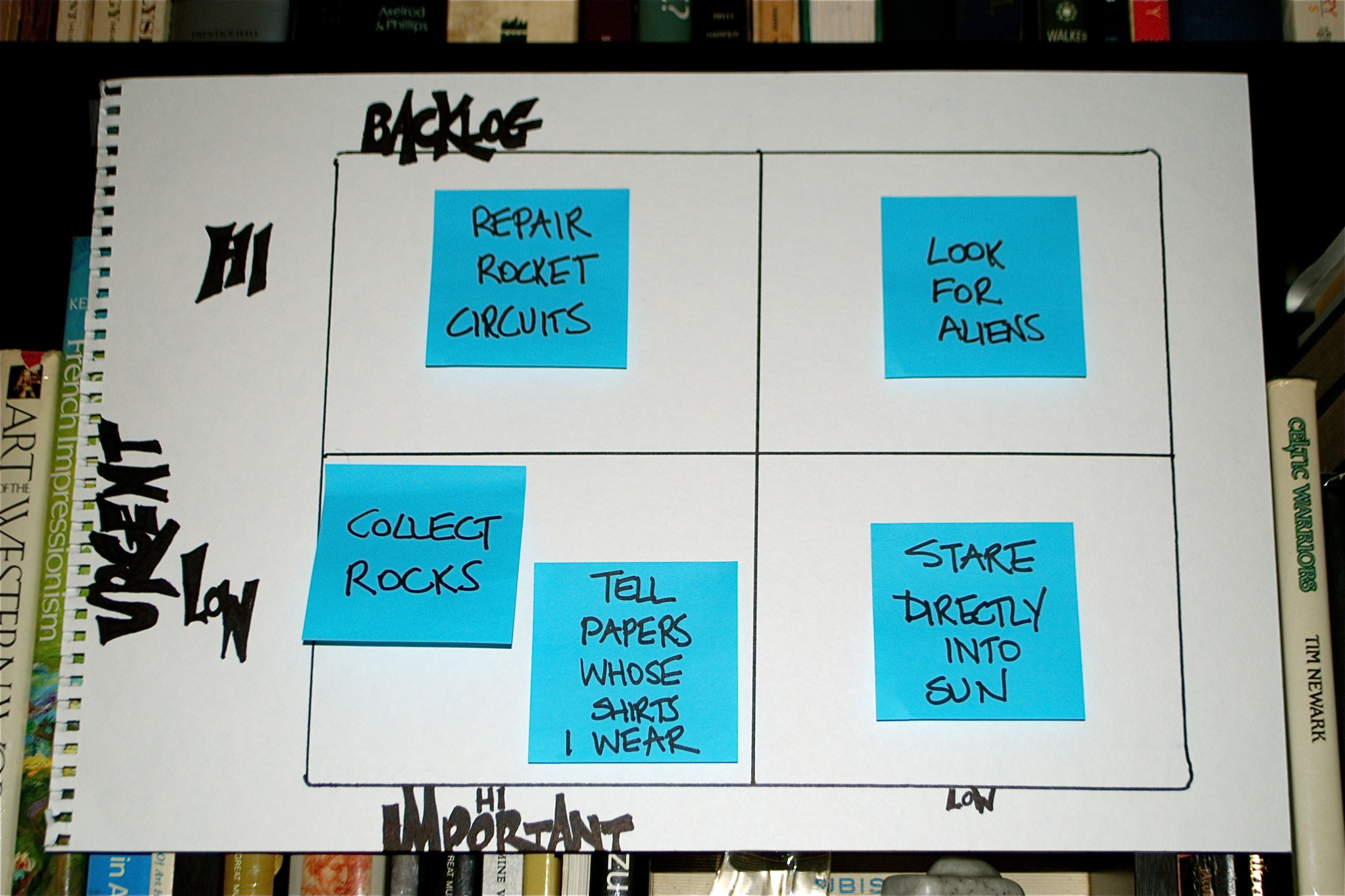
I have just erased my to do list and transformed it in something kanban-like. My own to do list format, that always worked well for me, had 4 categories:Important and urgentImportant, less urgentLess important, urgentLess important, less urgent.That helps me a lot because I normally love the less important, less urgent tasks, and while they often lead to really interesting creative outcomes, it is important for me to keep procrastination at bay and make sure that I don't just impress myself with the number of tasks performed, but also do those things that are most urgent and/or important.

priority_filter_personal_kanban_jim_benson

Major Tom's Backlog

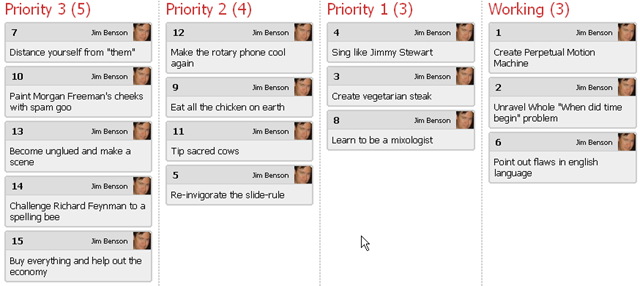
This got me thinking about the relationship between productivity and effectiveness. Eva recognized that simply increasing her throughput was not enough, that was mere mindless productivity.What Eva was searching for was effectiveness.At Modus, we do dynamic prioritization using a priority filter that looks like this:For Tonianne and myself, this works wonders. We constantly have a short list of items that need doing, and as they move from 3 to 2 to 1 they become more important. However, prioritization is a contextual exercise that varies from moment to moment. As we can see here, “Eat all the chicken on earth” is Priority 2, but that could suddenly change to Priority 1 if suddenly I were in a place where all the chicken on earth was accessible.Eva, like many organized people, uses a matrix to ascribe values of urgency and importance, which results in something like this:In the case of Major Tom, he has been sent into space to find out what’s there. He’s a celebrity and everyone is watching him. There are a variety of things he could be doing up there, but he has a a backlog that varies between levels of urgency and importance.So for example, the papers want to know whose shirts he wears. That’s important both to his individual fame and to the space program in general because after all, it’s being good to the press. But at the moment, he’s in space so he can get to that later.If the press scores an interview while he’s up there, though, it can become relevant and therefore is something to complete.So we reach Major Tom here in the middle of his work day. He’s already managed to tell his wife he loves her very much, and he's stepped outside the capsule. He’s put his previously active conversation with ground control on hold because at the moment, he's working on other things. And he’s now floating in a most peculiar way (and noticing how different the stars look).Major Tom is still limiting his WIP and he’s still visualizing, even if his backlog is drawn as a matrix rather than columns. The matrix is a familiar organizational tool for him, and it should be preserved. (Although he probably should have checked his instruments.)So Eva’s concern is very real - we stand a real risk of becoming mindless production units, grinding tasks out at hyper-speed without assessing their value. The key with Personal Kanban is to assess the value of what you are doing – however it is that you define value.We’re all individuals – quality, value and growth are different for us all.Not only that but quality, value and growth are also contextual. Today, home repair might be very low on your list. After a tornado, however, it's probably going to be pretty high. Did you put it there? No. Life did. Context shifted. For that reason, just-in-time dynamic re-prioritization is key for workload management.So be like Eva. Find the way you define your work - visualize it, and thoughtfully examine how you can best be effective.

Boosting Productivity and Learning with Spikes

71878930_02a27afb1b_m

Is there something you don’t know?Almost everyday it seems we are faced with having to learn something new. Some of those things are trivial and easy to accomplish, while others are important and a more than a little daunting to master.There are some easy steps to make learning less overwhelming.On the Lean Agile Machine blog, there have been two consecutive, thought-provoking posts on Personal Kanban and productivity. One describes how to set up a Personal Kanban for research and writing production. The second describes how to set up short bursts of research and quickly evaluate the results.

SPIKE

n. A short burst of work to create a sample version of something

In agile programming, savvy developers will quickly cobble together a prototype, something merely to demonstrate the idea is feasible. Spikes make sure that assumptions about selected technologies and implementation are sound.In short, a spike is a burst of work that makes sure that further work is warranted.Learning is a great way to do this because there will always be things we do not know. Every field of study has nuances and developments that even ardent devotees can’t keep up with. So, when we suddenly need to bone up on say, deck waterproofing methods, we really don’t want to have to become a master carpenter.So, you do a Spike.You set aside 15 to 25 minutes (perhaps with your Pomodoro timer) and blast through as much research as you can. You Google, you Wikipedia, you save some links, you find some review sites. At the end of your spike, you have one of three outcomes:

  1. You have learned as much as you need;

  2. You have a good idea where to get information and how much longer it will take; or

  3. You have learned that asking an expert is a better idea.

Now learning is easy. The spike gives you a predictable amount of time to spend to get results that tame the learning beast.(Please do read the two posts from Lean Agile Machine.)Photo by Shavar Ross

Rapture – Training Your Mind for Completion

Don’t strain your brain, paint a trainYou’ll be singing' in the rain…- Blondie

466866299_a78acb1584_m

Your brain is a muscle. As we repeat certain actions, our “muscle memory” becomes comfortable with those actions, and programs itself to anticipate them. As it trains itself to anticipate them, it optimizes for them. This is the basis of kaizen, continuous improvement. Your brain gets used to your workflow, it becomes an subconscious process, and so it looks for ways to do things better.Smoother.Faster.You get sensitized to completion. Sensitized to waste.So using Personal Kanban on a regular basis, through its visual and tactile interactions, sensitizes you to the building blocks of success.

Tell me and I forget. Show me and I remember.Let me do and I understand.- Confucius

Simply put: your brain responds very well to doing. The active nature of Personal Kanban is what your brain wants. Confucius figured this out 1700 years ago.Managing your workload with static lists, while they can help you organize, doesn’t have the same brain-training impact as having a visual tool like Personal Kanban. Lists don’t involve motor skills or elements of flow.Lists merely “tell you.”Personal Kanban both shows you, and lets you do.Image by Rob Web

" "