
" "

WIP: The Kidzban Book

3039640785_6d11f633f6_b

My dad was magical.

When I was growing up, he turned everything into a game - studying, yard work, even combatting my fear of the Wicked Witch of the West. "Life should be fun!" he'd insist, invoking his own father's optimism, a dictum in broken Italian dialect I struggle to remember but have long since forgotten. I can't say if it was by way of nature or nurture, but there’s no doubt the DeMaria men believed in enjoying life. When situations that were decidedly unpleasant presented themselves, they simply viewed them as opportunities to get creative.And creative they got.Whether it was setting the seemingly interminable list of prepositions I had to learn by rote to the tune of Pop! Goes the Weasel (

About, above, across, after, against, among, ar-rou-uuund!

), or sending me into the science class I struggled with carrying a Tupperware container filled with a freshly butchered calf's brain (can I still distinguish between the cerebellum and the medulla oblongata? you betcha!), my father believed life was too short not to make even difficult tasks enjoyable.And then came the bane of my existence: Mr. Pittman's history class. I despised it, and the 10 pound textbook that I'm still convinced was written to combat chronic insomnia. All those foreign names to pronounce! All those dates to remember!

Boooor-ring

was my justification for coming perilously close to failing an exam. But my father assured me, "they're just stories," after which he proceeded to re-create tales from Greek mythology casting all my friends as characters. Thousands of "stories" and two history degrees later, I couldn't agree with him more. Life - even the tedious parts - should be fun. With a little creativity in fact, they can be fun

and

educational.That's why I had to write this post. And why Kidzban is so important to me.

For the past year and a half, Jim and I have heard from countless people - some from as far away as South Africa and Japan - all excited to share inspiring accounts of how they use Personal Kanban (and a little creativity) to inspire their children. Among the most common uses for “Kidzban” (as we’ve affectionately come to call it) involves visualizing and tracking progress as it relates to household chores, family projects, homework and exam prep, extracurricular activities, religious pursuits, and even confidence building initiatives.

Lately however, another group of Kidzban practitioners is emerging. Increasingly we’re hearing from teachers and home educators who are using it with great success in and beyond the “traditional” classroom. In an attempt to maximize student performance - and make learning fun - they are utilizing Kidzban to establish course goals, visualize homeschool curriculum workflow, track progress (relative to the student’s personal best as well as to that of their peers), identify strengths and weakness, and implement and monitor solutions.We look forward to sharing many of their stories with you in the upcoming publication from Modus Cooperandi Press

Kidzban

, the follow-up to our recently released

Personal Kanban: Mapping Work | Navigating Life.

So why all the enthusiasm about some sticky notes on a whiteboard, you ask?Personal Kanban creates a narrative of  “work” comprehensible to people of all ages and learning styles. Work ceases to be a collection of unrelated tasks and instead becomes a series of events that impact each other and flow from one to the next. With just a glance, users see the things they do well, identify areas that cause them to struggle, and gauge the distance from their goal. In the context of Personal Kanban - or Kidzban, in this case - struggle is not construed of as a failure but rather, as an opportunity for improvement. As a visual radiator, Personal Kanban lets the user know their success simply requires an alternate path. When that happens, they can look for root causes and then going forward, they can adjust their actions to suit.Personal Kanban transforms our “work” into a system. It takes even the most tedious tasks and turns them into a game that’s appropriate for all ages.Consistent among the stories we’ve heard is how children become excited about taking on even the most unpopular or even boring tasks, like picking up their toys or writing the letter “G” until they perfect it or making sure Fido has enough kibble in his bowl.Not only is this "game" a simple one, but it’s an evolutionary one, too. Because Personal Kanban reflects our ever-changing context, it creates a game with an ever changing board. It’s a game we can improve upon, so boredom is kept at bay.Children “beating” their siblings (and even their parents) by completing the most chores becomes commonplace. Students “compete” not only with their classmates but with themselves, finishing their lessons quicker and with less error. In both cases we’ve discovered that upon task completion, kids often seek additional tasks, incentivized by the satisfaction they get from moving yet another sticky note into the “Done” column.Games can assume myriad forms, from head-to-head battles, to problem solving, to role-play. Depending on the circumstance, kids can find themselves besting their brothers and sisters in individual performance, or they can team up - “swarm” on a problem to solve it quickly and effectively. Parents and educators alike are using visualization to build creative games aimed at specific outcomes and to reward specific behaviors.In the end, the games themselves become an education.Whether it entails chores or schoolwork, being able to visualize and focus on the task at hand as part of a system - with immediate and ultimate goals - allows kids to see their action’s trade-offs while learning the best way to exercise their options. They take responsibility for their action (as well as their inaction), and feel pride in a job well done, establishing their independence and buttressing their self-esteem.Kidzban curtails arguments, energizes families, and leaves kids empowered.As a visual radiator, the board offers reinforcement for their efforts. Every member of the family can see that they’ve been effective, that they contribute value. When one person gets hung up, they know where help is needed.So tell us - how are YOU innovating with Kidzban? Are you interested in sharing your experiences or visualizations, or just want to hear more from other practitioners? Whether you’re a parent or educator or even a kid, we invite you to become part of the emerging Kidzban community of practice.On Facebook:“Like” the Personal Kanban page on Facebook to meet and engage with others interested in Kidzban.On Twitter:Whether you have questions, ideas, or experiences you want to share, be sure to add the hashtag #kidzban to your Tweet to ensure other members of the Kidzban community can join in on the conversation.In the interim, be sure to check out some of our favorite Kidzban practitioners:For an innovative approach to chores, see Janice’s

One Kid'z Kanban Board

For ways to use Kidzban throughout the home, see Maritza’s

Becoming and Agile Family

For incorporating Kidzban in the classroom, see Patty’s

Not Out of Reach

And last but certainly not least...Recently I had the extreme pleasure of stumbling upon the most delightful yet profoundly insightful videologs from two of Kidzban’s most perceptive practitioners: siblings Jillian and JoHanna - ages 8 and 11 respectively who, later with the help of 3 year old Joy - are Kidzban rockstars (and agilistas in the making). Don’t miss their dad Joseph’s

Saturday Chores with Kanban

series, part I and part II.

Saturday Chores with Kanban, Part I

Saturday Chores with Kanban, Part II

And it's just a hunch, but judging by the fun these young ladies are having helping out with the housework, I'm fairly certain they feel their dad is magical, too.

Image by Sprezzatura.

The Diffusion of Responsibility

Personal Kanban and Diffusion of Responsibility

When I was an urban planning student at Michigan State University, I was part of a team involved in a large group project. We were writing a downtown redevelopment plan for Albion, a small city in southern Michigan which, like the rest of the state, had fallen onto hard times. We needed to come up with ways for the town to get back on its feet.There were about 8 of us on this team, and while we were a fairly responsible group of kids, we knew that other classes, outside jobs, and our social lives would present us with competing responsibilities and very different schedules. Fortunately for us, the project had only one deliverable - a paper that was due at the end of the term. Being urban planners, we’d all had a few psychology courses, and we knew all about Kitty Genovese, and so we wanted to avoid something called diffusion of responsibility.Diffusion of responsibility is a negative outcome in groups where responsibility isn't clearly assigned nor is leadership taken. In other words, it's a situation where roles are poorly defined. Its ugliest and most infamous example is the 1964 murder of Kitty Genovese. Returning to her Queens apartment late one evening, the 28 year old was brutally attacked in front of her home by a man who shoved a knife into her back - twice. In earshot of her neighbors, her cries for help brought residents from the surrounding apartments to their windows, their shouts scaring off her assailant.Temporarily. Newspapers reported that upwards of 38 neighbors heard Kitty’s screams or witnessed her attack that Spring night. While some did call the police, no one ran to Kitty’s aid. Instead, they all assumed someone else would go to help her. Sadly, no one actually did.Minutes after he fled, Kitty’s assailant returned. Following the trail of blood she left leading to her apartment’s foyer, he stabbed the young woman to death.It was no one’s explicit responsibility to help the victim, therefore no one came to her aid.This horrific scenario encompasses two forms of diffusion: social loafing and the bystander effect, elements we likewise wanted to avoid in our work group. We didn’t want parts of the project to be dropped or ignored because no one had taken responsibility for them. So we met during school hours as well as afterwards, regularly taking the group’s pulse. Most tasks were assigned to more than one person, and most were due the next time we had class. We did not assign a leader but instead, equally divided responsibility amongst group members so no one could control the group or lazily benefit from the hard work of others.Diffusion of responsibility takes other forms as well. It is part of herding mentalities like mob mentality or group think. In these situations, people end up taking part in actions that they would never sanction on their own. In the military and in business, it can also lead to people’s blind obedience, simply because they lack the positional power to object to direct orders. (Just consider the Nuremberg Trials and the events leading up to the collapse of Enron.) This is sometimes called superior orders.In teams, when we use a visual control like a kanban or a screen with well-chosen metrics, we actively thwart diffusion of responsibility. Social loafing is exposed immediately for what it is and usually dealt with not by reprimand, but simply by conscience: when it’s obvious to everyone that you are loafing, you’re compelled to stop. If you don’t, it’s pretty easy to dismiss you.The presence of visual controls make herding mentality less likely because the context of work and the opportunities for meaningful dialogue are heightened. This increase in dialogue also lessens the likelihood of falling prey to superior orders.In all these instances, diffusion of responsibility results when people have either incomplete information or lack the ability to act on the information they have. When using Personal Kanban, our goal is to give ourselves and others the maximum amount of information available that can aid in better decision making. We are less likely to loaf, follow the pack, or fall prey to blind obedience when the impacts of our actions are directly presented to us and our colleagues.Image “An Apparently Homeless Young Woman Sits Crying in a Doorway, Ignored by the World” by Arty Smokeshttp://www.flickr.com/photos/artysmokes/2963629524/sizes/z/in/photostream/

There is No “We” in Bowling

...except for maybe Wii Bowling.

“We have a team of 24 customer service professionals.”That was how it started, innocently enough. This “team” had heart, heroes, and a whole lotta backlog it needed to work through. So they established what would seem to be the most logical metric: number of individual tickets processed per day, per person. People would then be able to compare their numbers; laggards would be identified, heroes could be lauded. This, they felt, would spur support staff to process more tickets and ultimately, shrink the backlog.To their dismay a month later, their backlog was larger. A second month went by and its growth showed no sign of slowing down. Epic Fail.So what happened? The “team” was indeed raising its rate of production.They were working harder, much harder in fact. Everything was working according to plan. But things were getting worse.They were functioning as a team. But what kind of team were they functioning as?Teams tend to fall into one of two categories: they are either structured like a bowling team, or a football team. In this case, the team’s structure resembled a bowling team.On a bowling team, individuals combine their scores to create a composite. The team members approach the line one-at-a-time and aim for a strike. If one bowler gets a strike, it in no way impacts his teammates’ individual scores. On a bowling team, other than camaraderie, there is no combined effort; there is no bonus for playing well together.With a football team, 11 players convene on a field, and from that point on can achieve absolutely nothing alone. Either they perform as a coordinated unit, or they get annihilated. The same is true for all football - rugby, soccer, whatever.Does winning require a competent coach? To some extent, yes. But even the best coach is limited by the capability of his athletes and their ability to work as a team. Each player is optimized not only to their position, but also to the situation. They read the field, they make changes on-the-fly, they optimize for effectiveness at that precise moment.The team we were working with was a bowling team on a football field.And man were they getting hammered.Part of the problem with the bowling team approach is that individuals optimize for themselves and assume that in the end, the group will benefit. This team needed a re-orientation. Cumbersome and overburdened, they relied extensively on “heroes,” putting flexibility and long-term effectiveness at risk. So we put into place some game-changers. Taking into account complexity theory, we recomposed the unwieldy, 24 person team into four smaller, interdisciplinary teams to optimize the department’s capabilities and help focus the teams’ resources. We introduced a visual control  - a kanban - to give team members transparency into what their colleagues were working on and where their strengths lie. We set up daily stand-ups to encourage and reward knowledge sharing/cross-training, collaboration, and continuous improvement. And when those kaizen moments occurred, we ensured those improvements were implemented immediately.Most important, was that we re-invisioned the backlog: no longer was it a pile of distinct tasks for the individual to process and remove serially but instead was now a large, coherent team target of which we began to ask a series of questions:

  • Are there tasks that are no longer relevant?

  • Are there tasks that can be consolidated?

  • Are there tasks being ignored due to personality issues?

  • Are there tasks stalled waiting for internal expertise?

By viewing the backlog from various perspectives, the newly-formed smaller teams could combine their talents and solve problems quicker. True teamwork not only increased the rate at which tickets were processed, it helped focus on the right tickets to process: work was quickly directed to the team member(s) most capable of handling that specific work type. Information dissemination and cross-training became a by-product of day-to-day teamwork.The result: their backlog shrunk approximately 50%.Examine your teams. Ask yourself if they are more akin to a bowling team or a football team. When problems arise, do they focus on their tasks, or do they swarm to find a resolution to the team’s most pressing problem? Is the team structure inhibiting their situational awareness?What can you do to make a situation more collaborative?

Lean Meetings 2: Semper Gumby!

Personal Kanban and Meetings

Point of Order! I make a motion to rescind Roberts Rules of Order in their entirety and free us from the inflexible, outmoded, ungainly, and utterly dehumanizing parliamentary procedure!

Conversations are contextual. They meander, move in unintended directions, and give way to discovery. For this to happen, flexibility is key. Control, agendas, and procedures impeded conversation, focusing on the structure of the meeting rather than the topics at hand. If you want people to engage in and feel they’ve derived value from your meeting, make them feel respected, not restricted.

“Only those who respect the personality of others can be of real use to them” ~ Albert Schweitzer

The truly “Lean” meeting is democratized. The agenda is replaced with a backlog. Attendees choose both the topics and the order in which they will be discussed. The meeting isn’t confined to previously established topics. Attendees can introduce new topics into the backlog at any time, and the group can prioritize or re-prioritize them on the fly. Quite often, new topics will spontaneously emerge as the conversation evolves. When this happens, it's perfectly okay for someone to notice that a new topic has entered the flow and to add it to the DOING column.

“Nothing is softer or more flexible than water, yet nothing can resist it” ~ Lao Tzu

Flexibility is strength. Rigid structures topple and collapse in an earthquake, so structural engineers design skyscrapers and bridges that are flexible enough to withstand seismic shock and move without collapsing. Conversation is the same way. Suppose you’re in a meeting about developing new markets, and there’s a set agenda involving direct sales to Asia. Ten minutes in, your affiliate program becomes relevant. While it is certainly germane to the discussion and an easy transition to make, technically it's not in the meeting’s agenda and so you’re forced to put off discussing it until a future meeting.In a democratized and lean meeting, the introduction of this new albeit relevant topic to the queue would be seamless, and the conversation would continue.This acknowledges the natural, unimpeded progression of the conversation and gives participants the opportunity to continue with the original discussion, adapt to the new topic, or table the new topic for a future meeting. The meeting participants have the freedom and the flexibility to discuss and innovate. The meeting and its direction are now creative and interactive.*Photo by

Tonianne

Democratize Meetings with Personal Kanban

Agendas are so 20th Century.

Personal kanban and meetings

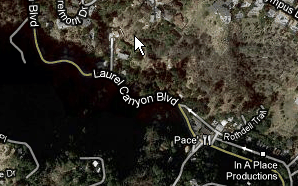
Los Angeles’ Hollywood Hills are known for their exclusive neighborhoods, sprawling estates, and the people who inhabit them. They aren’t (but should be) known for their perilous and serpentine roadways. Among the most treacherous is Laurel Canyon Boulevard. Those familiar with the area don’t seem to give the twisting roads a second thought. They maneuver down snug stretches of this automotive obstacle course at 60 mph, because it’s become second nature to them. In contrast, newcomers to the area - sweat beading up on their temples - cautiously crawl along at a snail’s pace, at once in awe at the glorious homes around them and terrified they’ll veer off the road and through a gilded gate at the very next bend.When you are familiar with something, you take it for granted. You aren’t critical of it and so you tend to blast right through it. Just consider what happens when we call a meeting. Are we looking for what we are already familiar with? Are we basing the meeting on our assumptions and expectations that come from past experiences? Are we just going to “blast through it?” Or are we taking it slow - as a learning opportunity - in an attempt to expose hidden insights that can actually help us achieve our goals?

“The most dangerous kind of waste is the waste we do not recognize.”- Shigeo Shingo (Toyota)

When you set an agenda, you control the conversation. In essence, you define your own road. When you control the agenda, you control the lessons learned. Since we enter a meeting with only our assumptions to guide us, agendas follow our assumptions. Our assumptions are based on what we already know. But what about the things we don’t know? Quite often, it’s the conversations we don’t plan on that give us the most insight. Why not instead run our meetings to learn or to discover?About a year ago, Jeremy Lightsmith and I discussed starting a professional organization around Lean management. We figured that if we controlled the agenda, we'd control the thought. If we controlled the thought, we'd never get beyond our own thinking. Jeremy and I wanted to grow a community - starting in Seattle - but we also wanted to grow as individuals.So we set up Lean Coffee. This popular, agenda-less weekly meeting has taken us in directions we never anticipated. Held in a local coffee shop, and with a totally open format, we begin each gathering by setting up a table-top Personal Kanban. Participants vary from week to week, but whoever shows up is free to grab some sticky notes, and populate the backlog with items they’d like to discuss.  Everyone gets two votes for which topics they want to discuss first. This builds the prioritization. The agenda and the order are both popularly devised.

Personal Kanban Ends Endless Meetings

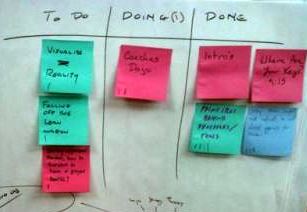
It's that simple. A kanban for a Lean Coffee might look like this:

Lean Coffee has spawned an active community in Seattle and increasingly in other cities like Stockholm, Toronto and San Francisco. More are coming. The best thing about Lean Coffee is that it has already outgrown its founders. Since we never set the agenda in the first place, Jeremy and I could start the ball rolling and step back.Lean Coffee takes place every week at 8:30 am in Seattle whether we are there or not. It is now truly an open forum for learning.

Learning from a Meeting

"Time waste differs from material waste in that there can be no salvage.  The easiest of all wastes and the hardest to correct is the waste of time, because wasted time does not litter the floor like wasted material."  ~Henry Ford

Conventional wisdom suggests that businesses hold far too many meetings attendees deem a waste of their time. Among the most common complaints are how certain individuals hold the floor too long, that the information being disseminated is worthless, and more often than not, the meeting is held merely to satisfy egos or fulfill political requirements.To combat this, some call for meetings with rigid agendas. They want to know in advance exactly what they’ll get in exchange for their time, and so they assume that having a control in place will prevent the meeting from wandering off-track. That sounds like a pretty good idea.Or does it?Suppose for a second that there is more than one reason for a bad meeting. Certainly poor planning is an easy culprit, but perhaps the bigger issue is that we assume etched-in-stone agendas lead to better results. We assume we know what we need ahead of time, we also assume that we know what the attendees need ahead of time. What is more likely is that we know what we need to discuss, which is different than an agenda.An agenda is your personal, politicized reason for gathering people, while the discussion of a stated topic is a conversation. In fact, the entire reason we are calling the meeting is to have a conversation.Why then, if we feel it is inappropriate - rude, even - to dominate the conversation in every other aspect of our lives, would we codify dominating the conversation in a meeting?Perhaps the reason meetings go off track is that the agenda doesn’t actually address topics of concern to the attendees. People come to your meeting and - becoming bored or frustrated with the content or the direction the meeting takes, or feeling their input is not valued or that they can’t be fully engaged - they switch topics to something that interests them or initiate side conversations. Since there is no established mechanism for discussion in the meeting, a power struggle ensues between the person who called the meeting and the people in attendance. This is not good.If we want to learn from our meetings, we need to allow the conversation to be set by the very professionals we invited to the meeting in the first place. If they were worth inviting, they must be worth including. If they aren’t, your meeting should serve another purpose: to hand out pink slips.Allowing the group to have a say in setting the agenda gives them buy-in for the importance of the topics. This helps prevent people running on at the mouth or providing information that goes off topic. Everyone has a stake in an efficient meeting because they all have discussion topics in the backlog. Group ownership means the person who called the meeting no longer serves as the traffic cop directing the conversation.Instead, as the person who called the meeting, you can now direct the overall topic and even seed a few of the initial sticky notes. Yyou can even set a few “must discuss” stickies at the top of the board and prioritize them the highest. But the group must be able to discuss what their professional direction drives them towards.The steps for doing this are simple:

  1. Framework: Draw a Personal Kanban

  2. Personal Agendas: Invite all attendees to write their topics on sticky notes

  3. Democratization: Invite all attendees to vote on the topics on the table (each person gets two votes)

  4. Group Agenda: Prioritize the sticky notes

  5. Discuss

And voila! We have brought democracy to meetings. No longer do we tolerate meeting despots and spontaneous rebellions through filibuster or hijacking. Before these were power plays between the meeting organizer and the person acting now. Now they are interruptions of the group. Let society sort it out.After the meeting, you can construct your meeting minutes outline by simply gathering up the topics in the order discussed.(Want more on Lean meetings? Tune in tomorrow for a discussion of flexibility and democratization.)

" "