" "

The Fallacy of Work / Life Balance

"Yes, well that's the fallacy of  work / life balance, isn't it? I mean...it's all life.”~ Lean Coffee participant, Sydney June 2011

The Fallacy of Work / Life Balance – Work life balance is more than personal and it is more than a choice. Whether we are employers or employees, we need to recognize and respect that “work” is part of life, not some opposing force we balance against life. Studies show that a strong collaborative corporate culture helps organizations weather the current economic downturn better. Pre-Lean Campconversations have drawn focus on this fallacy and toward respect in the workplace.Work / Life Balance. It's one of those concepts that just simply falls apart under the slightest scrutiny. At what point at work do we cease to be alive?I've just come off two weeks of working / living with AMP, a large financial services firm based in Sydney, Australia. This is a conservative company that is examining just what "conservative" actually means. The conclusions people were coming to were very exciting for me.Several people agreed that people at AMP bifurcated their lives. They would come to work, focus on work, and then leave at the end of the work day to return to their homes and presumably to their “lives.” Everyone agreed that this scenario was true…for other people. But not for themselves.As we spoke they realized that they were holding back at the office, because they assumed their co-workers were bifurcating their lives – but in reality very few people actually did so. Everyone was wanting work / life … balance?No.They like their work. They like their lives. There was no division. There was no opposing weight to balance.What they wanted was their home life to respect their work life and vice versa. They wanted these two elements of their lives to stop being a zero sum game. Some days home life happened during working hours. Some days it was the other way around.Some days …? Or maybe all days.Definitely all days.Life happens during life hours.Work / Life Balance is a fallacy. It's all living. Right now, you are living. Wherever you are reading this, you are living. And everywhere you go today, you'll be living there, too.Now, I ask you. In this moment, what is the thing of highest value you could be doing?Think about it.Then do it.Image by Tonianne DeMaria Barry

Why I’m Excited About Lean Camp

LEAN_Camp-WebBanner

JUST LET ME LEARN!Hallway conversations are almost always what people peg as their favorite parts of conferences. Yet conferences rarely provide ample space and time for people to have these conversations. When we actually converse with our peers or with the speakers, we learn more and, more importantly, we retain more. We are actively engaged in the learning, rather than just being spoken to.When Jeremy Lightsmith and I sat down to plan a conference, we didn't spend any time on the format at all. We both knew we wanted conversation, learning, and community over talking heads, big names, and locations. The Open Space model was a logical fit for the Lean Camp we wanted to create.I am very excited about Seattle Lean Camp because it embodies some central ideas.

  1. The Future of Work – In the last several years, science has uncovered some startling new truths about how we learn, how we collaborate, how we are motivated, and why we work. Through the intersection of Lean techniques, neurophysiology, and social economics, we are learning that humans respond better to respect than remuneration. Additionally, changes in the way we communicate and the cost of information storage and dissemination has had profound impacts on the workplace. As the workplace becomes more social and more humane, it also is becoming more innovative and less reliant on traditional top-down management.

  2. Learning and Creation – Lean Camp is about value creation from the outset. While many attendees have been headliners at other conferences, at Lean Camp they are there to share their wisdom and learn from others – just like everyone else. The potential topics at Lean Camp are as varied as the participants. At Lean Camp we want to find new solutions to old problems in a dynamic, charged environment.

  3. Cross-pollination - Conferences that are for one industry and attended by only people in that industry miss the opportunity to really learn from others. At Lean Camp, we already have attendees representing software design, government, manufacturing, medicine, academia, graphic design, engineering, and more.

  4. Gender Balance – I have been pleasantly surprised to see something very near gender parity in the people signing up for Lean Camp. After years of putting on conferences in both software development and engineering, this is certainly a first for me. I'm looking forward to asking attendees what drew them to Lean Camp to find out why we are enjoying such remarkable attendance

  5. The Fallacy of Work / Life Balance – Work life balance is more than personal and it is more than a choice. Whether we are employers or employees, we need to recognize and respect that “work” is part of life, not some opposing force we balance with life. Studies already show that companies with a strongly collaborative corporate culture have weathered the current economic downturn better. Pre-Lean Camp conversations have drawn focus on this fallacy and toward respect in the workplace.

  6. Low Inventory – W. Edwards Deming warned us of keeping inventory in our companies decades ago. Inventory are those things that we create, believing they are value, but then need to maintain and mange those things. For manufacturing, inventory might be the parts you need to make your product, or the products themselves. We want to make just enough and at the right time. For a conference, inventory takes the shape of expensive speakers, venues, large elaborate dinners, and many sponsors with special needs. In creating Lean Camp, we've specifically kept our inventory low. Even though everyone who comes to Lean Camp will receive a free T-Shirt and free food from two of Seattle's premier gourmet food trucks, and will enjoy spending time at the University of Washington's beautiful Center for Urban Horticulture, Lean Camp is only $50.

  7. Great Food – Those who know me, know when I’m around food can’t be far away. This year at Lean Camp we have two of Seattle’s premiere gourmet food trucks providing free lunches to all attendees. On Saturday we have Where Ya At Matt? with his awesome Cajun selection. On Sunday we have Pai’s with his highly acclaimed Hawai’ian and Thai works of art.

  8. Clothing – Nordstrom’s Innovation Lab is making sure that everyone who attends also leaves warmer and happier with a beautiful Seattle Lean Camp T-Shirt.

  9. Value Cascade – So what we have here is a beautiful setting, smart people, an open format in which to think, great food, and a stylin’ t-shirt. All for $50.

This year in Long Beach, California, the LSSC put on a conference that explored Lean and kanban in software development. We had a wonderful turnout and fantastic conversations that resulted. With Lean Camp, we are hoping to take those conversations and combine them with creative minds from other industries. We want to explore the personal, the teams, the governmental, and the corporate views of these emerging ideas.I am excited about Lean Camp's potential to unlock new ways of thinking about work, about life, and about the future. More than anything, I’m excited to see what community grows from this. We’ve built a strong community of practice for kanban and lean with Seattle Lean Coffee – what comes next?Thank you for all who have signed up thus far and looking forward to seeing the rest of you there as well.  (And I’m looking forward to the food ….)

You Cannot Yell at a Board with Stickies on It

Arguments are not productive

It is now two weeks before your major deadline.For the last four weeks, you’ve barely slept a wink. You know your team is behind. They know they’re behind. But the deadline is firm. Your team promises you - nay, vows to you it will be done on schedule. You, in turn, promise the client who in turn, promises their bosses. Their bosses are promising their clients …Everything is riding on this release.You close your office door and look at the remaining unfinished requirements. You begin to add up the time you think it will take to complete.Nope. Not even close.You go to your team and tell them what you’ve found. They get upset and begin yelling about how meetings like this are what slows them down. "If only we could just do our work!"You yell back. "We’re too far behind! We’ll never finish!"The situation is as predictable as it is unnecessary.What we have here is not necessarily a failure to communicate but instead, a confluence of avoidance behaviors exacerbated by a lack of a visual control.Huh?Okay, it’s kind of convoluted, so let’s bullet it out:

  • No one ever had a device that could show - visually - the state of the project and the context in which decisions were made;

  • Since no one could see what was happening, they relied on reports that lagged decision-making and often told an incomplete story;

  • Incomplete elements were then left to be discussed in meetings, which were often adversarial, conducted hastily, and poorly documented;

  • People were then required to rely on individual memory and interpretation of events;

  • When these memories diverged, they became angry when their interpretations were perceived as being different from reality;

  • Divergence from reality then became a point of conflict;

  • The points of conflict were argued about;

  • Those in positions of power declared their faulty memory to be the standard, and those who were not in agreement were treated like failures;

  • Blame for divergence from schedule or delivery promises was then directed towards "the failures,” and

  • Everyone loses: product is late, the workforce is demoralized, management is angry, money is lost, quality is deprecated.

Visualizing work on a kanban can help depersonalize arguments

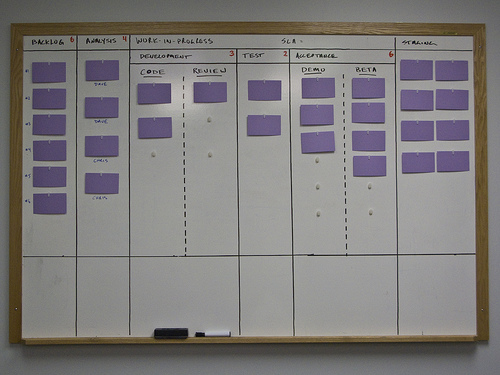
Short form: No one had a status board to point to and say Look! You see? That is what is going on! Regardless of which side of the management / worker or client / consultant fence you might sit, reality is much easier to address when you can actually see it.A kanban (see image) is a status board. It shows who is working on what, which tasks come next for each group to pull from, and the rate at which work flows through the system. In addition to being a powerful project management tool, the kanban also decreases the animosity frustrating work can generate.You see, the issues that slow production are rarely sabotage, subterfuge, or incompetence. Instead, they're more likely due to lack of necessary information, conflicting expectations, hidden policies, and the intricacies of knowledge work. Seldom is it personal. But we personalize it nevertheless, because it’s all we have. We can’t make our tools work faster, so we yell at our people.A visual control gives the team a gift: a disinterested third party that merely reports reality. The kanban becomes an interactive arbitrator. Our work is no longer the responsibility of one person. On the board it becomes an object (the sticky note) that everyone involved wants to move. The inability to move a sticky note becomes a shared responsibility, and is no longer personified by the last person holding the task.In this way, the board depersonalizes work. Now, rather than yelling at each other, you can get together and yell at the stickies on the board.Wait, that sounds pretty stupid.If yelling at a sticky note seems stupid, why did it ever seem like a good idea to yell at your co-workers / employees / consultants? Did you think abusing them was going to spur them to greatness?With the kanban, we can look at the work as it happens, discuss changes that need to be made, and work towards our release date with realistic expectations.Image “Argument” by Fred Camino Image of kanban by David Laribee

WIP: The Kidzban Book

3039640785_6d11f633f6_b

My dad was magical.

When I was growing up, he turned everything into a game - studying, yard work, even combatting my fear of the Wicked Witch of the West. "Life should be fun!" he'd insist, invoking his own father's optimism, a dictum in broken Italian dialect I struggle to remember but have long since forgotten. I can't say if it was by way of nature or nurture, but there’s no doubt the DeMaria men believed in enjoying life. When situations that were decidedly unpleasant presented themselves, they simply viewed them as opportunities to get creative.And creative they got.Whether it was setting the seemingly interminable list of prepositions I had to learn by rote to the tune of Pop! Goes the Weasel (

About, above, across, after, against, among, ar-rou-uuund!

), or sending me into the science class I struggled with carrying a Tupperware container filled with a freshly butchered calf's brain (can I still distinguish between the cerebellum and the medulla oblongata? you betcha!), my father believed life was too short not to make even difficult tasks enjoyable.And then came the bane of my existence: Mr. Pittman's history class. I despised it, and the 10 pound textbook that I'm still convinced was written to combat chronic insomnia. All those foreign names to pronounce! All those dates to remember!

Boooor-ring

was my justification for coming perilously close to failing an exam. But my father assured me, "they're just stories," after which he proceeded to re-create tales from Greek mythology casting all my friends as characters. Thousands of "stories" and two history degrees later, I couldn't agree with him more. Life - even the tedious parts - should be fun. With a little creativity in fact, they can be fun

and

educational.That's why I had to write this post. And why Kidzban is so important to me.

For the past year and a half, Jim and I have heard from countless people - some from as far away as South Africa and Japan - all excited to share inspiring accounts of how they use Personal Kanban (and a little creativity) to inspire their children. Among the most common uses for “Kidzban” (as we’ve affectionately come to call it) involves visualizing and tracking progress as it relates to household chores, family projects, homework and exam prep, extracurricular activities, religious pursuits, and even confidence building initiatives.

Lately however, another group of Kidzban practitioners is emerging. Increasingly we’re hearing from teachers and home educators who are using it with great success in and beyond the “traditional” classroom. In an attempt to maximize student performance - and make learning fun - they are utilizing Kidzban to establish course goals, visualize homeschool curriculum workflow, track progress (relative to the student’s personal best as well as to that of their peers), identify strengths and weakness, and implement and monitor solutions.We look forward to sharing many of their stories with you in the upcoming publication from Modus Cooperandi Press

Kidzban

, the follow-up to our recently released

Personal Kanban: Mapping Work | Navigating Life.

So why all the enthusiasm about some sticky notes on a whiteboard, you ask?Personal Kanban creates a narrative of  “work” comprehensible to people of all ages and learning styles. Work ceases to be a collection of unrelated tasks and instead becomes a series of events that impact each other and flow from one to the next. With just a glance, users see the things they do well, identify areas that cause them to struggle, and gauge the distance from their goal. In the context of Personal Kanban - or Kidzban, in this case - struggle is not construed of as a failure but rather, as an opportunity for improvement. As a visual radiator, Personal Kanban lets the user know their success simply requires an alternate path. When that happens, they can look for root causes and then going forward, they can adjust their actions to suit.Personal Kanban transforms our “work” into a system. It takes even the most tedious tasks and turns them into a game that’s appropriate for all ages.Consistent among the stories we’ve heard is how children become excited about taking on even the most unpopular or even boring tasks, like picking up their toys or writing the letter “G” until they perfect it or making sure Fido has enough kibble in his bowl.Not only is this "game" a simple one, but it’s an evolutionary one, too. Because Personal Kanban reflects our ever-changing context, it creates a game with an ever changing board. It’s a game we can improve upon, so boredom is kept at bay.Children “beating” their siblings (and even their parents) by completing the most chores becomes commonplace. Students “compete” not only with their classmates but with themselves, finishing their lessons quicker and with less error. In both cases we’ve discovered that upon task completion, kids often seek additional tasks, incentivized by the satisfaction they get from moving yet another sticky note into the “Done” column.Games can assume myriad forms, from head-to-head battles, to problem solving, to role-play. Depending on the circumstance, kids can find themselves besting their brothers and sisters in individual performance, or they can team up - “swarm” on a problem to solve it quickly and effectively. Parents and educators alike are using visualization to build creative games aimed at specific outcomes and to reward specific behaviors.In the end, the games themselves become an education.Whether it entails chores or schoolwork, being able to visualize and focus on the task at hand as part of a system - with immediate and ultimate goals - allows kids to see their action’s trade-offs while learning the best way to exercise their options. They take responsibility for their action (as well as their inaction), and feel pride in a job well done, establishing their independence and buttressing their self-esteem.Kidzban curtails arguments, energizes families, and leaves kids empowered.As a visual radiator, the board offers reinforcement for their efforts. Every member of the family can see that they’ve been effective, that they contribute value. When one person gets hung up, they know where help is needed.So tell us - how are YOU innovating with Kidzban? Are you interested in sharing your experiences or visualizations, or just want to hear more from other practitioners? Whether you’re a parent or educator or even a kid, we invite you to become part of the emerging Kidzban community of practice.On Facebook:“Like” the Personal Kanban page on Facebook to meet and engage with others interested in Kidzban.On Twitter:Whether you have questions, ideas, or experiences you want to share, be sure to add the hashtag #kidzban to your Tweet to ensure other members of the Kidzban community can join in on the conversation.In the interim, be sure to check out some of our favorite Kidzban practitioners:For an innovative approach to chores, see Janice’s

One Kid'z Kanban Board

For ways to use Kidzban throughout the home, see Maritza’s

Becoming and Agile Family

For incorporating Kidzban in the classroom, see Patty’s

Not Out of Reach

And last but certainly not least...Recently I had the extreme pleasure of stumbling upon the most delightful yet profoundly insightful videologs from two of Kidzban’s most perceptive practitioners: siblings Jillian and JoHanna - ages 8 and 11 respectively who, later with the help of 3 year old Joy - are Kidzban rockstars (and agilistas in the making). Don’t miss their dad Joseph’s

Saturday Chores with Kanban

series, part I and part II.

Saturday Chores with Kanban, Part I

Saturday Chores with Kanban, Part II

And it's just a hunch, but judging by the fun these young ladies are having helping out with the housework, I'm fairly certain they feel their dad is magical, too.

Image by Sprezzatura.
The Diffusion of Responsibility

Personal Kanban and Diffusion of Responsibility

When I was an urban planning student at Michigan State University, I was part of a team involved in a large group project. We were writing a downtown redevelopment plan for Albion, a small city in southern Michigan which, like the rest of the state, had fallen onto hard times. We needed to come up with ways for the town to get back on its feet.There were about 8 of us on this team, and while we were a fairly responsible group of kids, we knew that other classes, outside jobs, and our social lives would present us with competing responsibilities and very different schedules. Fortunately for us, the project had only one deliverable - a paper that was due at the end of the term. Being urban planners, we’d all had a few psychology courses, and we knew all about Kitty Genovese, and so we wanted to avoid something called diffusion of responsibility.Diffusion of responsibility is a negative outcome in groups where responsibility isn't clearly assigned nor is leadership taken. In other words, it's a situation where roles are poorly defined. Its ugliest and most infamous example is the 1964 murder of Kitty Genovese. Returning to her Queens apartment late one evening, the 28 year old was brutally attacked in front of her home by a man who shoved a knife into her back - twice. In earshot of her neighbors, her cries for help brought residents from the surrounding apartments to their windows, their shouts scaring off her assailant.Temporarily. Newspapers reported that upwards of 38 neighbors heard Kitty’s screams or witnessed her attack that Spring night. While some did call the police, no one ran to Kitty’s aid. Instead, they all assumed someone else would go to help her. Sadly, no one actually did.Minutes after he fled, Kitty’s assailant returned. Following the trail of blood she left leading to her apartment’s foyer, he stabbed the young woman to death.It was no one’s explicit responsibility to help the victim, therefore no one came to her aid.This horrific scenario encompasses two forms of diffusion: social loafing and the bystander effect, elements we likewise wanted to avoid in our work group. We didn’t want parts of the project to be dropped or ignored because no one had taken responsibility for them. So we met during school hours as well as afterwards, regularly taking the group’s pulse. Most tasks were assigned to more than one person, and most were due the next time we had class. We did not assign a leader but instead, equally divided responsibility amongst group members so no one could control the group or lazily benefit from the hard work of others.Diffusion of responsibility takes other forms as well. It is part of herding mentalities like mob mentality or group think. In these situations, people end up taking part in actions that they would never sanction on their own. In the military and in business, it can also lead to people’s blind obedience, simply because they lack the positional power to object to direct orders. (Just consider the Nuremberg Trials and the events leading up to the collapse of Enron.) This is sometimes called superior orders.In teams, when we use a visual control like a kanban or a screen with well-chosen metrics, we actively thwart diffusion of responsibility. Social loafing is exposed immediately for what it is and usually dealt with not by reprimand, but simply by conscience: when it’s obvious to everyone that you are loafing, you’re compelled to stop. If you don’t, it’s pretty easy to dismiss you.The presence of visual controls make herding mentality less likely because the context of work and the opportunities for meaningful dialogue are heightened. This increase in dialogue also lessens the likelihood of falling prey to superior orders.In all these instances, diffusion of responsibility results when people have either incomplete information or lack the ability to act on the information they have. When using Personal Kanban, our goal is to give ourselves and others the maximum amount of information available that can aid in better decision making. We are less likely to loaf, follow the pack, or fall prey to blind obedience when the impacts of our actions are directly presented to us and our colleagues.Image “An Apparently Homeless Young Woman Sits Crying in a Doorway, Ignored by the World” by Arty Smokeshttp://www.flickr.com/photos/artysmokes/2963629524/sizes/z/in/photostream/

" "