
" "

Tool Review: KanbanFlow

Kanban flow title image

About a month ago, I was going on about how you should periodically throw out your Personal Kanban and replace it with a new one. Doing so, I reasoned, would compel you to address the clutter in your Personal Kanban and help you re-evaluate the way you work and the options you face.My friend Simon Marcus took me to task over this, and asked when exactly I last tossed my own board.Well...my answer was “December.” And yeah, that seemed a little too long to me, too.So on the first of May, Tonianne and I took on a new internal rule. We'd use an online Personal Kanban tool for two months, then switch to a completely different tool and in the process, hopefully learn something about the way we work.At the end of the first month of use, we’d write a blog post reviewing it.Tonianne says: C'mon, Jim. You know that's not the way it went down. I'm perfectly fine with you telling people I raised holy hell at the prospect of you taking away my board after only *one* month. Particularly after several weeks of travel, having something consistent and intuitive and downright enjoyable to use was comforting. Not to mention the satisfaction I was getting beasting your Pomodoro score...Jim says: Fine. But don't tell them about the Pomodoro score yet, I'll get to it in a bit!Ahem. So where was I. For the past month we’ve been using KanbanFlow, and we’re happy to say we’ve enjoyed it immensely. So much so, that one of us *might have* originally wanted to change out our Personal Kanban every month, but we were enjoying it so much we opted to make it two!Jim says: Happy?Tonianne says: Very. 

What’s So Good About It?

Look and Feel

big kanban flow

KanbanFlow has a few bells and whistles, but for a tactical, quickly designed, shared Personal Kanban, it's extremely intuitive. We have eight columns on our Personal Kanban that are easily understood at a glance. The divisions between the stickies, the unpretentious layout, and focus on functionalism is key to the success here. But there are some small, unassuming, and powerful additions.
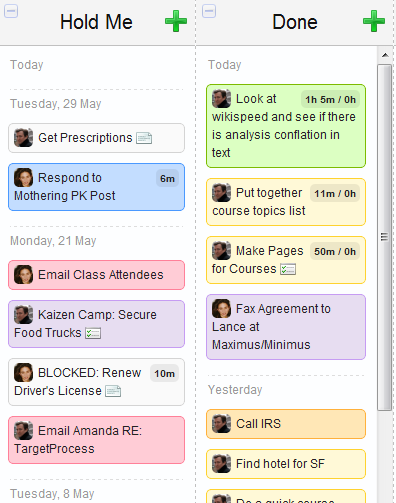
Dates in Kanbanflow

Visual Date Tracking

Very Nice!As you can see here, columns can be set up to record when something happened. In Personal Kanban this can be  useful specifically in “The Pen” (this month we’ve called The Pen – "Hold Me"). This is the column we use to track tasks that are waiting on an outside party for completion. Seeing when these tasks were put in this column is an extremely useful bit of information. First, it categorizes tasks neatly. Second, it lets us see  how long tasks have aged. Third, it shows us days where things have not progressed as we had originally foresaw.Today, for example, the task put in Hold Me on the 8th of May became too painful to look at. So after making this screenshot, I took a quick bit of time to take care of it. While I was at it, I assessed the other items in Hold Me, devised some quick fixes, and now the column only has three items in it. The discomfort of seeing 8 May at the bottom of the list was so great, I was compelled to act immediately.

Pomodoro Built Right In!
kanban flow pomodoro
Stats
work log

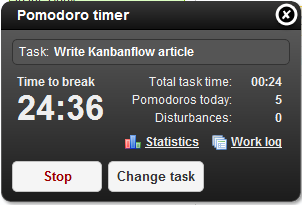
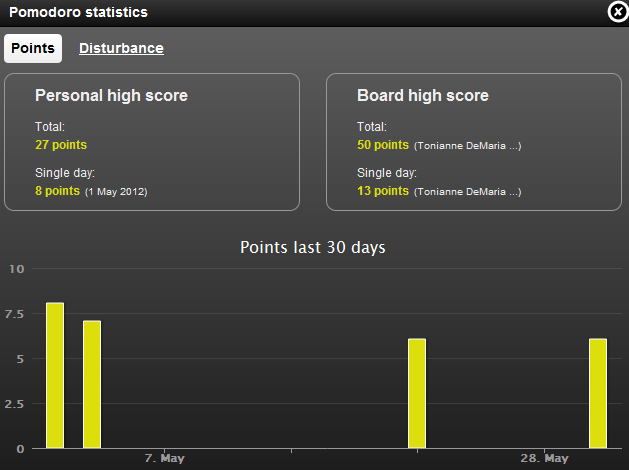
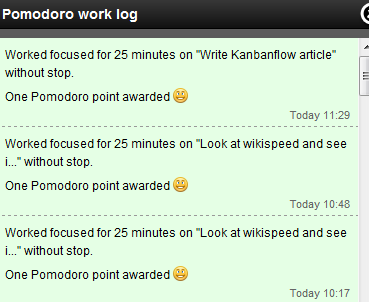
Look! There's a pomodoro timer build right in! The Pomodoro feature is clean and attaches itself to specific tasks. If you finish your task, you can move it into the DONE column and then easily select “Change Task” before you pull a new task into DOING. At the end of your 25 minutes of work, it alerts you to take a break and, if you’ve been good, you get a “pomodoro point.” The points let you keep track of completed or successful pomodoros. You can see that my day today has been miraculously interruption-free. I’ve done 5 successful pomodoros.If you are interrupted, it lets you select the reason for that  interruption, so  you can use that piece of information to complain later (and hopefully improve your process in the interim).KanbanFlow also provides statistics, competitive ones at that. Here you can see that my best day was at the start of May when I scored an impressive 8 points. Tonianne, however, is pulverizing me with her Olympic-caliber 13 points in a single day. (More than likely that was a day she didn’t have me interrupting her…)Lastly, we have the Pomodoro work log, which tells us what we worked on in a single pomodoro. Today I worked for 3 pomodoros (or excuse me, "pomodori") on a section for our upcoming Scrumban II book, then turned my attention to this blog post.When you combine these three pomodoro features, you end up with an unexpected bonus. Being able to tie completion times to actual work – and having that work interruptible and open for pomodoro break – that’s a godsend for busy knowledge workers.Plus, in integration of the Personal Kanban with the real-time Pomodoro timer really helps hold your focus on your Personal Kanban.

Adding Tasks is Not a Problem
adding tasks

Smile

exploding tasks
not expanded

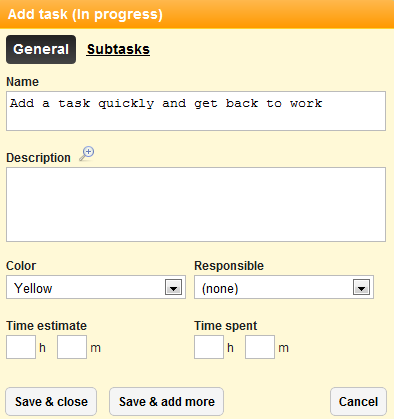
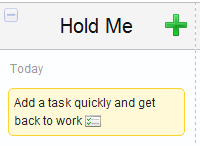
With KanbanFlow, adding tasks is easy. At the top of every column is a huge green “+” sign. Click on it and you get this lackluster yet powerful "Add Task" box.You can quickly add a new task and then click “save and add more” if you choose. You can set a color and the person responsible. You can even add a Time Estimate if you haven’t read our Why Plans Fail eBook   (which tells you why that might not be a good idea).More interesting here is the “Subtasks” area. Now, many on-line kanban tools have subtasks, so that’s nothing new. But this one is coupled with a setting in the columns of your kanban.You can set columns to “explode” these tasks when they get pulled in. So in the backlog, this task says, “Add a task quickly and get back to work.” But when we pull it into "IN PROGRESS" we get the column on the left.When the task enters this column the subtasks immediately become visible.This has allowed Tonianne and me to easily make tasks with minor steps or dependencies explicit. It’s also allowed us to pull in and work on joint tasks without having to break them down into ridiculously small chunks.

Print Feature

print feature

It’s so simple! You can print a column or columns of your board.This seems foolishly simple when you see it, but it’s extremely important to teams that want to meet to discuss items in the backlog, in process, or for a retrospective. It’s also pretty handy if you need to go run a bunch of errands. Think of it like am iPhone app...but on paper!

Our KanbanFlow Wish List

Anyone who has developed software knows that when you give customers what they want... they ask for more of what they want. This is certainly true for us. We’re really impressed with KanbanFlow – so don’t let the length of this wish list make you think otherwise.Tonianne says: I think we should put "really" in bold and in caps so people know we mean it.Jim says: Geez you're awfully demanding today. And don't give me the eyebrow. I can sense it's raised all the way from Seattle.So yes, we're REALLY impressed with KanbanFlow - so don't let the length of this wish list make you think otherwise.Also, we’re assuming many of these wishes will be repeated again and again as we write other reviews.

  • Shared Task Responsibility: Many tasks are undertaken by more than one team member. Having the icons or names for a specific person is great, now let us collaborate!

  • Add a Blocked Status: You can’t note that a particular task is blocked.

  • Create a Color Key: Users lose track of what the colors mean unless its written or communicated somewhere.

  • Individual WIP Limits: "In Process" limit should not be six, but should be 3 for Jim and 3 for Tonianne.

  • Swim Lanes: In every Personal Kanban seminar we have, people immediately and intuitively set up swim lanes. KanbanFlow needs them. Stat.

  • Archive: Once something is done, it just sits there. There needs to be an archive for tasks after they've been reviewed.

  • Pomodoro Additions:

    • Alerts: Tonianne would like me to know when she's mid-pomodoro so I don’t bother her. Tonianne says: Can I get a hallelujah? But what I'd really love to see is a tomato icon on the task I'm in the midst of working on so it'll serve as a visual cue not to disturb me. Maybe even an alert that pops up on Jim's screen that says which task is actively being pomodoro-ed.

    • Not an Interruption: Interruptions aren't always negative. Sometimes you just naturally end your tasks before the 25 minutes are up. We don't want to get penalized for this.

    • My Interruptions are Different: Allow me to enter my own interruptions.

    • “Start” when clicking “Break”: During a break, the start looks like you are “starting your break," not the next pomodoro. We’ve mistakenly started a new pomodoro many times.

That’s It!

That’s our take on KanbanFlow. We’ve really enjoyed our first month into it and are looking forward to the second.Tonianne grins smugly. See you in two months with the next Personal Kanban product review.

5s in Personal Kanban

Introduction

Personal Kanban is a great tool to visualize your work, to limit your WIP and to take better control of your life, either alone or together with your significant other, your kids or even your team at the office. In contrast to industrial Kanban, in Personal Kanban, the items contained in the value stream are often less defined and more often than not even the outcome is not clear. A "go shopping for dinner" task might be clear enough but you could as well end up checking the shelves in the supermarket and decide you prefer to get a Chinese takeaway instead.Nevertheless, if you have a Personal Kanban in place, customized to your own wishes and needs, suited for the way you like to work, things might or might not improve. After all, Kanban is only a tool, a method, and you still have to find the motivation inside you to make proper use of it. If you are so inclined, a simple Japanese philosophy might help you with this task.

5S

Like Lean and Kanban, 5S comes from Japan and is regarded as one of the fundaments for what literature named "Just-In-Time" production. It basically is a set of steps that streamline the way people work, eliminate waste and inefficiencies and help in reducing variation in the process. Of course, your daily schedule is not such a process but the basic idea of these five steps is still helpful. If you pay attention to them, your Personal Kanban will prove fruitful for you and you will reap the benefits. If you are reading this, chances are high that you already are, without knowing it.

Step 1 - Seiri

Seiri means as much as cleaning, throwing your junk away, and in a certain way, this is what you need to do when implementing your Personal Kanban. If you have used (or still use) different ways of keeping track of your tasks, get rid of them. No scribbles next to your keyboard, no sticky notes next to your phone, no random reminders in your mobile phone. Do a spring clean, if it's a task, put it in your Personal Kanban (the backlog, if it's for later on), if it's useless information, dump it. Make sure that there is only one place for you that contains all the information you need.

Step 2 - Seiton

Seiton means to bring things in order so you can use your Personal Kanban efficiently. It doesn't matter if you are using a big whiteboard, a table or your office door but whatever you use, you should have everything you need accessible. Stock up on post-it notes in different colours, have pens at hand, maybe even a filer so you can store your finished tasks for later. Whatever it is, you should not have to search for it when you want to work with your Personal Kanban, and the tools should neither be far away nor in an uncomfortable position. A corner in your room for example is a bad idea, as I guarantee that you'll lose your motivation if you constantly have to bend down to get a new post-it note.

Step 3 - Seiso

Seiso means to clean things or to shine them. This does not only mean that you should regularly take a cloth and scrub your whiteboard, if you have one, as noone likes dirt and dust. The bigger part of this means that you should keep your Personal Kanban tidy and in good shape. At the end of your workday, take a look at it, and ask yourself whether it is still a representation of your work. If tasks have become obsolete, then mark them as done. If you like to make notes to your tasks for later retrospectives, then now it's the time to do so. Rearrange what's left, reorder, make it look good. These minutes are not a lot of effort but if you start the next morning with a clean and up-to-date Kanban, you will feel better than if you had to start your day with cleaning things up first.

Step 4 - Seiketsu

Seiketsu is the task of standardizing things. Define for yourself a method for your Personal Kanban, and stick to it. If you use different colours or shapes for different kinds of things then be consistent with it. If you usually categorize doing your dishes as house chore, don't suddenly use a different category just because you couldn't find a post-it of the correct colour at hand. If you like to add deadlines to task items, make sure that each task with a deadline is marked accordingly. You want to be able to rely on the information your Personal Kanban gives you to make your decisions.

Step 5 - Shitsuke

Shitsuke means to sustain things and to be disciplined. Pay attention to the four steps above regularly. Use your Personal Kanban. Keep things clean and tidy, stick with the system you defined for yourself, restock on tools and whatever you need. And, above all: commit to what you are trying to achieve. Without discipline, your method will deteriorate over time and you'll gradually fall back into your way you worked before you introduced Personal Kanban. With discipline you will not only maintain but also over time improve your flow (through Kaizen), and you will have more often successful days when you see what you've done.

Conclusion

Most likely, all of the five steps mentioned above will sound obvious to you. For me, personally, they have formed a ritual and a mindset that help me maintain order and stability in my Personal Kanban, which leads to clarity and allow me to make the right decisions.

Customers, Respect & Value: Lean Muppets Post 9

Respect is a fundamental value in Lean

Profit in business comes from repeat customers;customers that boast about your product and service,and that bring friends with them.~ W. Edwards Deming

Everyone has been in this position before.  You’re doing business with someone – your only goal is to give them money for their services – and they make the simplest request onerous. In this case, the customer has ordered a bowl of soup and it is, apparently, defective.  We can feel his dread of calling support when he notices the fly. He knows frustration is just around the corner.

But, he’s not getting value for money and he calls Grover over. Grover goes through several emotional phases before confronting the problem.

Avoidance – Grover puts him off. “Just a moment sir,” and “Not now sir.”Misdiagnosis – The customer tells Grover there is a fly in his soup. He’s been around soup enough and knows full well the scope and extent of the problem. Grover however, then goes through a set checklist of problem solving provided to him on his first day in customer support. First, the checklist tells him to look under the soup. The customer tells him it’s not under, but rather it is in the soup. Grover returns to his checklist and looks next to the soup. Again, the customer clearly tells him the fly is in the soup.Disbelief and Blame – “I will look in  the soup now, for this supposed fly.” Grover first insinuates that the customer is wrong, and then looks “on” the soup.At this point the customer loses his cookies and lays into Grover, to the point that the two almost come to blows.Admission – In the heat of this exchange, Grover asks, “Why did you order fly soup!?” It turns out that the system (his restaurant) specially serves bowls of fly soup. What was a feature for the restaurant is a defect in the eyes of the customer.Complete Communication Breakdown – To placate the customer, Grover then goes to get another bowl of soup. He returns and offers, “I think you will be very happy with this.” When the customer asks what it is, he replies “Cream of Mosquito.”While we could certainly  talk about failure demand, like we did in back in post two when Ernie painted Bert’s portrait, here we’ll talk about respect.Customers who have a choice will not continue to deal with companies that do not respect them. If you are in a business where you are lucky enough to enjoy a monopoly or near-monopoly you can treat your customers poorly or even regularly insult them. But if they have a choice, you may want to think twice.In general, people do not feel respected if they feel “processed.” So checklists, forms, and formalities do not set a stage for repeat customers.But let’s take Deming’s quote one level further. In business, you get profit from repeat customers. But our customers are not always people buying services from us. If our spouse asks us to take out the garbage, they become our “customer” for that task. (If you don’t believe me, dump the garbage on the floor and tell me if your spouse doesn’t act like Grover’s customer).Each day we engage in myriad transactions. Some of them are economic, but most are social. Consistently disrespecting people will eventually erode our social capital and leave us with no friends and distrusted by all. If we respect others, then we will have friends that boast about our product (ourselves) and bring more friends with them.

~

This is ninth in a series of Lean Muppet Posts. For a list of Lean Muppet posts and an explanation of why we did this, look here -> Lean Muppets Introduction

Practice, Practice, Practice: Lean Muppets Series Post 8

Practice Makes Perfect for Fozzie, Maybe Too Perfect

If you will recall in the Introduction, I said that the shared vision for Lean, Muppets, and Modus was:

  • If we care, we create.

  • If we create, we improve.

  • If we improve, we live.

But there is something underpinning all of these, and that is practice. When we practice, a few key elements lead to the evolution of our mastery:

  1. We learn more about how to do it.

  2. We learn more about if we like to do it.

  3. We learn more about what “right” looks like.

  4. We become more comfortable.

A state of continuous improvement does not come easily to people or teams. While it is not quite an unnatural state, it is nevertheless, one most of us are not accustomed to.Like Fozzie here, we are going to have some misses, some near misses, and some very strange successes.And pain.Lore has it that it took the Beatles' 18 takes to get “Helter Skelter” right, at the end of which Ringo Starr cried out, “I’ve got blisters on my fingers.” Practice sometimes can even be scarring.But practice leads to (while never quite reaching) perfection.

To think is to practice brain chemistry. ~ Deepak Chopra

Eventually, Fozzie will learn the right pressure to apply to his hat rim to receive only one rabbit.  The blisters on Ringo’s fingers eventually healed.But in order to improve, they both need to practice. In practicing, our brains actually reorganize internally – adjusting to new patterns, looking for others, and becoming more of an “expert” at what we are practicing. So, imagine if in continuous improvement we constantly practiced improving. Our brains would actually optimize for improvement – which would involve all the awareness, learning, and compassion required to do so.

Practice and MetaPractice

We have two types of practice here:

  • Normal Old Practice: the repetition of something either in preparation  or actual production that results in learning about the action, and

  • MetaPractice: the practice of practicing in which we internalize the need to rehearse, repeat, and relearn what we do.

I consider my friend John Von to be a pretty stunning musician. He’s played all around the globe in front of packed crowds in mega stadiums. He played the bass for years, then stopped for a few years to do digital music work. Sometime around 2006, he decided to return to the bass and so he spent weeks practicing for 8 hours a day. I was confused. For me, it seems like John naturally has a bass guitar attached to him. It’s been that way since we were in grade school.But John has always understood both practice and metapractice. In order for him to improve he not only needs to practice what he’s doing, but also practice practicing. He needs to incorporate practice into his daily life. John understood the drive for continuous improvement long before I did.

If my doctor told me I had only six minutes to live, I wouldn't brood. I'd type a little faster.  ~ Isaac Asimov

Over the course of 72 years, Isaac Asimov wrote or edited over 500 books. If we were to deduct 22 years for growing up, that’d equate to 10 books per year, or nearly a book a month for life. Asimov practiced writing daily. He wrote limericks, postcards, jokes. He would write and write and write. He wasn’t just interested in the practice of writing science fiction, but also in practicing practice.Asimov’s writing could only improve if he practiced other types of writing. So his 500 books actually span every major category in the Dewey Decimal System. In order to write about those things, he had to learn about those things. In order to learn about those things, he had to be committed to practicing learning - and then practicing whatever he was learning about – even if only through exercises.Fozzie’s downfall has always been his impetuousness; he acts well before he has practiced. The Muppet Band, however, seems to always be the surprise antithesis to Fozzie. Floyd is well practiced at practice. He is therefore cool, collected, and seemingly ready for anything. He is practiced and therefore comfortable, even around the craziness of the Muppet Show.

Fozzie’s Alter Ego

This is the eighth in a series of Lean Muppet Posts: For a list of Lean Muppet posts and an explanation of why we did this... look here -> Lean Muppets Introduction

Flow, Cadence, Slack, and Stress: Lean Muppets Post 7

Scooter Reduces Cycle Time to Rowlf’s Breaking Point

Here we find Rowlf singing Coleman and Fields’ “It’s Not Where You Start, It’s Where You Finish.” He sings at a comfortable rate and all is well. Scooter then tells him he needs to do it again, but this time a little faster. So Rowlf turns on the juice, hits more of a ragtime vibe, and blasts through the song, completing with a bit of stress, but still can add a flourish or two on the piano. Scooter then pokes his head in and tells him to do it again in 20 seconds. Rowlf then shifts into high gear, his ears flapping, his head bouncing, and words coming out fast enough to rival hardcore 80s punk. At the end of the third, he's done his work in such a short amount of time, he must close the piano all together and simply concentrate on breathing.In our work, we have lean concepts of flow, cadence, and slack. In our book, Personal Kanban, we describe them like this:

  • Flow: The natural progress of work

  • Cadence: The predictable and regular elements of work

  • Slack: The gaps between work that make flow possible and define cadence

Flow is a little deeper than this, because the concept of “flow” differs slightly for psychologists or lean practitioners. Both concepts, however, are important for knowledge workers and managers.For psychologists, “flow” is a state of mind where we feel in the zone. This is where everything is moving at the right pace, we have clarity and comfort with our actions, and we have a sense of peace with the process under which we are working.In lean, “flow” is more the rate at which work progresses. You have a value stream and work flows along it. Flow is hindered by bottlenecks, constraints, policies, or other ne’er-do-wells.Cadence helps us set flow. It’s like the beat. It’s the rhythm of our work. The right cadence can move tasks from start to completion at just the right rate to maximize completion and quality.Slack is sort of the space between beats. You can’t have a drum solo without silence.All three of these work together to create a natural system of work not unlike music. So we see it in Rowlf.The first round of the song he is fine, even the request for a faster variation is welcome. He can complete his task and is ready for more.The second round of the song, he makes little jokes like, “how’m I doing?!” He’s going faster than he’s comfortable with, his pace is not sustainable, but he can still complete the work. (This unsustainable fast pace is where many companies try to keep their knowledge workers).The third round is where some misguided managers like to live every day. Rowlf is asked to do the song at the very limits of his capability: in 30 seconds. Scooter, the project manager, isn’t even listening to the song, he’s just counting the seconds to on-time completion. Rowlf does bring the project in on-time but, again, he completely collapses after it is done.Between the first and third rounds, Rowlf endures a great deal of stress. When flow, cadence, and slack are in agreement, product delivery is flawless and nearly effortless. The more they are not in agreement, the more effort is needed and the more stressful the work is.At his initial pace, Rowlf could probably play all day, every day. At the second pace, maybe he could play for an hour. At the third however, he'd barely make it through one playing.And as we can see below, even adrenaline junkies like Animal are not immune.

Maybe Buddy Rich is Immune

This is the seventh in a series of Lean Muppet Posts: For a list of Lean Muppet posts and an explanation of why we did this... look here -> Lean Muppets Introduction

" "