" "

Personal Kanban Wins the Shingo Prize

Shingo Emblem

Personal Kanban won a Shingo Prize for Operational Excellence this year. This is the highest honor in Lean and we share the award with some pretty august company.This award is humbling. Shingo awards are usually focused on manufacturing or applications of specific Lean principles with many direct nods to Toyota.Personal Kanban is strongly rooted in Lean ideals, but it much more focused (as the name implies) on the individual – on us as people.Tonianne and I are greatly energized by this award and look forward to seeing Personal Kanban continue to grow and thrive.Read about it on CBS News and the Lean Systems Society sites.

HOW TO: How to Limit WIP #4– How to Size Tasks (sort of)

Strangely, although people routinely overburden themselves with work, their first objection to limiting work-in-progress is “don’t all my tasks need to be the same size? How do I size my work?” They hear the possibility that we can get more work done in a system where we see our work and focus on completion, but they are doubtful that this is enough.So, after never paying attention to your work at all, now you want to be a superhuman estimator as well?

Simply changing how we think about work can help us manage work.

Ultimately, for me, I recommend not paying attention to task size at all at first. Wait until you actually see your work flow for a while.But, at some point, you will start to get a little more sophisticated and start to really wonder about task sizes.In this video, Stephen Covey plays a game where he coerces this apparent executive to place rocks in a tub. The goal is to put in the big rocks after all the little tasks have been achieved. The little tasks can be seen as interruptions, distractions, or the day-to-day minutia of working.The end-result is that it is, of course, easier to plan for the big rocks (by putting them in first) and there’s still plenty of capacity for the little rocks to fit into the nooks and crannies.I really love Stephen Covey and have gained mightily from his insights. However here, we can see a few flaws and they related precisely to our fears about task sizing and estimation.  (Go on, watch the video, then come back to this…)

Planning for the Big Rocks

Our issue here is that we are trying to size elements (little rocks) of larger concepts (big rocks) without fully understanding the larger concepts. How many of us focus on the task we are assigned, but don’t question the overall project?  How many of us get bogged down in a task and then notice the deadline looming and say, “I’ll make up for this delay later?” How many of us take on a two-hour project that we work on for two-days?In short, we can’t really distinguish big and little rocks.We end up focusing on the size of tasks and not the flow of tasks. We wonder what the cost of delay is, but we can’t measure it because there is no flow for the delay to impact.Covey is making the same mistake most people make, he thinks those things are ROCKS.

This implies that they have definite shape, weight, and color. Corporate planning is not a solid, it is a gas. It will fill the space you provide. If you give Covey’s rocks no definition, they will swell up and overflow your big plastic tub. (Am I really posting about gaseous rocks?)This tortured analogy is necessary only because we all simultaneously conceive of projects as definite and without form. We recognize the number of unknowns. We make plans and they scare us. The more scared we are, the more we try to tightly control our projects. This is like bearhugging a water balloon. At some point we control too much (hug too tightly) and it explodes all over us. Then we get frustrated and blame the balloon. (more analogies!)

Better the Bucket

Projects are actually the bucket. Tasks are the rocks. Most tasks, as Covey shows, are pebbles. They flow through our day as easily, and as awkwardly, as they did when she poured them in at the end. Most flew right on in, but every so often she had to stop and shake the bucket.That made everyone laugh, and it made her and Covey grin conspiratorial little grins.Why? Because it was awkward.And so is our work.In the end, the size of any of those tasks didn’t matter a bit. What did matter is she devised a system that noted that there were observable differences in her task types. She put one task type in first, in a deliberate way, and then allowed the other task type to flow.  In this case it was physical size.In other cases it could be something else.

Context Has a Size

Tasks all have context that relate to our concept of their size. If I told you, your task was to walk into the next room and get something I just printed out of the printer, you’d estimate the size of that task to be small. If the next room involved crossing a pool filled with crocodiles, you might be surprised when it took you longer.The politics, emotional weight, and implementation details of the seemingly smallest task can prove to be gigantic. We simply won’t know until we understand the system. When she understood Covey’s system, she changed her approach to work.Size might matter.

Kaizen Camp: Seattle 2013 Announced

Kaizen Camp

Kaizen Camp 5

Join us July 30-31 as Modus Cooperandi will be hosting its third annual Kaizen Camp: Seattle on the beautiful grounds of the University of Washington’s Center for Urban Horticulture. Join Jim Benson and Tonianne DeMaria Barry as we host our third year of Personal Kanban, continuous improvement, and better work management in Seattle. This event is two days, with wonderful food, conversation, and learning in a beautiful setting.Early bird pricing is $99 for the two-day event and only 175 people can attend, so register NOW!Last year we sold out quickly. We look forward to seeing you there.Kaizen Camp™ is an unconference. It's two idea-dense days of conversations about learning, creating, and building value through Lean Principles, agile methodologies, systems thinking, problem-solving, the thought leadership of people like Deming, Ackoff, Kahneman, and Argyris, real-world stories, and the impacts of collaboration and respect in the workplace. Kanban, Personal Kanban, GTD, Agile, Six Sigma, 5s, Cynefin are all on the table...but so are the root of all these forms: Continuous Improvement or Kaizen.Join practitioners, thinkers, and luminaries from across healthcare, education, manufacturing, retail, human resources, publishing, software development, and personal productivity. We had a sold-out crowd last year, and we expect to sell-out again quickly. So be sure to register today.Kaizen Camp™ is brought to you by Modus Cooperandi and sponsored by:

HOW TO: How to Limit WIP #3–Reducing Interruptions

22069889_2fec506fbb

Four hours ago, I walked up to a big pad of paper and started mind mapping all the types of interruptions we might face while trying to get our work done.

  • While I was working, Tonianne, who was on Skype, wanted to do a microphone test.

  • Then I received an e-mail for a meeting request from a client.

  • While responding to that, I received a lunch request from a colleague.

  • While responding to that, e-mail arrived from another client with documents needed for our meeting. So I accepted those Google docs and scanned them.

  • While responding to that, my bladder told me that I should rush off for a bio break.

  • After that, I rushed to the board and started writing furiously about things that might interrupt us.

  • Then Tonianne wanted to discuss some work that was coming up.

  • Then I had my meeting.

And now, 3.5 hours later, I am finally writing this blog post.My goal is to get this done by my call at 1 pm.How do we limit our work-in-progress in a world of constant interruptions?Interruptions are more common in knowledge work than work, it seems. They are little things, one minute, five minutes, ten minutes. Happening here and there.

What is an Interruption?

The Free Dictionary defines Interruption as:

in·ter·rupt (nt-rpt)

v.in·ter·rupt·ed, in·ter·rupt·ing, in·ter·rupts

1. To break the continuity or uniformity of: Rain interrupted our baseball game.

2. To hinder or stop the action or discourse of (someone) by breaking in on: The baby interrupted me while I was on the phone.

3. To break in on an action or discourse.

All three of these are important to us at work. While we are working, we are achieving (hopefully) a state of flow. Both in the psychological and the mechanical sense of the word, we are actively focusing, working, and completing the task at hand.An interruption is anything that breaks that flow-state. <The phone just rang. On call for 2m13s.>When we break that flow state, just like that side comment about my own interruption broke up the flow of this post, we have several states we transition through:

  1. Initial shock (Oh my god, I’m being Interrupted!)

  2. Adjustment (Context switch into new context)

  3. Existence (Live in new context)

  4. Closure (Close off new context)

  5. Return (Return to previous context)

Depending on the detail needed by the interruption, these states can take take minutes, tens of minutes, or more. Luckily for me, my interruption was minor and rather fun, so leaving the blog post and coming back was relatively easy.

Interruptions and You

Since most interruptions are small, routine, and often important, we tend not to notice them. When interruptions are annoying, we do notice them. Then, when we are late in finishing something, we will blame our lateness on the annoying interruption and conveniently forget all the other ones.The fact is that interruptions are part of knowledge work. We seldom do it alone, which means we have colleagues. Colleagues require information. Information requires communication. Communication requires attention.We are also social animals. So, if I come into your office and say, “Hey, I need to talk to you about the Amalgamated Salamander contract,” you are likely going to say, “Okay,” and we’ll talk. Even if you say “No,” you are unlikely to simply say “No,” and ignore me from then on, because that’s rude. And if you are truly rude, you will not stop at “No,” you’ll tell me exactly why you don’t have time for me which is still an interruption.We cannot declare interruptions as waste, either. Knowledge work and personal work is fraught with rapid changes in context. Micropriorities that never existed on your project plan crop up every day. Like “Hey, Barb’s out sick, you still want to have that meeting?” Or “I just got this fax from the FDA and they are claiming that epoxy isn’t a food and we have to pull our Gluey-Chooies off the market.” Things like that.So, we need to understand what our interruptions really are, before we decide that we want to eliminate them.There are many systems out there to help you isolate yourself from interruptions, but completely closing yourself off from change – in an environment with high degrees of change – doesn’t make a lot of sense.

Understanding Interruptions

In order to know a thing, you must become a thing. So, you must first go out and interrupt as many people as you can.No … scratch that.In order to understand interruptions, a good place to start is to (surprise) visualize them. Here are some suggested ways in increasing levels of complexity.Write Them Down: That’s simple enough. Keep a pad of paper nearby and when you are interrupted by ANYTHING write it down. Even if you are interrupted by daydreaming about how awesome lunch is going to taste.Add Them to Your Kanban: Get a special shaped sticky notes, like maybe ones shaped like the human cochlea (or something) and add substantial interruptions to your board. This way you can track them and see them mixed with your other work.Record Severity:  Create a table on a sheet of paper. 8 rows for the hours of the day, and 12 boxes for five minute increments. Then color in the boxes during which you were interrupted from your primary task.Now that you’ve recorded them. Ask some key questions:

  • Are these interruptions necessary?

  • Did I provide or receive value while involved in this interruption?

  • Does this interruption happen frequently?

  • Can I schedule this interruption, making it a planned event?

  • Did I have the time and mental capacity to help with this interruption?

Again, the goal is not to eradicate interruptions. The goal is to understand them and work with them. Some will be waste and you can remove them. Some will be part of your job and you must find elegant ways to work with them.

Limiting Work in Progress

After you understand the nature of your interruptions, you can build much more resilient strategies for limiting work-in-progress. We can limit unnecessary interruptions, understand when it is appropriate for us to sequester ourselves in a Pomodoro, and structure our work to allow us to stay as much within our WIP limits as possible.Photo: “Dorrie Interrupts Sissy Bathing” by Paul Schultz.
HOW TO: How to Limit WIP #2–Affinity Mapping

Lightroom-2

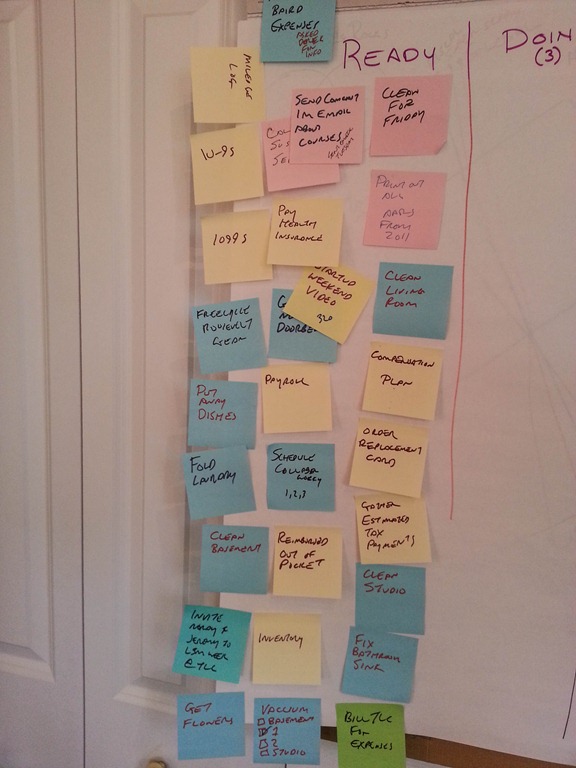
Does this look familiar?

This is a problem, because an disorderly and frightening READY column is, in and of itself, a form of work-in-progress. Even if you are limiting your WIP, looking at that huge string of demanding post-its weighs us down just looking at it.

When we limit our personal Work-in-progress, our ultimate goal is to provide a calm, stable, and flowing state of work. We want a system that allows us to focus on the task and hand and complete quality work.

Having a huge, daunting backlog undermines our quality and destroys our focus.

What we need to do is focus this work. We can start by gathering some of those tasks together into groups and taking a look at what they really are.

We can do this by doing a quick exercise called Affinity Mapping.

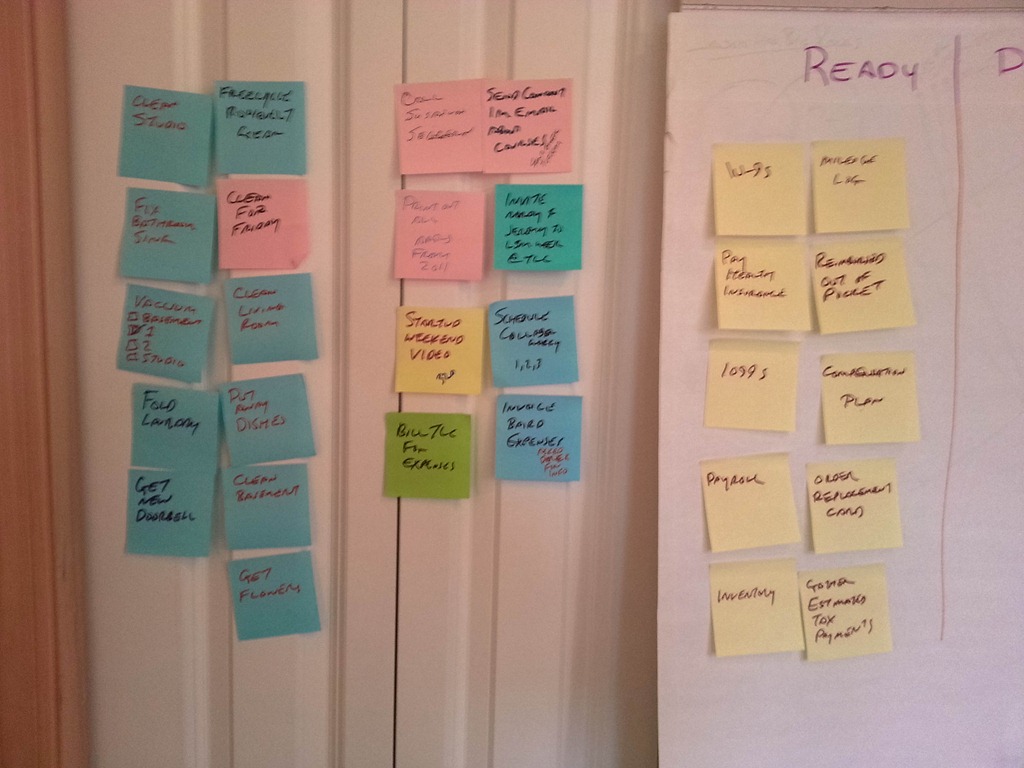
We take the bulk of the stickies that we have in our read column and we sort them into groups that feel right. These might be easy, medium, and hard. These might be project 1, project 2, project 3. There might be two categories or there might be ten.

Lightroom-3

In the end, however, you’ll have your pile of pain sorted into easy-to-digest groups.

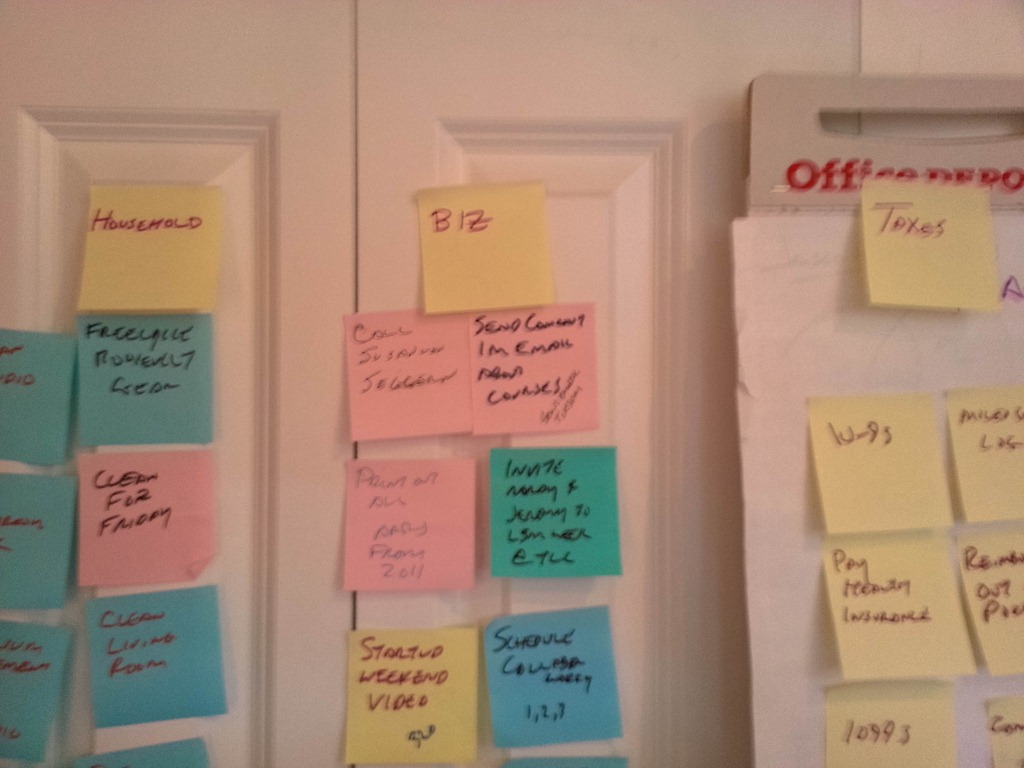
Then, you can name your groups. In this case they are “Household Projects”, “Office Work”, and “End-of-Year Taxes”.

Now we have a little more clarity over what is in our backlog. The previously undifferentiated jumble is a bit more orderly. We can now pull work knowing a few new things:

  1. What projects we are really working on

  2. What we are completing (and what we are procrastinating on).

  3. What work we need to schedule for and what work can simply flow

  4. Which tickets are still scary

headings with backlog

Perhaps the most important thing is that the cognitive load of the original backlog was enormous. That added to our work-in-progress. The cognitive load of this new organized backlog (no matter how you feel about doing your taxes or cleaning) is much less. Your brain is spending less time and energy trying to make sense of what’s coming up.

" "