" "

What is the Personal in Personal Kanban?

What is Personal?

The “Personal” in Personal Kanban can mean many things.Capital P Personal – This is the personal nature of you. Your work, your decisions, your professionalism, your problem solving, your improvement, your life at home, your life period. Since we rarely act fully alone, no Personal Kanban is ever going to only relate to us as individuals and it is rarely only going to be used by us. However, we will want to track those things that are us. We can’t hide them or hide from them. If we do, others will always be giving us work without knowing what we can really do for them.Of Value to People – You create things every day. As a 21st century worker, we are always building things, combining information, processing, and evolving. Tracking only products in our Personal Kanban removes the human element. How much work are you doing? Are you or your teammates overloaded? Can you help each other? Can work be more enjoyable? The human (you) is the creator.(Inter)Personal -  Who do you interact with at work? Who are your clients? How do your clients and coworkers know what you are doing and when? How do you know when others are in need of your help? How do they know when you are? Life is relationships. Making it clear who is doing what and how loaded they are helps us all. Most of the discomfort between people comes from misunderstanding what is going on in their lives. The more overloaded we are, the less tolerant we are of inconveniences caused by our teammates. We blame them. They become hurt and blame us. Things spiral downwards. The (Inter)Personal nature of Personal Kanban keeps everyone apprised of what’s going on and why.If your kanban isn’t taking these into account, you just may have an impersonal Kanban … and who wants that? :-)

Five Years of Personal Kanban | Travel, Exploration, and Learning

It's been 5 wonderful years since Tonianne and I released the Personal Kanban book.The people we've met, the problems we've helped solve, the boards we've seen have been amazing. Every problem we've seen has had unique bits and predictable bits. What's been fun is learning what are those really predictable parts, what parts seem predictable, and what is novel.We've learned a lot since we started Modus Cooperandi and since we launched the book. Why we make certain decisions, why we focus on some things and not others, why we are so easily distracted, what systems actually help us create quality work and finish.This year we've launched a new webinar series and an online Personal Kanban class that extends what was in the book.  Why an online class and not another book? Because we've found that human contact and short bursts of information mean a lot when adults are learning.We hope to see you there and thank you for five years of Personal Kanban awesome!

Little Cues

Little Cues Help Communication

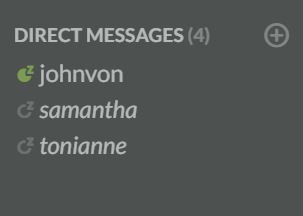
Little cues in the tools we use can be very helpful in helping us communicate effectively. The shot to the right is from Slack, a tool that helps us at Modus Institute communicate, collaborate, and stay informed.We use it not only to chat with each other, but also to get status from our Personal Kanbans in LeanKit and Trello, as well as broadcast activities of our students at Modusinstitute.com. This means that no matter where we are, we have both our Personal Kanban and the information in Slack keeping us up to date.But we do work all over the world and sometimes if I'm in London and John is in Los Angeles, it is hard for me to know exactly what time it is for him. Even though he's online right now, the slack channel is telling me that for John, Toni, and Sam it is outside normal working hours. This helps by letting me know that John might not reply right away or at all, even though is shows him online (it's green).This helps me respect John's time and better plan for what I can do right now. If I need any of the three of them to complete a task, I should wait to pull it when they are truly available to collaborate.

Complete Meaningful Tasks

The MusingOur work should provide value to someone or something, otherwise why do it?When we build our Personal Kanban, we are building a board that drives us toward completing our work. But is that work worth doing?val·uenoun

  1. the regard that something is held to deserve; the importance, worth, or usefulness of something.

  2. person's principles or standards of behavior; one's judgment of what is important in life.

verb

  1. estimate the monetary worth of (something).

  2. consider (someone or something) to be important or beneficial; have a high opinion of.

Application

Tasks

Visualizing a goal

Visualizing Clear Goals

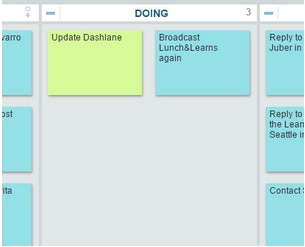
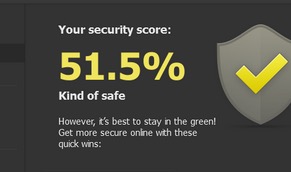
The words we use to describe value (regard, importance, usefulness, standards, beneficial) indicate that value is not merely based on cash, but also on how it makes us feel, how we respond to it.  So when we say we want to understand the value of our work it means a great deal to us, to our colleagues, to our companies, and to society. You figure out in your own Ayn Rand to Che Guevara scale where your own value equilibrium lies.But … understand it and work towards it.The Practical ApplicationLet’s take a look at a simple case to see what this means practically.Over the Christmas break I quickly assessed how secure my internet holdings were. The answer was rather frightening. I, like most people, was extremely susceptible to hackers getting ahold of emails and passwords and running amok with my accounts.I downloaded Dashlane and began working with it to set strong and constantly changing passwords for all my accounts.My first ticket read “Update Dashlane”. I knew what Dashlane was and why I was updating it, so that seemed to make sense and tell me why I was doing the work.The problem: I had no idea what updating Dashlane meant to me. I knew I wanted to get done by the end of the week, but updating all your passwords and making sure you are letting others impacted by those changes know what’s changed leaves “Update Dashlane” as an open ended task.

I need a Victory Condition.So I created this ticket. “Update five sites in Dashlane.” Okay, great. That had a clear victory condition.The problem: I had no idea what I was working toward or where I was in the process. Or what I was working toward. What was my goal? I wanted to be more secure. Dashlane gives me a metric about security.I wanted to become more secure, not just update sites. Who cares if I update 100 sites and am still dismally unsecure?So, I changed the ticket yet again. This time to give myself a specific goal that was measured by Dashlane. I want to get to 80% by Friday. So 50% today, 60% tomorrow, 70% Thursday and 80% Friday. Four tickets, clear goal, all with demonstrated value.This was today’s card, it’s surrounded by other “Dones” which say what I am doing and the value provided. Note the card next to the 50% card tells me not just to reply to my colleague in Oregon, but also what resolution to get out of that reply.Sage AdviceWhen you create a card, ask yourself what the goal or the value of that work is. That not only gives you the task to complete, but the way to know when you have completed it. Quality and value are hard to determine without a definition. Let yourself know when you’ve achieved victory.And do yourself a favor … if you can’t come up with a goal or a value statement for your work, strongly question why you are doing it in the first place.

Visualize Your Past

Visualization Retrospective

Happening right now

It’s New Years again and time to take stock of things in our lives. As we know, the two rules of Personal Kanban are to Visualize Your Work and Limit Your Work-In-Progress (WIP).One of the most important factors in limiting or controlling our WIP is understanding our work - this includes appreciating our work, when we’ve completed it, and what we did to complete it.2014 has been a pretty tough year for me personally and when I look back on the last 12 months I tend to view it in my own pessimism bias.But Timehop, an app I have on my Galaxy Tab, keeps thwarting my pessimism and it’s doing it by confronting me with facts. Simply confronting me with what actually happened one, two, three, four, and five years ago. Timehop is an automated long-range Retrospective.Right now it is nearly exactly one year since I stood in my office in Seattle and drew the image above.  See? That’s right now.If you would have asked me, I would have said that was at least two years ago. It’s significant because it means that those drawings led to the Modus Cooperandi Problem Solving System, about a dozen Lunch&Learns where we taught customers the process, and a great partnership with Riot Games to create a complete version of it.When we have sour notes, we tend to allow those notes to overwhelm our interpretation of the entire song. We can have one long very pleasant event and then something happens at the end and we say, “That just ruined the whole thing for me.” I was allowing this last year to be painted with a broad brush because I was focused on a few particularly painful episodes.Timehop, here, served as my visual control, sampling my social media past and showing me what I have actually been doing. What other visual controls are you employing beyond your Personal Kanban to keep track of the good work you’ve done?

" "