Plan
The best way to approach short term planning is by asking the following two questions:
This is especially important when you’re planning your tasks for the day. The goal is to plan your time and what you can tackle. The idea is to avoid getting in situations where you let down yourself or others. So, it’s important to commit with cards you know you can finish.
Also, we don’t live in a bubble. Interruptions will happen and we have to make space for them as well. Don’t plan to be at full capacity at all times. Leave room for unexpected calls, emails, or blockages.
Produce
The ultimate goal is to complete work, right? In order to do that you need to answer these questions:
The goal here isn’t to start a bunch of things only to not finish them. We don’t want to pull worк that will just sit there and not get done. We need to understand our impediments. It’s not just urgency that drives us to pull cards in progress, it’s what we can realistically finish.
Prospect
When we get a task that we don’t really understand, we need to consider our options. What can you do to understand the context before acting? Start with these questions:
The goal is to create new options not following a backlog blindly. You should understand the actual context of your work, not just do what somebody else told you to do. Ask yourself: are the things you do right now really important and do they solve a problem? If not, create new options. You can't manage your time well if you’re doing the wrong work.
Plow
There are days that turn into disasters. This one is exactly for intense situations. No matter how well we tend our Personal Kanban, sometimes a crisis arises or we work ourselves into a looming deadline and now we have to deliver. Ask yourself the following:
Essentially, people can’t do quality work under pressure. That is why you need to focus on what you can actually get done that has value. After all, the goal isn’t to be perfect, it’s to survive the crisis. You also want to be able to delegate some tasks. Focus on what’s difficult and your expertise is vital. Simple tasks can be handled by someone else from the team.
Ponder
This allows you to think and solve. Let’s imagine you have a task to do. You can remember how you’ve done it before, or find a new approach. Often, we learn something and we forget what our ways were before. So, it’s best to answer these two questions:
Take notes on each card on the board even if it seems obvious. Then, take time to thoughtfully solve things, not just rush to get it done. The goal isn’t to finish task after task like robots, the goal is to learn.
Pigeonhole
If we come to work and tackle a bunch of unrelated tasks from different projects, we will be exhausted by noon because we’re context switching so much. That’s why these questions are critical:
Your brain processes information in chunks for around 20 minutes. So the Pomodoro technique is great to help you concentrate, ignore interruptions, and just finish what you need to. In addition, group similar tasks on the personal Kanban board and do them one after another. This way your focus and memory aren’t all over the place. The goal here is for your brain to survive the day, not just do important things.
How to Reach Your Potential with Personal Kanban
Despite our best efforts, life is hectic sometimes. People, obligations, deadlines, and even recreational activities all fight for our attention. The stress of juggling several objectives doesn’t sit well with the human brain. Personal Kanban can help with this. Let's see how you can unlock your hidden potential.
Visualize
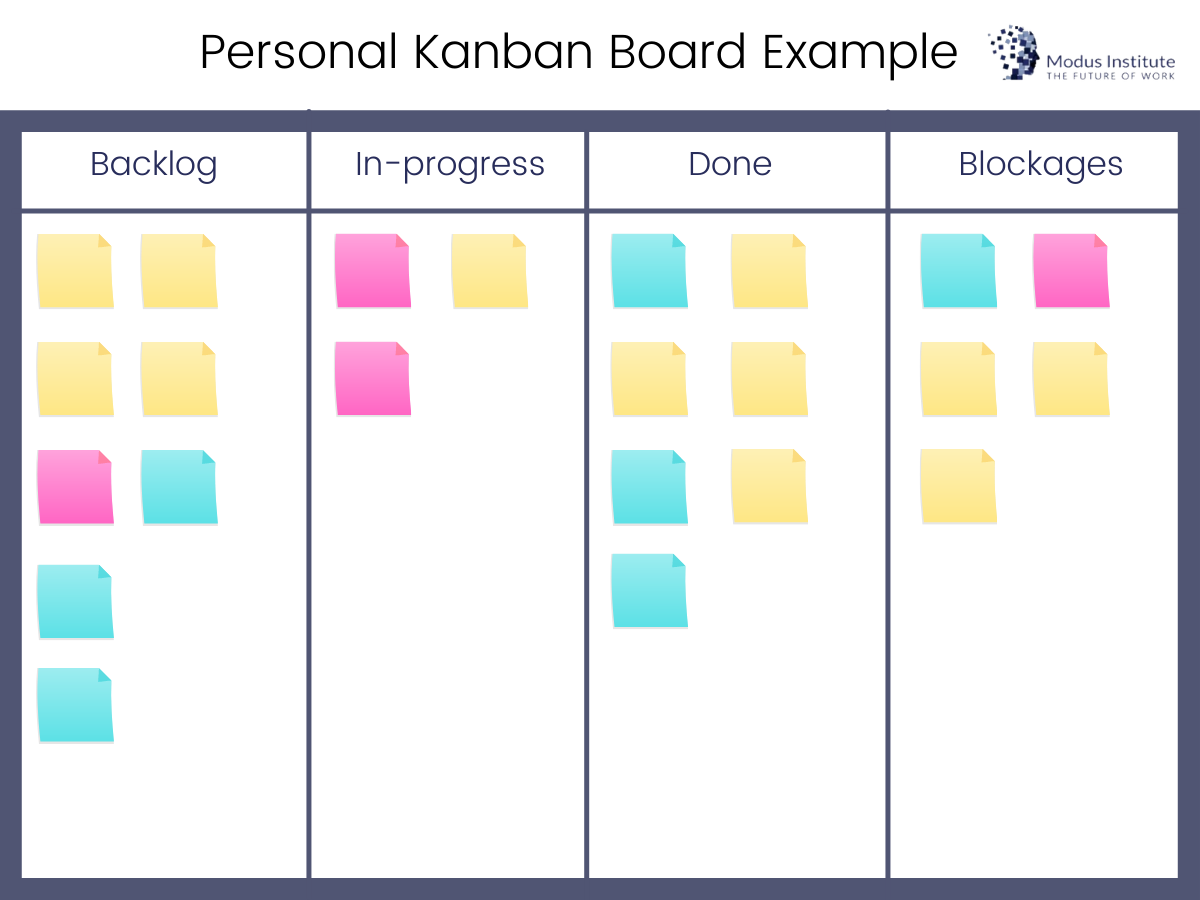
As we already know, the most important part of Personal Kanban is visualization. First, you want to choose a tool or app to create your board. Get everything out on the cards, even the little tasks. Make sure all the information you need is visible and clear. You can step it up by adding further details, labels, images, checklists, etc. to each card. By doing this you can prioritize more efficiently.
Make Priorities
Prioritization is confusing to many of us. There are so many things that seem important and getting all of them done feels chaotic and even impossible. A good starting point is to ask yourself “Which tasks will cause me the most trouble if I don’t complete them?” When you identify a few of these items, tackle them first.
Start Pulling Cards into Your “Doing” Column
Now that you’ve put the focus on the important tasks, it’s time to actually do some work. Pulling cards is exciting but don’t have too much fun with it. It’s recommended to establish healthy boundaries on how much you can take.
One of the reasons we’re unable to unlock our potential is having too much on our plate. We rarely manage to finish tasks. After a while they get tedious and we decide to switch to something else. This is a vicious never-ending cycle.
Another great perk of using a method like Personal Kanban is the WIP limits. This means, setting a limit of cards you can have “In progress”. Usually, a healthy number is between one and three. Using this method you can concentrate on one task at a time before moving on to the next one. Your productivity increases and you’re actually saving valuable time because you know exactly what to do.
The stress of having to juggle multiple tasks at once is removed and you can rock and roll.
Reflect on What’s Done
Every once in a while, it’s essential to evaluate your progress in order to continuously improve. You can review what went well and what didn’t. Then, you’ll be able to make new adjustments. Don’t forget to be flexible. Personal Kanban is about adapting the system to your needs and making it work for you.
One For The Road
When you see your work, you’re able to understand so much more about it. All we need is to visualize, learn and improve. This will make us better individuals and better parts of a team, whether that team is your colleagues or family. We work best together. We just need to learn how to do that.
In our Platinum Subscription, we focus on Personal Kanban and go over how to get the most out of it. We teach you multiple ways to visualize, manage WIP limits, continuously improve, and even the psychology behind planning, work, and prioritization. Join us!