
Note: This story and more are in the Personal Kanban book. The longer article and video about this are on the Humane Work substack.
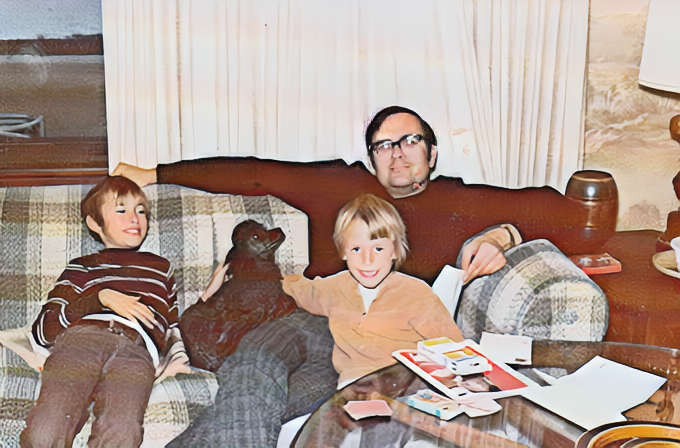
Me, Cookie, my brother Dave, and my Dad in … I think … 1977.
Cookie was an expert food catcher and could catch nearly anything short of a whole turkey if you tossed it to her. She was extremely productive, effective, and efficient. But she had a capacity. She had a system you could work with, or break.
Throw her one cocoa puff? Caught it. Perfect.
Throw two? Caught both. Still winning.
Throw three? She’d get two, one would drop. Starting to struggle, but mostly okay.
Throw four? She’d catch one. Miss three. Now she’s frustrated.
Throw five? She might catch one, but might.
Throw a huge handful at her? Complete meltdown. She’d catch nothing, just wave her head like a Muppet, jaw wide open, overwhelmed while cocoa puffs bounced off her nose, forehead, or fly by. Then she’d make an annoyed snarf-sound and eat them off the floor.
This is you. This is all of us. We’re Cookie with too many cocoa puffs.s.
Cookie had a WIP limit of three.
So do you.
We Need Triggers and Gates
You are more interested in cocoa puffs than serving sizes. Cookie never said, “Look, if you keep throwing too much at me, I’m just going to leave.” (Well, actually she would do that after a while, she was really good at becoming annoyed…and she would sulk!)
Anyway, you are able to know you are becoming overloaded, just that you have become overloaded. And if you have become, it’s too late. So… we need triggers and gates.
A Trigger is something that says “You Are Going Too Fast.” It is a thing we create that tells us when we are exceeding our limits and about to hurt ourselves.
A Gate is a point in time or in your work flow where you stop and say, “Am I Going Too Fast?”
Right now, commitments come at you constantly:
"Can you do this?"
"Quick favor?"
"One more thing?"
Emails, messages, requests, emergencies
And you say yes. Because you don't want to disappoint anyone. Because you think you should be able to handle it. Because there's no system helping you evaluate whether you actually can.
So you take it all on. And you become Cookie with a handful of cocoa puffs…catching nothing, finishing nothing, disappointing everyone anyway.
Triggers (usually visual) say, whoa. Gates (usually time based) make you say, “whoa.”
Say Whoa, Not No
People think getting out of too much work is about "learning to say no." It's not.
You don't want to say no. Cookie didn't want fewer cocoa puffs. She wanted to catch them.
You want to say yes effectively.
"Yes, I can do this. Here's when I can realistically deliver it."
Saying no is rejection, people don’t like that. You want to use your kanban (triggers) and your daily huddles or other sessions (Gates) to make sure you aren’t overloaded, that the team’s expectations are at least similar, and that people know when you’ll need them or be available.
Cookie Based Trust Building
Cookie limiting herself (limiting us) to 3 cocoa puffs? Catches them all. Builds trust. Gets more cocoa puffs over time.
Cookie trying to catch a handful? Catches nothing. Loses trust. People keep throwing more trying to figure out why she "stopped performing."
Limited WIP = higher delivery = more trust = more opportunity.
Unlimited WIP = catching nothing = disappointing everyone = burnout.
This is your career. Your reputation. Your sanity.
Your Overload Needs Attention
When you're running above capacity, it doesn't feel like "catching nothing." It feels like:
Constantly working (email at 10pm)
Always stressed (something's always slipping)
Lower quality (too fragmented to do good work)
Inability to focus (constant context-switching)
Guilt (letting people down despite working constantly)
This feels like your failure. Like you should be able to handle this.
It's not you. It's the system.
You don't have a gate. No way to evaluate incoming work against actual capacity. Everything gets added. Everything suffers.
Build Your Trigger System
Personal Kanban isn't about tracking work. It's about knowing what to do about your work.
Step 1: See your current load
Write down everything you're doing. Put it in three columns:
OPTIONS (committed but not started)
DOING (actively working on)
DONE (finished)
Count what's in DOING. That's your current WIP.
Most people discover they're juggling 10-18 things when they thought it was 2-3.
Step 2: Set a real limit
Can you actually juggle 5 things? Or are you Cookie with too many cocoa puffs?
Pick an honest number. Maybe 2. Maybe 4. Something real.
Step 3: Manage the incoming
Old way: "Yeah, yeah, sure" (adds to pile immediately)
New way: "I'd love to. I'm working on X, Y, and Z. You'd be #4. I can start [date] and finish by [date]. Does that work?"
Real expectations. Real capacity. Everyone wins.
Step 4: Watch what happens
You finish things (momentum builds)
Quality improves (you're not fragmented)
People trust you (you deliver what you promise)
Stress decreases (you're not drowning)
You get MORE opportunities (trust compounds)
You're not doing less. You're accomplishing more because what you do is actually complete.
Permission Granted
You're allowed to have limits. You're allowed to have realistic capacity. You're allowed to say yes in a way you can actually deliver.
Cookie knew this. She had a WIP limit of three. Anything above that, she'd make the snarf-sound and clean up the mess.
You can do the same with your commitments—but you have to build the system yourself. Your cocoa puffs won't self-regulate.
Want to go deeper?
Subscribe to the Substack for more like this
Read Personal Kanban for the complete system
Take the Personal Kanban class to build your system with support
Join the webinar or the workshop to learn WIP limits at scale
Because unlimited cocoa puffs are a choice. And a bad one.
Choose better.