" "

GTD & Kanban: Series Overview

For a long time I have been a Getting Things Done (GTD) advocate in both my personal and professional life, starting from the basics and working my way up to a full blown implementation in various paper and electronic forms over the years.  GTD has been a huge help, yet I have always felt there is something missing in my implementation that helps me better manage prioritisation and focus around work, which led me to explore the use of Kanban as a form of GTD list.  Over a series of posts I intend to explore a number of aspects of GTD and how I have applied Kanban to limit my work in progress, adopt a pull based system, and overall, increase the flow of completed actions in my key areas of focus in life and work:

  1. GTD & Kanban: Similarities, Differences & Synergies Between The Two

  2. GTD & Kanban: Managing The Relationship Between Someday/Maybe & Active Projects

  3. GTD & Kanban: Work In Progress Limiting GTD Next Actions Within A Context

  4. GTD & Kanban: Inboxes, Lists, Calendars, Kanbans & Mind Maps Working Together In Harmony

  5. GTD & Kanban: An Example Of It All Coming Together

Getting Things Done Workflow

I am getting value from the changes I have made to how I work, yet still experimenting to improve.  Any suggestions or questions, please do comment or email in the interest of moving all of our understanding forward.

The Time Capsule Personal Kanban in Detail

image

whiteboards 051

Timecapsule

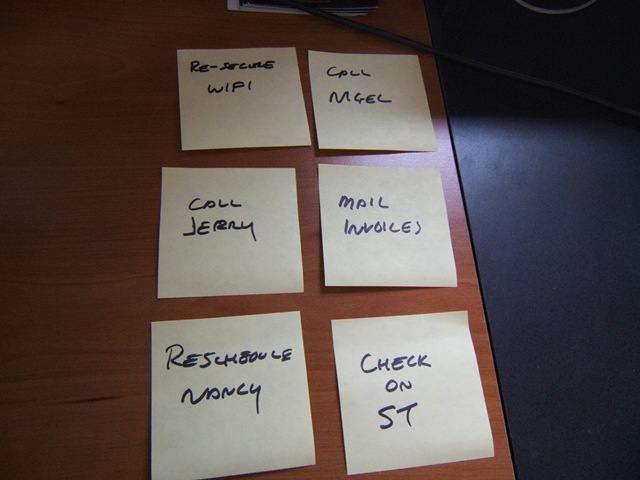
Individual work is a real PITA. Over time, we invariably amass a lot of small tasks that are necessary but not urgent.  We end up with a number of things that aren’t high priorities but, the longer we put them off the more they will eventually eat up a lot of our time.  Such tasks are waste-in-waiting. They are the five minute nuisances you never got to, that in the end will cost you 10 minutes to apologize for not doing.The Time Capsule approach is to approach the kanban, notice that there are a multitude of little tasks, pull them all off the board, go to your desk, and start doing them until they’re done or your day is over.  And if you have 8 hours of small tasks, well, that’s a learning event for you.Move them across the desk through 3 stations. Backlog, In Process, and Done.This is now a speed tasking exercise. Don’t spend a lot of time prioritizing, you already know your backlog.  Prioritize on-the-fly. You will most likely game the system by doing some or all of the following:Sweat the small stuff: Very small tasks can be done very quickly.  Doing 20, five minute tasks quickly fills up the “done” column with a satisfying number of post-its.Launch all missiles: Tasks that require a quick email are easy to get into the “active” column. Today, completion is the goal. Having many active tasks is okay, so long as you know it’s moving toward completion. Remember: You are the only judge of the effectiveness of the time capsule.Play for Pay: You want to move those tickets to the done side of your desk. Screw convention, screw the Agilistas, screw the WIP monsters – you are only interested in those tickets moving to the right.Focus after Fast: Tasks that require a bit of your time and focus should be done after the fast things and after the missiles are launched.  While those emails are out-reaping rewards, you can work on the more delicate tasks.Rememberthis is a strategy for coping with clutter in your backlog. The mess will happen from time to time because personal tasks are unruly. If you find yourself de-cluttering more than once a month, then it’s likely you have too many commitments, or aren’t prioritizing well.

The Throughput Approach to Personal Kanban in Detail

image

In the previous posts we looked at the Time Capsule workaround to having a backlog cluttered with small tasks of varying importance.  This throughput approach might help mitigate the need to use that approach.Kanban tends to have swim lanes – or lanes through which value flows. In your personal kanban, it is possible to have a WIP that takes into account varying sizes of tasks?Let’s say you set a WIP of 5 items: two of these can be large tasks, while three are small.In the throughput approach, the small items are placed daily, and addressed first. The larger items can be handled throughout the day, and will remain on the board as long as it takes to remove them.The goal here is to make sure that at least a minimum amount of small tasks are done regularly, to help avoid the pain of a marathon Time Capsule day.When I’ve done this, I’ve tried to take into account that there will be “flares” – tasks that arise and are completed during the course of a day that don’t make it onto the board. Say your lawyer calls and asks you to track down an email and send it to her. That takes you maybe 15 minutes, but it never makes it onto the board.This is why I don’t move completed tasks off a throughput board until the end of the day.  If you keep moving them and placing new tasks up there, you really haven’t limited your WIP.  You aren’t maximizing for throughput in the number of cards you are moving with the throughput approach, as much as you are maximizing your productivity.With this approach, you will get a number of small tasks done but also devote time to the larger tasks and, hopefully, have the bandwidth to deal with flares.

" "