" "

Time To Completion

expand to completion

Parkinson’s law is:

“Work expands to as to fill the time available for its completion.”

And people misconstrue it all the time.Logic plays funny tricks on our brains sometime. People somehow believe that Parkinson’s Law warns us that work will expand (or contract) to fill the time to the deadline.  So if I give you a project that will take you two weeks to do, and give you an eight week deadline, you will not complete it for eight weeks.That might be true. But it is also true that if I give you eight weeks’ work and a two-week deadline, you will complete it in two weeks.You’ll just do a really crappy job.The eight week deadline, on the other hand, gives me the option of prioritizing other work first until I need to get to your project.So, the problem here is not the gaseous nature of work – it’s that deadlines themselves are a major element for prioritization.In other words, work is a game and a major goal of the game is to get work done on-time.Sounds good.But … what if there was a different kind of game of work? What if the game of work was to continuously improve the quality and rate of delivery of your work? The game becomes ways to discover how you can work most effectively, most innovatively. The game stops being how close to an arbitrary deadline can you complete something.Then some interesting things happen.First, work becomes more predictable. You learn the rate at which you truly complete tasks. You can schedule better, promise better. You can complete better.Second, the creation of value becomes more realistically defined. Before, we considered the elements of work to be whatever was included in the contract we were satisfying. When we focus on quality, we find that tasks like making our workspace comfortable, our tools up-to-date, and our minds rested and ready-to-think are of equal weight. We find that rushing toward deadlines decreases quality and taking a few 5 minute breaks throughout the day increases quality. We find that while we can rush work out, that work tends to come back. We start to question if meeting a deadline and having revision requests come back was ever meeting the deadline to begin with.Third, you learn the real goal of estimating is to promise completion you can deliver with quality. Sometimes that takes longer, sometimes it does not. But the goal is quality, not speed.Fourth, communication with others increases. We quickly learn that working alone is working in peril. Our projects benefit from regular communication with our partners and clients. The more constant the collaboration, the more likely there will be success.Deadlines will always be a reality. We will never escape them. The goal here is not deny the existence or advocate for the abolishment of deadlines. What we want is to remove the stress and focus on the date and transfer that to the work itself. So if something is due on the 31st of December and we get it on the 1st of November, it’s finished when it is finished (November 15th) and does not wait until the deadline.So what Parkinson’s Law is really saying is that when you give people a deadline, that’s what they focus on. The game becomes the deadline. S

How To: Mapping Your Value Stream

When we build our kanban – whether for ourselves or for a team – we first need to build a value stream. A value stream is simply a list of the steps you take to create value. When we build a kanban, work flows along the value stream and this visualizes our flow.

Before We Begin

There are some quick tips about a value stream.

  1. It should match reality as closely as possible.

  2. It should be only as detailed as necessary to see and understand your work flow.

  3. As your understanding and contexts change, your value stream will also change.

These three tips are telling. Words like stream,flow, and value are all difficult to pin down. They change, they evolve. In tip number one, we want to match reality as closely as possible. We will never draw a map that perfectly matches our workflow forever.

The Beginning: Start with the Ends in Mind

What is it you are doing?In a meeting you may be:

  • fully discussing a topic

  • coming up with action items

  • planning a future set of tasks

At home you might be:

  • delegating chores

  • planning a vacation

  • building a deck

During the workday you might be:

  • creating documents

  • managing staff

  • building a section of an airplane

Kanban End States

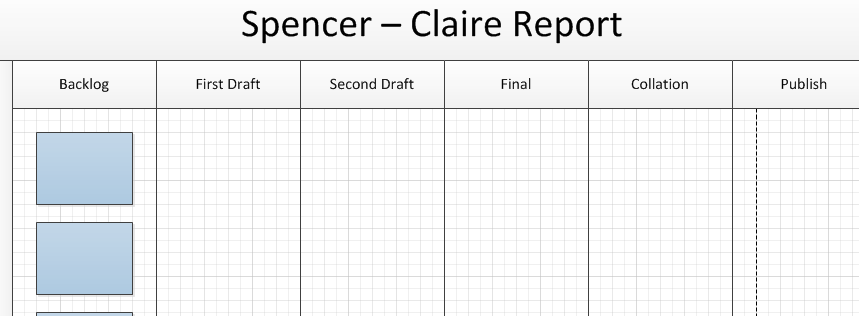
All nine of these might have very different end-states.So, if we are writing a report, the end state might be “publish.”The other end … your backlog … is usually called “Backlog” or “Ready”. That is where your value stream starts. So, for our publishing value stream, our backlog looks like this:

Next Step: Fill in the Blanks

Full Sample Value Stream

Between start and finish is creation. What steps do you take to create something? Working backwards from publish, we might have collation, before that is final, before that is second draft, and before that might be the first draft.This now starts to build a stream into which the specific sections of the report can flow. The report team can now track each section or chapter as it moves toward completion.

Important Bits to Remember

1. Your value stream is your best educated guess as to how your work is actually occurring.

For some teams, the value stream above will work nicely. They would likely have a report that is from a template and being updated or customized, because the value stream suggests a very orderly process with no surprises or constant re-writes. Other teams will have a value stream that visualizes more editing, document re-organization, or people involved.

2. Your value stream will change.

As mentioned above, your value stream will change as you better understand your work. You do not need to sit around for a month figuring out the perfect mapping of your value stream. Just get one up and start working. You can refine as you move along. Different phases of projects may require very different value streams. Do not allow yourself to fall into the trap of rigid process.

3. Your Value Stream is Fault Tolerant

If you move a stickie to the right and something changes to make you move it back to the left – this is not a problem. It is reality. You really did move a chapter from the first draft to the second draft, conditions changed and then it moved back to the first draft stage again.

This is a Personal Kanban 101 Post. See others in the series.

The Fallacy of Work / Life Balance

"Yes, well that's the fallacy of  work / life balance, isn't it? I mean...it's all life.”~ Lean Coffee participant, Sydney June 2011

The Fallacy of Work / Life Balance – Work life balance is more than personal and it is more than a choice. Whether we are employers or employees, we need to recognize and respect that “work” is part of life, not some opposing force we balance against life. Studies show that a strong collaborative corporate culture helps organizations weather the current economic downturn better. Pre-Lean Campconversations have drawn focus on this fallacy and toward respect in the workplace.Work / Life Balance. It's one of those concepts that just simply falls apart under the slightest scrutiny. At what point at work do we cease to be alive?I've just come off two weeks of working / living with AMP, a large financial services firm based in Sydney, Australia. This is a conservative company that is examining just what "conservative" actually means. The conclusions people were coming to were very exciting for me.Several people agreed that people at AMP bifurcated their lives. They would come to work, focus on work, and then leave at the end of the work day to return to their homes and presumably to their “lives.” Everyone agreed that this scenario was true…for other people. But not for themselves.As we spoke they realized that they were holding back at the office, because they assumed their co-workers were bifurcating their lives – but in reality very few people actually did so. Everyone was wanting work / life … balance?No.They like their work. They like their lives. There was no division. There was no opposing weight to balance.What they wanted was their home life to respect their work life and vice versa. They wanted these two elements of their lives to stop being a zero sum game. Some days home life happened during working hours. Some days it was the other way around.Some days …? Or maybe all days.Definitely all days.Life happens during life hours.Work / Life Balance is a fallacy. It's all living. Right now, you are living. Wherever you are reading this, you are living. And everywhere you go today, you'll be living there, too.Now, I ask you. In this moment, what is the thing of highest value you could be doing?Think about it.Then do it.Image by Tonianne DeMaria Barry

Why I’m Excited About Lean Camp

LEAN_Camp-WebBanner

JUST LET ME LEARN!Hallway conversations are almost always what people peg as their favorite parts of conferences. Yet conferences rarely provide ample space and time for people to have these conversations. When we actually converse with our peers or with the speakers, we learn more and, more importantly, we retain more. We are actively engaged in the learning, rather than just being spoken to.When Jeremy Lightsmith and I sat down to plan a conference, we didn't spend any time on the format at all. We both knew we wanted conversation, learning, and community over talking heads, big names, and locations. The Open Space model was a logical fit for the Lean Camp we wanted to create.I am very excited about Seattle Lean Camp because it embodies some central ideas.

  1. The Future of Work – In the last several years, science has uncovered some startling new truths about how we learn, how we collaborate, how we are motivated, and why we work. Through the intersection of Lean techniques, neurophysiology, and social economics, we are learning that humans respond better to respect than remuneration. Additionally, changes in the way we communicate and the cost of information storage and dissemination has had profound impacts on the workplace. As the workplace becomes more social and more humane, it also is becoming more innovative and less reliant on traditional top-down management.

  2. Learning and Creation – Lean Camp is about value creation from the outset. While many attendees have been headliners at other conferences, at Lean Camp they are there to share their wisdom and learn from others – just like everyone else. The potential topics at Lean Camp are as varied as the participants. At Lean Camp we want to find new solutions to old problems in a dynamic, charged environment.

  3. Cross-pollination - Conferences that are for one industry and attended by only people in that industry miss the opportunity to really learn from others. At Lean Camp, we already have attendees representing software design, government, manufacturing, medicine, academia, graphic design, engineering, and more.

  4. Gender Balance – I have been pleasantly surprised to see something very near gender parity in the people signing up for Lean Camp. After years of putting on conferences in both software development and engineering, this is certainly a first for me. I'm looking forward to asking attendees what drew them to Lean Camp to find out why we are enjoying such remarkable attendance

  5. The Fallacy of Work / Life Balance – Work life balance is more than personal and it is more than a choice. Whether we are employers or employees, we need to recognize and respect that “work” is part of life, not some opposing force we balance with life. Studies already show that companies with a strongly collaborative corporate culture have weathered the current economic downturn better. Pre-Lean Camp conversations have drawn focus on this fallacy and toward respect in the workplace.

  6. Low Inventory – W. Edwards Deming warned us of keeping inventory in our companies decades ago. Inventory are those things that we create, believing they are value, but then need to maintain and mange those things. For manufacturing, inventory might be the parts you need to make your product, or the products themselves. We want to make just enough and at the right time. For a conference, inventory takes the shape of expensive speakers, venues, large elaborate dinners, and many sponsors with special needs. In creating Lean Camp, we've specifically kept our inventory low. Even though everyone who comes to Lean Camp will receive a free T-Shirt and free food from two of Seattle's premier gourmet food trucks, and will enjoy spending time at the University of Washington's beautiful Center for Urban Horticulture, Lean Camp is only $50.

  7. Great Food – Those who know me, know when I’m around food can’t be far away. This year at Lean Camp we have two of Seattle’s premiere gourmet food trucks providing free lunches to all attendees. On Saturday we have Where Ya At Matt? with his awesome Cajun selection. On Sunday we have Pai’s with his highly acclaimed Hawai’ian and Thai works of art.

  8. Clothing – Nordstrom’s Innovation Lab is making sure that everyone who attends also leaves warmer and happier with a beautiful Seattle Lean Camp T-Shirt.

  9. Value Cascade – So what we have here is a beautiful setting, smart people, an open format in which to think, great food, and a stylin’ t-shirt. All for $50.

This year in Long Beach, California, the LSSC put on a conference that explored Lean and kanban in software development. We had a wonderful turnout and fantastic conversations that resulted. With Lean Camp, we are hoping to take those conversations and combine them with creative minds from other industries. We want to explore the personal, the teams, the governmental, and the corporate views of these emerging ideas.I am excited about Lean Camp's potential to unlock new ways of thinking about work, about life, and about the future. More than anything, I’m excited to see what community grows from this. We’ve built a strong community of practice for kanban and lean with Seattle Lean Coffee – what comes next?Thank you for all who have signed up thus far and looking forward to seeing the rest of you there as well.  (And I’m looking forward to the food ….)

You Cannot Yell at a Board with Stickies on It

Arguments are not productive

It is now two weeks before your major deadline.For the last four weeks, you’ve barely slept a wink. You know your team is behind. They know they’re behind. But the deadline is firm. Your team promises you - nay, vows to you it will be done on schedule. You, in turn, promise the client who in turn, promises their bosses. Their bosses are promising their clients …Everything is riding on this release.You close your office door and look at the remaining unfinished requirements. You begin to add up the time you think it will take to complete.Nope. Not even close.You go to your team and tell them what you’ve found. They get upset and begin yelling about how meetings like this are what slows them down. "If only we could just do our work!"You yell back. "We’re too far behind! We’ll never finish!"The situation is as predictable as it is unnecessary.What we have here is not necessarily a failure to communicate but instead, a confluence of avoidance behaviors exacerbated by a lack of a visual control.Huh?Okay, it’s kind of convoluted, so let’s bullet it out:

  • No one ever had a device that could show - visually - the state of the project and the context in which decisions were made;

  • Since no one could see what was happening, they relied on reports that lagged decision-making and often told an incomplete story;

  • Incomplete elements were then left to be discussed in meetings, which were often adversarial, conducted hastily, and poorly documented;

  • People were then required to rely on individual memory and interpretation of events;

  • When these memories diverged, they became angry when their interpretations were perceived as being different from reality;

  • Divergence from reality then became a point of conflict;

  • The points of conflict were argued about;

  • Those in positions of power declared their faulty memory to be the standard, and those who were not in agreement were treated like failures;

  • Blame for divergence from schedule or delivery promises was then directed towards "the failures,” and

  • Everyone loses: product is late, the workforce is demoralized, management is angry, money is lost, quality is deprecated.

Visualizing work on a kanban can help depersonalize arguments

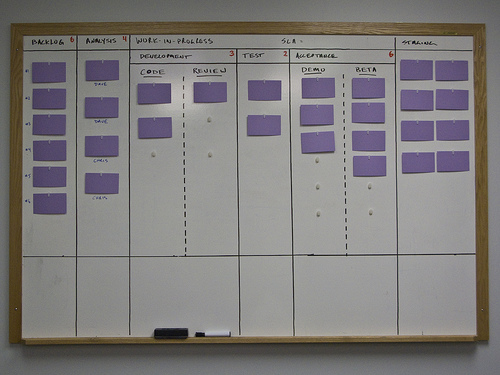
Short form: No one had a status board to point to and say Look! You see? That is what is going on! Regardless of which side of the management / worker or client / consultant fence you might sit, reality is much easier to address when you can actually see it.A kanban (see image) is a status board. It shows who is working on what, which tasks come next for each group to pull from, and the rate at which work flows through the system. In addition to being a powerful project management tool, the kanban also decreases the animosity frustrating work can generate.You see, the issues that slow production are rarely sabotage, subterfuge, or incompetence. Instead, they're more likely due to lack of necessary information, conflicting expectations, hidden policies, and the intricacies of knowledge work. Seldom is it personal. But we personalize it nevertheless, because it’s all we have. We can’t make our tools work faster, so we yell at our people.A visual control gives the team a gift: a disinterested third party that merely reports reality. The kanban becomes an interactive arbitrator. Our work is no longer the responsibility of one person. On the board it becomes an object (the sticky note) that everyone involved wants to move. The inability to move a sticky note becomes a shared responsibility, and is no longer personified by the last person holding the task.In this way, the board depersonalizes work. Now, rather than yelling at each other, you can get together and yell at the stickies on the board.Wait, that sounds pretty stupid.If yelling at a sticky note seems stupid, why did it ever seem like a good idea to yell at your co-workers / employees / consultants? Did you think abusing them was going to spur them to greatness?With the kanban, we can look at the work as it happens, discuss changes that need to be made, and work towards our release date with realistic expectations.Image “Argument” by Fred Camino Image of kanban by David Laribee

" "