" "

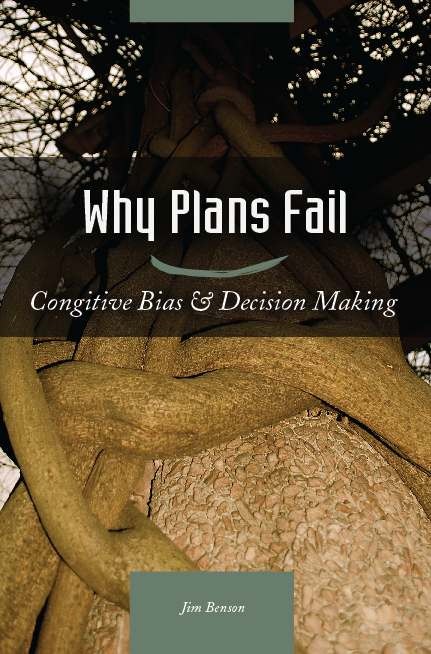
Just Released: Why Plans Fail: Cognitive Bias, Decision Making, and Your Business.

Cog Bias book_cover_artboard EDITABLE

A few months ago, I wrote a series of posts in this blog about cognitive bias. Those became the pre-writing for this short ebook: Why Plans Fail.It’s $2.99, or free if you have Amazon Prime.This is the first in our new MemeMachine Series, which will be little eBooks like this that introduce a topic and begin discussions.Here’s the writeup for it from Amazon:Business runs on decisions. Recently, we've discovered that people aren't the great decision makers we thought they were.Business relies on estimates, plans, and projections - and we all know how accurate they tend to be. Careers are made, careers are broken based on accurate estimation and planning.But what if the successes and failures of these projects were not based on the prowess of those making the plans? What if success or failure were more often the result of a more complex set of events?Why Plans Fail directly addresses our ability of to plan, to forecast, and to make decisions.Written by Jim Benson, an urban planner, software developer, and business owner who has planned and built everything from small software projects, to houses, to urban freeway systems - Why Plans Fail is told by someone with much skin in the estimation and planning game.This short work is the first in the Modus Cooperandi Mememachine series - which looks specifically at underlying issues that directly impact the success of teams, companies, and individuals. The Mememachine series is meant to start conversations and advance discussion.

Pomodoro Daisuki–Session Based Personal Kanban and Pomodoro

Today I installed the Pomodoro Daisuki app in Chrome and thought I’d give a quick experience report.

So far today, Tonianne and I have run our entire workday using Pomodoro Daisuki. Yes, it has the usual Pomodoro functionality, but some extra benefits.

Daisuki Kanban Desktop

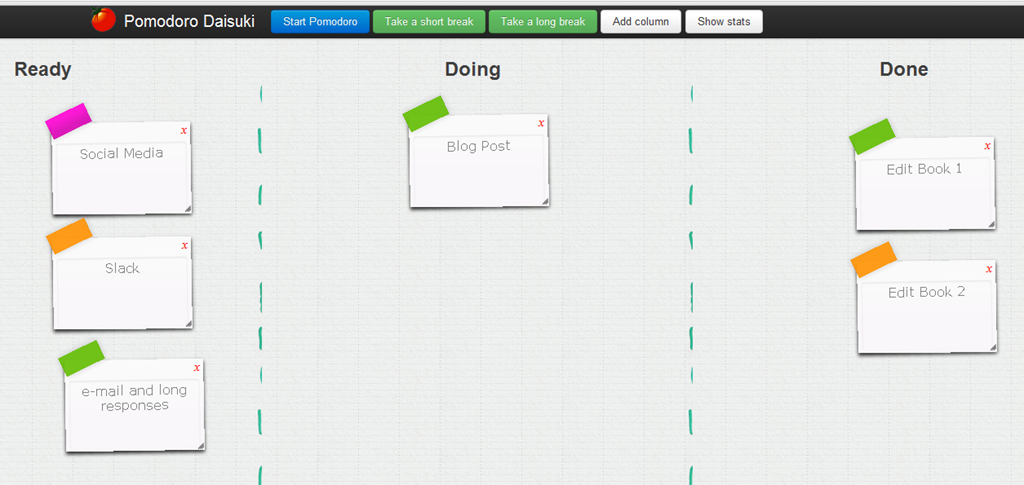
As you can see here, it comes with the fastest set up, easiest use cardwall tool I think I’ve ever seen. It enforces no WIP limits, but it does give you cards with colored “tape” to quickly set up and distinguish a variety of tasks.

Today, Tonianne and I are editing our next book about using Personal Kanban for Meetings. So we’ve already done a few Pomodoros in the book.

The nice thing here is that when you are in focused productivity mode, you don’t want to move around from application to application. With this, you can easily move the current work to done and then pull in the next task.

Pomodoro Daisuki top line

Pomodoros work as you would expect them. You hit the “Start” button and you get a 25 minute timer. A nice touch is that when you have break time, you can choose between a five and a fifteen minute respite.

The “Show Stats” button is compelling, but in the end it merely shows a count of the Pomodoros you’ve done so far. One can hope that it will have more features in the future.

daisuki resting

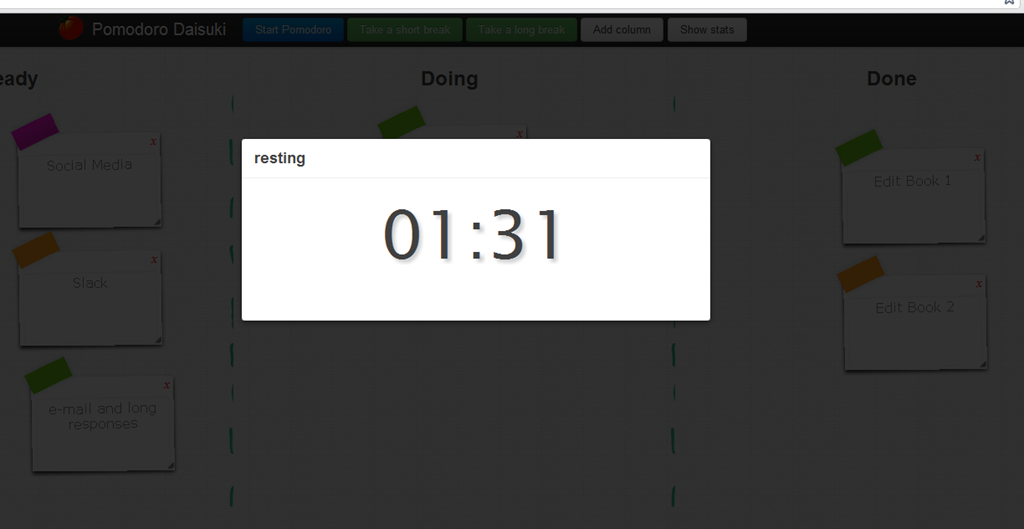
The only drawback is that once you start a Pomodoro or a break … you can’t stop! There is no “oops” button. So it treats the Pomodoro timebox a little too religiously. But, because these types of things tend to be fixed over time – I invite you to check the comments below to see if they do, indeed fix this.

How To: Setting Your Personal WIP Limit

There are only two rules in Personal Kanban.

Visualize Your Work

and

Limit Your Work in Progress

5761388593_81239d2b59

5761388593_81239d2b59.jpg

Since there are only two, it stands to reason that they are both important, vital even. When people see the value stream and the stickies, they feel they’ve received clear direction in setting up a Personal Kanban’s visualization. But how to come up with a number for your WIP limit?This is much easier to describe, but much harder to get the point across.

Start With 3

Why do we start with 3? 3 seems to be a good rule-of-thumb number. Three stickies are easy to see, easy to grasp. Three tasks will always be visible on a computer screen. They are easy to remember.Three is also a good balance number. Three is large enough to involve multiple stakeholders, but is small enough to manage. Three is a large enough number for other people to respect. One tasks becomes a zero-sum game where people can argue for hours about how you are using your time, three spreads out your work footprint to involve enough different things to diffuse such arguments.But three is not the only number. It’s just a handy, arbitrary one.

What We Want To Do Goal:

The goal in setting a WIP limit in Personal Kanban is to ensure that we do not take on more work than we can handle.Fact: People obsess over the WIP limit number because it is a number, which they take to be a rule. “If my WIP Limit is 3, I can never ever do more than 3 things.”That’s dangerous.Emergencies are EmergenciesIf you’re in the middle of a report, some accounting, and waiting for a team member to reply to an email - and your WIP limit is three – you have met your WIP Limit.If all that stuff is happening and you have a heart attack – you should deal with the heart attack even if it breaks your WIP. Don’t type faster to finish your report so you can pull the heart attack sticky!What we want for that WIP Limit to do is keep reminding us at all times that we are much more effective if we limit our work-in-progress. Emergencies will remain emergencies, they are real, we must attend to them.

Variation in our Capacity

Let’s look at Karl on three consecutive Mondays:Monday 1: Karl wakes up after a relaxing weekend. He eats a good breakfast. He is ready to attack the day. He arrives at work and finds his partner June equally ready. Together they feed off mutual creative energy and the day is off to an excited start.Monday 2: Karl wakes up after a stressful weekend. He slept little last night and is now hitting snooze over and over again. He misses breakfast and stumbles into the office late. He’s searching for enthusiasm.Monday 3: Karl wakes up, the weekend was fine, but he’s distracted – something doesn’t feel right. He gets to the office and he and June discuss this feeling he’s having. They spend the morning sipping coffee and talking until they finally figure out what is bothering Karl. It is an oversight they’ve had with their new product line. Luckily, it is something that they can work out. He and June spend the rest of the day coming up with solutions to the problem.In all these instances, Karl – the very same Karl – has a different capacity for new tasks each day. One Monday 1 it might be 3, on Monday 2 it might be2 and on Monday 3 it is probably just 1.Our WIP limits therefore can vary with our moods and our context.Don’t feel that your WIP limit is an advised speed at which you must travel at all times. If you are tired or need to focus, by all means, drop to a lower number of tasks.

Diet and WIP Limit

Studies have shown that throughout the day our glucose levels also fluctuate throughout the day. In the mid-morning and mid-afternoon, we are susceptible to dangerous drops in glucose that make our brains fuzzy, our decision-making questionable, and our productivity low.This is why smart businesses have fridges stocked with juices and bananas. (At Modus, Tonianne and I have apple breaks). This is also why energy drinks go flying off the shelves after lunch.Human beings are amazing machines, but we still need to be tended to. Our brains use a tremendous amount of our body’s energy – 20% of our total energy usage or more. The brain, after all, is running on electrical charges and the more you think the more you produce.If you let yourself get run down, your WIP will drop accordingly.The same is true for sleep and rest.

Conclusion: You Gotta Use Your Brain

You, whether you like it or not, are the one who has the information necessary to set a personal WIP limit. You are a system that is self-regulating. You choose when to rest, when to eat, when to drink water. You know what external pressures are resting upon you.Starting with 3 is always safe.But know your variation. Photo by Tonianne

Time To Completion

expand to completion

Parkinson’s law is:

“Work expands to as to fill the time available for its completion.”

And people misconstrue it all the time.Logic plays funny tricks on our brains sometime. People somehow believe that Parkinson’s Law warns us that work will expand (or contract) to fill the time to the deadline.  So if I give you a project that will take you two weeks to do, and give you an eight week deadline, you will not complete it for eight weeks.That might be true. But it is also true that if I give you eight weeks’ work and a two-week deadline, you will complete it in two weeks.You’ll just do a really crappy job.The eight week deadline, on the other hand, gives me the option of prioritizing other work first until I need to get to your project.So, the problem here is not the gaseous nature of work – it’s that deadlines themselves are a major element for prioritization.In other words, work is a game and a major goal of the game is to get work done on-time.Sounds good.But … what if there was a different kind of game of work? What if the game of work was to continuously improve the quality and rate of delivery of your work? The game becomes ways to discover how you can work most effectively, most innovatively. The game stops being how close to an arbitrary deadline can you complete something.Then some interesting things happen.First, work becomes more predictable. You learn the rate at which you truly complete tasks. You can schedule better, promise better. You can complete better.Second, the creation of value becomes more realistically defined. Before, we considered the elements of work to be whatever was included in the contract we were satisfying. When we focus on quality, we find that tasks like making our workspace comfortable, our tools up-to-date, and our minds rested and ready-to-think are of equal weight. We find that rushing toward deadlines decreases quality and taking a few 5 minute breaks throughout the day increases quality. We find that while we can rush work out, that work tends to come back. We start to question if meeting a deadline and having revision requests come back was ever meeting the deadline to begin with.Third, you learn the real goal of estimating is to promise completion you can deliver with quality. Sometimes that takes longer, sometimes it does not. But the goal is quality, not speed.Fourth, communication with others increases. We quickly learn that working alone is working in peril. Our projects benefit from regular communication with our partners and clients. The more constant the collaboration, the more likely there will be success.Deadlines will always be a reality. We will never escape them. The goal here is not deny the existence or advocate for the abolishment of deadlines. What we want is to remove the stress and focus on the date and transfer that to the work itself. So if something is due on the 31st of December and we get it on the 1st of November, it’s finished when it is finished (November 15th) and does not wait until the deadline.So what Parkinson’s Law is really saying is that when you give people a deadline, that’s what they focus on. The game becomes the deadline. S

How To: Mapping Your Value Stream

When we build our kanban – whether for ourselves or for a team – we first need to build a value stream. A value stream is simply a list of the steps you take to create value. When we build a kanban, work flows along the value stream and this visualizes our flow.

Before We Begin

There are some quick tips about a value stream.

  1. It should match reality as closely as possible.

  2. It should be only as detailed as necessary to see and understand your work flow.

  3. As your understanding and contexts change, your value stream will also change.

These three tips are telling. Words like stream,flow, and value are all difficult to pin down. They change, they evolve. In tip number one, we want to match reality as closely as possible. We will never draw a map that perfectly matches our workflow forever.

The Beginning: Start with the Ends in Mind

What is it you are doing?In a meeting you may be:

  • fully discussing a topic

  • coming up with action items

  • planning a future set of tasks

At home you might be:

  • delegating chores

  • planning a vacation

  • building a deck

During the workday you might be:

  • creating documents

  • managing staff

  • building a section of an airplane

Kanban End States

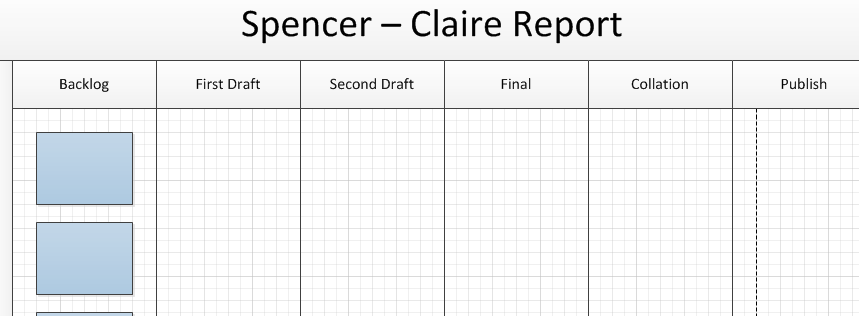
All nine of these might have very different end-states.So, if we are writing a report, the end state might be “publish.”The other end … your backlog … is usually called “Backlog” or “Ready”. That is where your value stream starts. So, for our publishing value stream, our backlog looks like this:

Next Step: Fill in the Blanks

Full Sample Value Stream

Between start and finish is creation. What steps do you take to create something? Working backwards from publish, we might have collation, before that is final, before that is second draft, and before that might be the first draft.This now starts to build a stream into which the specific sections of the report can flow. The report team can now track each section or chapter as it moves toward completion.

Important Bits to Remember

1. Your value stream is your best educated guess as to how your work is actually occurring.

For some teams, the value stream above will work nicely. They would likely have a report that is from a template and being updated or customized, because the value stream suggests a very orderly process with no surprises or constant re-writes. Other teams will have a value stream that visualizes more editing, document re-organization, or people involved.

2. Your value stream will change.

As mentioned above, your value stream will change as you better understand your work. You do not need to sit around for a month figuring out the perfect mapping of your value stream. Just get one up and start working. You can refine as you move along. Different phases of projects may require very different value streams. Do not allow yourself to fall into the trap of rigid process.

3. Your Value Stream is Fault Tolerant

If you move a stickie to the right and something changes to make you move it back to the left – this is not a problem. It is reality. You really did move a chapter from the first draft to the second draft, conditions changed and then it moved back to the first draft stage again.

This is a Personal Kanban 101 Post. See others in the series.

" "