" "

PK Basics: Why Limit Your WIP Series, Post 1

Limit your Work in Progress

In Personal Kanban we have only two rules. One of them is to limit your WIP.That sounds simple enough. But what does limiting your WIP really imply?This series describes what we mean by "WIP," why it's important to limit it, and - with all the competing demands on our time - how we can begin to go about doing just that.

WIP = Work-in-Progress

WIP is an acronym for "work-in-progress." It's the proverbial "stuff on your plate," the "balls you are juggling." It's the work you've begun and currently have in process.Now consider those things in your life that can and will at some point constitute your WIP:  deliverables you have at the office, improvement projects piling up at home, monthly bills that need tending to, doctors appointments that need scheduling, phone calls that need returning. Now take into account the things you enjoy doing (but that often get put on the back burner), like taking a photography class or working on your yoga practice. Things you both need and want to accomplish can add up to a huge number of tasks you have to hold in your head simultaneously.Some of these tasks are fairly low-impact. Others are more challenging and might require additional attention.We want to limit the number of active tasks we juggle because we have a "capacity" - a maximum amount of work we can process at a given time. We simply cannot do more work than we can handle.

What Happens When We Don’t Limit WIP

When we exceed the amount of work we can handle, it heightens our distraction and decreases our concentration.  Our attention to detail suffers, we leave things unfinished, or compromise the quality of our finished product.  All of these outcomes create more work or us in the future.

Forgetting

When we forget something - whether it entails leaving out important details or missing a deadline - invariably someone else will point out our misstep. When they do,  a conversation (most likely a pointed one) often ensues. Addressing and compensating for missteps takes time and effort, compounding cost, and ultimately frustration.

Leaving Things Unfinished

When we leave things incomplete we have two outcomes: (1) We never finish them or (2) We finish them later.For case (1) it's likely we've wasted time, effort, and resources.In case (2) we return to the task at a later date, when the task's context (its need, impact,  or resources available) might have changed. Oftentimes that requires looking at the task and figuring out exactly where we left off,  why we made the decisions we did, and what – exactly – was our preferred course to completion. This reorienting process of remembering and reorganizing likewise can consume time, and incur additional effort and resources.

Compromising Quality

A job poorly executed is sometimes worse than a job left incomplete. When work is done poorly, it usually contains defects. When defects become work multipliers, there are consequences down the line: defects can slow work down, break something else, or even hurt someone. Or they might just make your work product less helpful than it could have been had proper care been taken initially. If your defect is deemed serious enough to require repair (in essence, doing your work over again), first that defect must be discovered, then appreciated, then discussed, then deemed worthy of repair, then the repair needs to be identified, then acted upon.And those are the easy ones.When we compromise the quality of our work, we don’t just “do a bad job,” we leave someone to clean up an expensive and time consuming mess.

What Happens When We Do Limit WIP

We'd like to say that limiting WIP will solve all these problems, but it won’t. Nothing makes these things go away entirely.However, not limiting WIP means we are pretty much guaranteed to fall victim to these time wasters, and we are guaranteed to do it often.When we limit our WIP, we have less distractions. We are able to focus on correct decisions, completion, and quality.When we set a WIP limit, we are telling ourselves and the world around us that we want to get work done quickly, and we want to do a quality job.Even though prioritizing some tasks over others means some tasks have to wait, those tasks will still be completed sooner than they would have if we started them all right away. Since we are no longer paying the penalties for forgetting, incompletion, or poor quality, the work we finish is done faster and does not cause additional work.

What’s Next

This is just the tip of the iceberg as to why we should limit WIP. Over the upcoming months, we will be releasing more benefits to both Limiting Your WIP and Visualizing Your Work.Until then, there are other related resources on this site. Simply check out articles tagged “WIP,” or visit the PK 101 page.
What If I Had A Slack Card?

Showing Slack Card

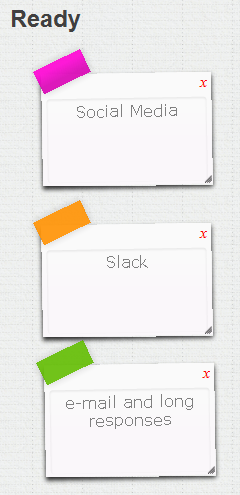
“All things in moderation, including moderation.”― Mark TwainIn yesterday’s post, you may have noticed that we have a “Slack Card” in our Personal Kanban for the day.The problem we, like most people, were having was this:Productivity feels good.The Zone feels good.But productivity and the zone can lead to burnout.Just like Pomodoro includes rests every 25 minutes, we wanted to include a Pomodoro that was nothing but slack.What we assumed was that we have eight half hour pomodoros in an eight hour work day.Interruptions, non-focused tasks, and other minutia tend to make pomodoros not start back-to-back.Of those eight, the slack card is kind of a “get out of jail free” card. It can let you spend a free half hour just resting, it can be spent collaborating on less focused tasks, it can be used to “throw away” if interruptions stop you from being able to do one of your Pomodoro.  Ultimately it’s a visual place holder for an option. You be the judge.

Just Released: Why Plans Fail: Cognitive Bias, Decision Making, and Your Business.

Cog Bias book_cover_artboard EDITABLE

A few months ago, I wrote a series of posts in this blog about cognitive bias. Those became the pre-writing for this short ebook: Why Plans Fail.It’s $2.99, or free if you have Amazon Prime.This is the first in our new MemeMachine Series, which will be little eBooks like this that introduce a topic and begin discussions.Here’s the writeup for it from Amazon:Business runs on decisions. Recently, we've discovered that people aren't the great decision makers we thought they were.Business relies on estimates, plans, and projections - and we all know how accurate they tend to be. Careers are made, careers are broken based on accurate estimation and planning.But what if the successes and failures of these projects were not based on the prowess of those making the plans? What if success or failure were more often the result of a more complex set of events?Why Plans Fail directly addresses our ability of to plan, to forecast, and to make decisions.Written by Jim Benson, an urban planner, software developer, and business owner who has planned and built everything from small software projects, to houses, to urban freeway systems - Why Plans Fail is told by someone with much skin in the estimation and planning game.This short work is the first in the Modus Cooperandi Mememachine series - which looks specifically at underlying issues that directly impact the success of teams, companies, and individuals. The Mememachine series is meant to start conversations and advance discussion.

Pomodoro Daisuki–Session Based Personal Kanban and Pomodoro

Today I installed the Pomodoro Daisuki app in Chrome and thought I’d give a quick experience report.

So far today, Tonianne and I have run our entire workday using Pomodoro Daisuki. Yes, it has the usual Pomodoro functionality, but some extra benefits.

Daisuki Kanban Desktop

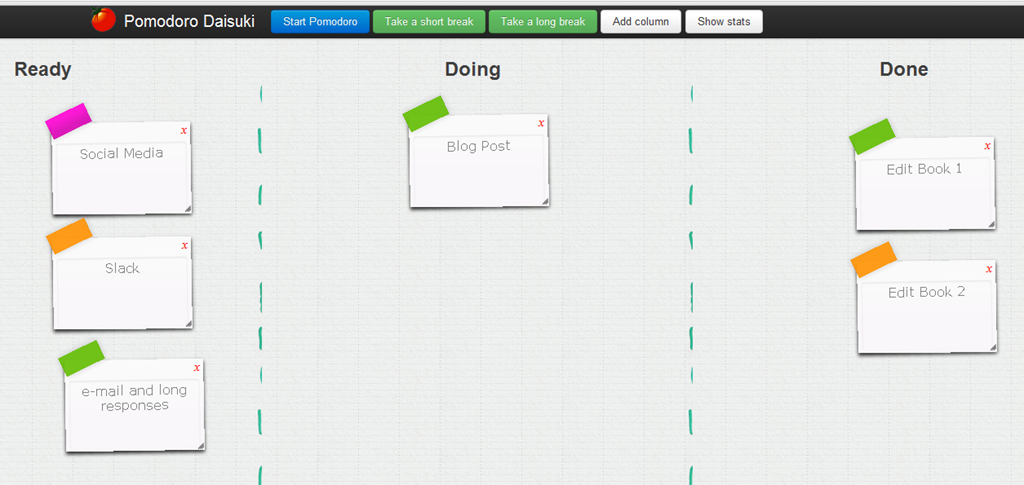
As you can see here, it comes with the fastest set up, easiest use cardwall tool I think I’ve ever seen. It enforces no WIP limits, but it does give you cards with colored “tape” to quickly set up and distinguish a variety of tasks.

Today, Tonianne and I are editing our next book about using Personal Kanban for Meetings. So we’ve already done a few Pomodoros in the book.

The nice thing here is that when you are in focused productivity mode, you don’t want to move around from application to application. With this, you can easily move the current work to done and then pull in the next task.

Pomodoro Daisuki top line

Pomodoros work as you would expect them. You hit the “Start” button and you get a 25 minute timer. A nice touch is that when you have break time, you can choose between a five and a fifteen minute respite.

The “Show Stats” button is compelling, but in the end it merely shows a count of the Pomodoros you’ve done so far. One can hope that it will have more features in the future.

daisuki resting

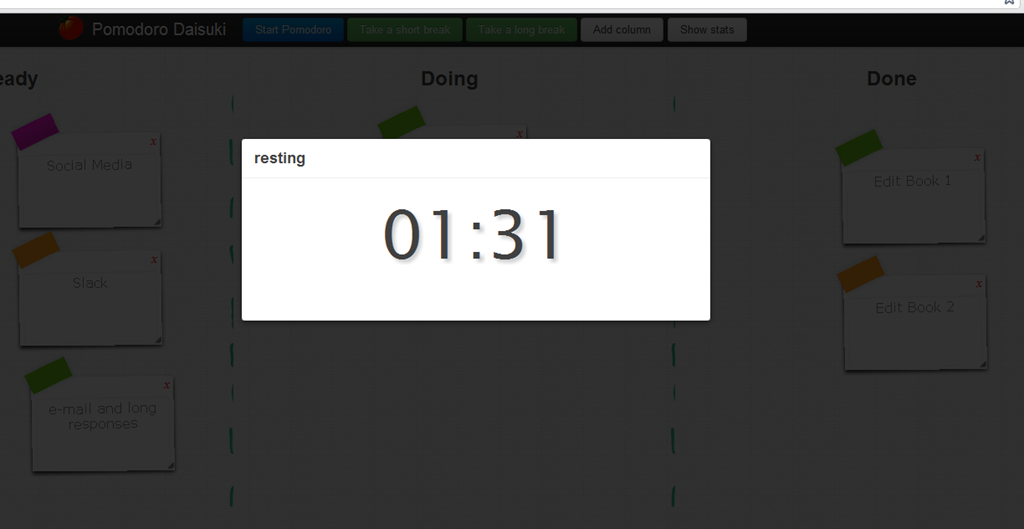
The only drawback is that once you start a Pomodoro or a break … you can’t stop! There is no “oops” button. So it treats the Pomodoro timebox a little too religiously. But, because these types of things tend to be fixed over time – I invite you to check the comments below to see if they do, indeed fix this.

How To: Setting Your Personal WIP Limit

There are only two rules in Personal Kanban.

Visualize Your Work

and

Limit Your Work in Progress

5761388593_81239d2b59

5761388593_81239d2b59.jpg

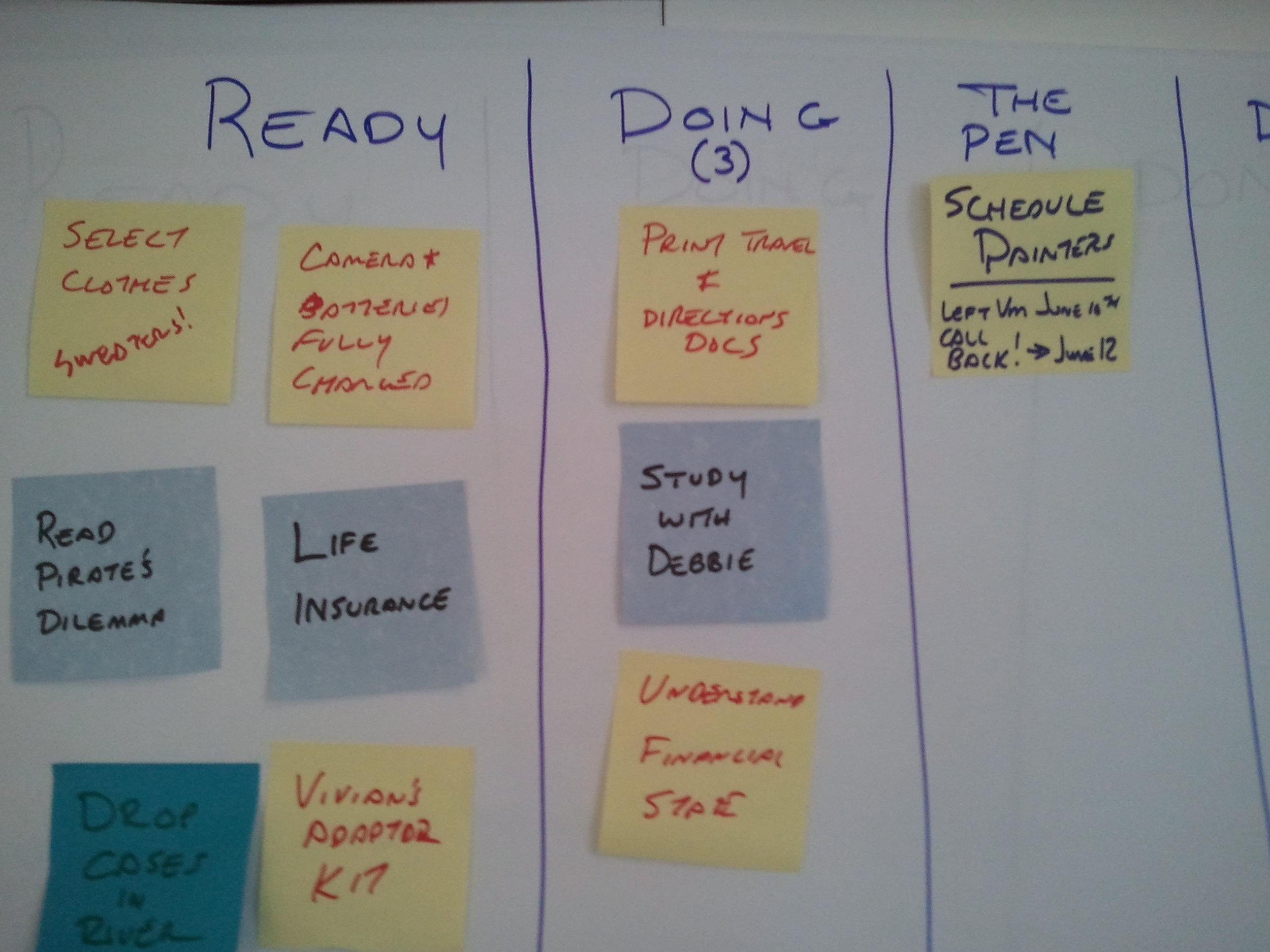
Since there are only two, it stands to reason that they are both important, vital even. When people see the value stream and the stickies, they feel they’ve received clear direction in setting up a Personal Kanban’s visualization. But how to come up with a number for your WIP limit?This is much easier to describe, but much harder to get the point across.

Start With 3

Why do we start with 3? 3 seems to be a good rule-of-thumb number. Three stickies are easy to see, easy to grasp. Three tasks will always be visible on a computer screen. They are easy to remember.Three is also a good balance number. Three is large enough to involve multiple stakeholders, but is small enough to manage. Three is a large enough number for other people to respect. One tasks becomes a zero-sum game where people can argue for hours about how you are using your time, three spreads out your work footprint to involve enough different things to diffuse such arguments.But three is not the only number. It’s just a handy, arbitrary one.

What We Want To Do Goal:

The goal in setting a WIP limit in Personal Kanban is to ensure that we do not take on more work than we can handle.Fact: People obsess over the WIP limit number because it is a number, which they take to be a rule. “If my WIP Limit is 3, I can never ever do more than 3 things.”That’s dangerous.Emergencies are EmergenciesIf you’re in the middle of a report, some accounting, and waiting for a team member to reply to an email - and your WIP limit is three – you have met your WIP Limit.If all that stuff is happening and you have a heart attack – you should deal with the heart attack even if it breaks your WIP. Don’t type faster to finish your report so you can pull the heart attack sticky!What we want for that WIP Limit to do is keep reminding us at all times that we are much more effective if we limit our work-in-progress. Emergencies will remain emergencies, they are real, we must attend to them.

Variation in our Capacity

Let’s look at Karl on three consecutive Mondays:Monday 1: Karl wakes up after a relaxing weekend. He eats a good breakfast. He is ready to attack the day. He arrives at work and finds his partner June equally ready. Together they feed off mutual creative energy and the day is off to an excited start.Monday 2: Karl wakes up after a stressful weekend. He slept little last night and is now hitting snooze over and over again. He misses breakfast and stumbles into the office late. He’s searching for enthusiasm.Monday 3: Karl wakes up, the weekend was fine, but he’s distracted – something doesn’t feel right. He gets to the office and he and June discuss this feeling he’s having. They spend the morning sipping coffee and talking until they finally figure out what is bothering Karl. It is an oversight they’ve had with their new product line. Luckily, it is something that they can work out. He and June spend the rest of the day coming up with solutions to the problem.In all these instances, Karl – the very same Karl – has a different capacity for new tasks each day. One Monday 1 it might be 3, on Monday 2 it might be2 and on Monday 3 it is probably just 1.Our WIP limits therefore can vary with our moods and our context.Don’t feel that your WIP limit is an advised speed at which you must travel at all times. If you are tired or need to focus, by all means, drop to a lower number of tasks.


Diet and WIP Limit

Studies have shown that throughout the day our glucose levels also fluctuate throughout the day. In the mid-morning and mid-afternoon, we are susceptible to dangerous drops in glucose that make our brains fuzzy, our decision-making questionable, and our productivity low.This is why smart businesses have fridges stocked with juices and bananas. (At Modus, Tonianne and I have apple breaks). This is also why energy drinks go flying off the shelves after lunch.Human beings are amazing machines, but we still need to be tended to. Our brains use a tremendous amount of our body’s energy – 20% of our total energy usage or more. The brain, after all, is running on electrical charges and the more you think the more you produce.If you let yourself get run down, your WIP will drop accordingly.The same is true for sleep and rest.

Conclusion: You Gotta Use Your Brain

You, whether you like it or not, are the one who has the information necessary to set a personal WIP limit. You are a system that is self-regulating. You choose when to rest, when to eat, when to drink water. You know what external pressures are resting upon you.Starting with 3 is always safe.But know your variation. Photo by Tonianne

" "