
In the early 2000s, people discovered how great pomegranate juice is. It’s filled with antioxidants that help us avoid colds and other maladies. Well, no one likes to be sick, so people started buying the juice by the case. Sure enough, they felt healthier. So they drank more and more until they started getting ulcers because they were repeatedly filling their stomachs with acid.This is an “anti-pattern”. A by-product of a beneficial act that corrupts that act into something harmful. It doesn't mean that pomegranate juice is evil. It means you can use it for better and for worse.This series discusses some Personal Kanban anti-patterns I’ve been seeing evolve over the last few years.Over the last several months, I’ve run into several situations where people have uttered variations on a disturbing statement… “We don’t do planning because we have a kanban.” This is our first anti-pattern.Some teams, weary of lengthy planning meetings in the past, have misinterpreted flow-based systems as systems that – in essence – are self-planning.A flow-based system is not self-anything – except perhaps self-reporting.The whole point of having a Kanban is to be aware. It is dangerous to turn control of your life, your work, or your future to anything – especially a white board with sticky notes on it.You as a person or team using Personal Kanban need to be vigilant that you are making the right decisions at the right time. In order to do that, you need to understand what work is coming on the horizon, why it is there, and what is NOT being done while you are doing something else.If you are not planning as you go along, you are ignoring what is coming up. It is also highly likely you are missing opportunities to improve, complete, and find efficiencies.Personal Kanban does not preclude planning, it makes planning more enjoyable.
Getting Beyond Done–When to Archive
“When do I remove tickets from the DONE column?”The short answer is, every week or so, try to have a short retrospective with your team or alone (if you are working by yourself). When you have the meeting, review what’s happened and archive as you do.Some of the tasks in your DONE column will spark introspection, some won’t. (Hopefully you don’t have to ponder all your work).As you discuss the tasks, you can move them into your ARCHIVE where you store completed tasks. Or, if you are so inclined, you can throw them away.In the video, the ARCHIVE is part of the software. With a physical board you can have your archive be a file folder or a shoebox.
Complexity Calming: Why Limit WIP Series, Post 4
In a wonderful meta moment today, I (Jim) was prepping for this post and listening to a talk on Library Futures by Jabe Bloom, the CTO of the Library Corporation. A large part of his talk dealt with complexity in modern life.
None of us can know everything; each of us knows something; and we can put the pieces together if we pool our resources and combine our skills. ~ Henry Jenkins via Jabe Bloom
This was one of Jabe’s slides.It reminds me of a discussion I had while I was living in DC with a recently retired CIA friend. We were discussing how intelligence was gathered in the past, and how current reality was more complex. Before we had a few, easily defined enemies who behaved according to fairly predictable patterns.

Mean Jabe
The Bad News
Today, we are working against a more amorphous “enemy.” By definition, the amorphous enemy is less defined. Because it is less defined we know less about it. Because we know less about it, it is more scary. Because it is more scary, it is more stressful.In short, our enemies have become more complex, unknown, and scary.This means two very important things.1. We can’t have one standard response to threats2. We are going to imagine a lot more danger than is actually thereIn our own work, we feel these threats all the time. Too many tasks, too many data streams, too much stuff coming from too many directions. We don’t have time to think, let alone collaborate.

Happy Jabe
The Good News
The good news is that we can use Jabe’s quote from Jenkins to deal with this complexity more effectively. And we approach Jenkin’s counsel through Limiting WIP.In our personal lives, we have the same problem as the CIA. The CIA has too many avenues of input. Too many distractions. And, oddly enough, too many experts. The only way they can solve their problems is through collaboration. The only way they can truly collaborate is to understand their own work and have the capacity for collaboration.The CIA used to have a linear problem. One, two, three other countries that were potential threats. Now they have an exponential problem. Potential threats that can form, execute, and disband before anyone knows who they are or why they did it.The CIA cannot solve their exponential problems with the linear problem solving solutions of the past. They cannot rely on solitary agents or even small groups. The organization as a whole needs to collaborate to remain effective.When I was growing up, I could choose between 4 TV channels, the telephone and maybe a movie at the theater for incoming streaming media. Outside that, I could read a book, magazine, or newspaper. Or maybe I could listen to music on my stereo or Walkman.At that time, we thought that was a pretty lengthy list. But it was a linear list. I could filter them out simply by walking away from them.The other day during a lunch with a friend, my Android Phone buzzed non-stop with tweets, text messages, Facebook updates, Foursquare updates, phone calls, and emails. Finally, I shut it off. I had to apply “aggressive filtering” to my lunch. But that was not enough.The number of distractions we have grows as the number of avenues for distractions grow. Not only that, but - like the CIA fearing more danger than is really there - even when the phone wasn’t vibrating, I was waiting for it to vibrate. Even when I shut the phone off, I could feel it was off and was vaguely worrying I was missing out on something. However, I was able to focus much more intently on my conversation.When we limit our WIP, we are filtering our work. We are filtering distraction, filtering data sources, filtering complexity. But that is only a temporary solution. Just like if the CIA only focused on one hot-spot, they could focus, but they would be ignoring everything else. But their collaboration would mean nothing if there weren’t sub-groups actively focusing on specific tasks.In this case, we want to limit our WIP so that we can focus in the service of becoming very aware of what we are doing, what we are not doing, and why. This lets us know, very well, what we know so we can begin to pool our resources and combine our skills. In our increasingly complex world, our role as individuals is changing. There’s too many things going on at once for any of us to take in, process, and act on.When we limit our WIP, we are recognizing that we can either pay attention to some things with great effectiveness, or we can pay attention to many things with little effectiveness. If we choose the first path, we are creators, if we choose the second path, we are consumers.Lastly, when we limit WIP and calm our own complexity, we are better able to find others to collaborate with, to add our unique value, and to create stronger teams. As we collaborate, we learn more about other disciplines and find ways to incorporate that learning our future work.
Slack: Why Limit WIP Series, Post 3

Bob_slack02
Slack.The word conjures up images of slothfulness, of days spent lazying about in a seaside hammock beneath the fronds of a blowing palm tree.But relaxation is not necessarily sloth. Just because someone or something appears to not be fully utilized is not an indication of their disutility.Consider the belts in your car’s engine. In order to operate effectively, they can’t be too tense, they must have some give. Engine optimization relies on belts having the appropriate amount of slack.It’s the same with our work. We need slack for our own optimization. In our work, we’d like to have a degree of slack to:
Make sure we are able to focus on the tasks at hand;
Make sure we have the capacity to deal with unforeseen events;
Make sure we can stop periodically to allow our brains to perform vital functions in memory, processing, and regeneration; and especially to
Make sure we don’t work ourselves into an early grave.
When we have unlimited WIP, we tend to start multiple tasks concurrently, and then run in circles trying to complete them. As we’ve discussed in our previous posts in this series, overwork creates additional work, heightens stress, and results in a poor quality product.
Focus on Tasks at Hand
Slack allows us to focus on the tasks at hand simply by giving us the ability to work in a non-freaked, sans-OMFG state. In the absence of slack, we aren’t only working on our current task, we’re fretting because we know there are countless other tasks we’ve started and that they demand completion. We live with an underlying fear that something, somewhere will break and when it does, it’ll be unlikely we’ll be able to deal with it.Slack is, in the end, a recognition that our time, our brainpower and our emotional fortitude are all limited. If we tax all these resources, we will not be able to do the work on our plate or deal with unforeseen events.
Unforeseen Events
When we’re overloaded with work, we invite panic. We invite emergencies. When we have zero capacity for new work, additional work exacerbates our overload. The thing is, unforeseen events are inevitable; they happen all the time. We can’t predict the future, we can only give ourselves the slack to deal with whatever may come our way - good or otherwise.If we have three tasks in process and something unexpected comes along, we - at worst - have four tasks in flight. This is still a substantial number less than most people currently have. This doesn’t make the unforeseen event a welcome one, but it does make it a manageable one.
Rest, Processing, and Catch-up
Francesco Cirillo’s simple yet profoundly powerful Pomodoro Technique invites us to use a timer set to 25 minutes during which we focus without distraction. The timer’s ring alerts us to rest. The ratio suggested is 25 minutes of work to 5 minutes of rest - and then repeat (taking an even longer break after 4 successive pomodori). This isn’t merely to let us have a “coffee break.” Our brains need recharge points.The brain is not some easy going organ...it’s a resource hog.When we’re working intently on something, our brain burns a lot of calories, uses a lot of water, and gets tired. Allowing periodic points of slack allows us to hydrate, grab a snack, and recharge.Not only this, but the brain also works in three memory modes: short term, mid term, and long term. Having slack and taking breaks allows the brain to pause and write vital information from short to mid term memory. The more we overload ourselves with work, the more we forget.
Stayin’ Alive
As we can see, without incorporating slack into our work day, we end up taking on too much work, too much stress, and with too little down time. These factors decrease happiness and longevity. That’s not a good thing.We limit our WIP specifically to achieve a comprehensible workload that allows us to complete, understand the costs of our choices, make better decisions, and react elegantly to life’s surprises.
Why Not a WIP of One?: Why Limit WIP Series, Post 2
With only two guiding principles - Visualize your work and Limit your WIP - much of Personal Kanban seems fairly straightforward. But it’s not as obvious as it seems, and there’s actually a lot going on under the hood.Tons, actually. So let’s discuss.We said in the previous post we want to limit our work-in-progress, our “WIP,” and set it within a reasonable limit. But there’s still some confusion about what WIP really addresses.Does it mean:
A: At this very moment, what task am I actively doing with my hands?
or
B: At this very moment, what tasks am I am actually doing with my brain?
To be clear, your brain does more than your hands.This goes back to the role of the visual control in your life. As a visual control, your Personal Kanban keeps you honest about the work being done in your head. The visual control is not necessary there to track what’s going on in your hands.So the Personal Kanban doesn’t need to tell you (A).This comment was left on our latest post How to Set Your WIP Limit:

Interesting. My WIP limit on my personal kanban has always been 1. Perhaps it’s just the way I’ve got it set up. For instance, right now the card I have in work is “read blog posts and comment”. Now, I have a ‘waiting’ lane for cards where I’m blocked from taking any direct action. So by having a different lane I suppose that’s an additional WIP item since it’s not complete, but I like to split that out if I can’t take any action on it myself at the moment. It re-enters my pull queue when the block has been resolved.What do you think about that Jim? Can I do better?-Josh
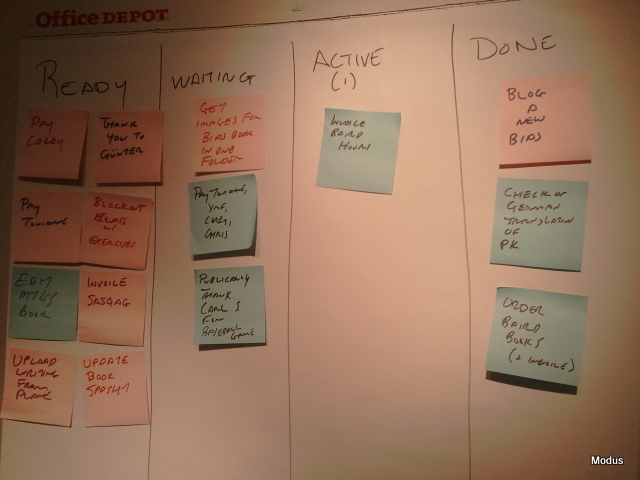
We’ve encountered numerous people who set their WIP limit to one and believe they are working on only one thing at a time. They will actually move cards in and out of DOING to note whether they are actively working on them. Again, what you are doing with your hands should tell you this.However, those tasks that were moved back into WAITING are still active. They are still IN PROGRESS. Simply because your fingers aren’t moving them right now, doesn’t mean your brain is not still DOING them.This is important, as the Zeigarnik Effect tells us two things about how we work:1: We have a psychological need to complete a task. Incomplete tasks tend to create intrusive thoughts, causing us to dwell on what we’ve left unfinished.2: We forget things that we’ve completed.In the book and in our talks, we go into great detail about how this impacts our work. For now, let’s focus on #1.When we begin a task and leave it unfinished, our brain keeps thinking about it. Psychologically we need closure, which can come from two sources - actual completion or officially deciding not to complete.If we have a column in our Personal Kanban that is just holding incomplete tasks, there will be an irresistible temptation to put more and more tasks in that column. We will come up with excuses like, “This one is more important” or “I don’t have time for that right now,” or “I’ll get to it later.”We want the DOING column to exert pressure on us. Our goal with Personal Kanban is to have a realistic WIP limit that is honestly displayed so that we can understand our options, better manage our work, and finish what we begin.More on this in future posts in the Why Limit WIP Series.