
In the Personal Kanban book, we say that the book is “not your mom.” The book is not telling you what to do - it is focusing more on why. Your Personal Kanban (or your team kanban) is also not your mom, but it is a lot of other things (not that your mom is a thing....). The kanban tells you what, when, why, and even some how of your work.Over the next thirteen posts (which in China is a lucky number), we’ll cover how the board helps us define a narrative, understand status, see flow, measure progress, tell the truth, see potential, select better, thwart cognitive bias, be a learning aid, foster improvement, increase effectiveness, and illuminate hidden assumptions.Here is the Table of Contents for these posts (links will be made live as each one publishes):
Mapping Your Work with Personal Kanban

To Do Lists are Not a Map
Rewrite Your To Do List
For more on how this works, see the various posts in Personal Kanban 101.To-do lists are something that we’ve turned to time and again to manage our work and we’ve always been disappointed. They become daunting, lengthy, undifferentiated lists of things we have to do. It is hard to get perspective from a list.I’m often asked for the difference between to-do lists and Personal Kanban, and why Personal Kanban differs from to do lists. We cover this in depth in the book, but we can do a short form here.Think of it this way:Here is downtown Seattle. Right away you can tell where the freeways are, the surface streets, the water, and so forth. With maybe a little studying you can quickly find one way streets, ferry lines, and piers.Now, let’s think of this like a to-do list:
Yesler Way
James Street
Cherry Street
Columbia Street
Marion Street
Madison Street….
Personal Kanban is a Map of Your Work
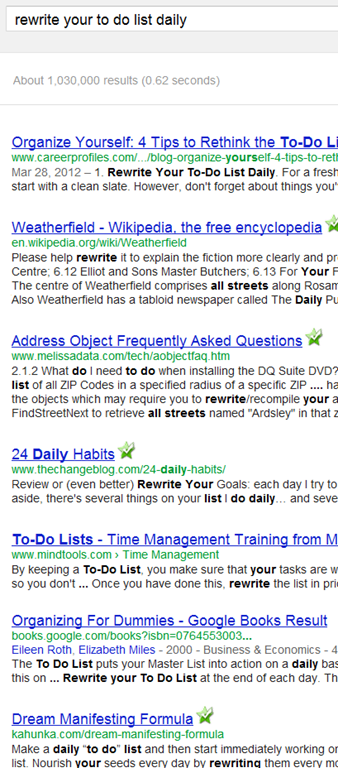
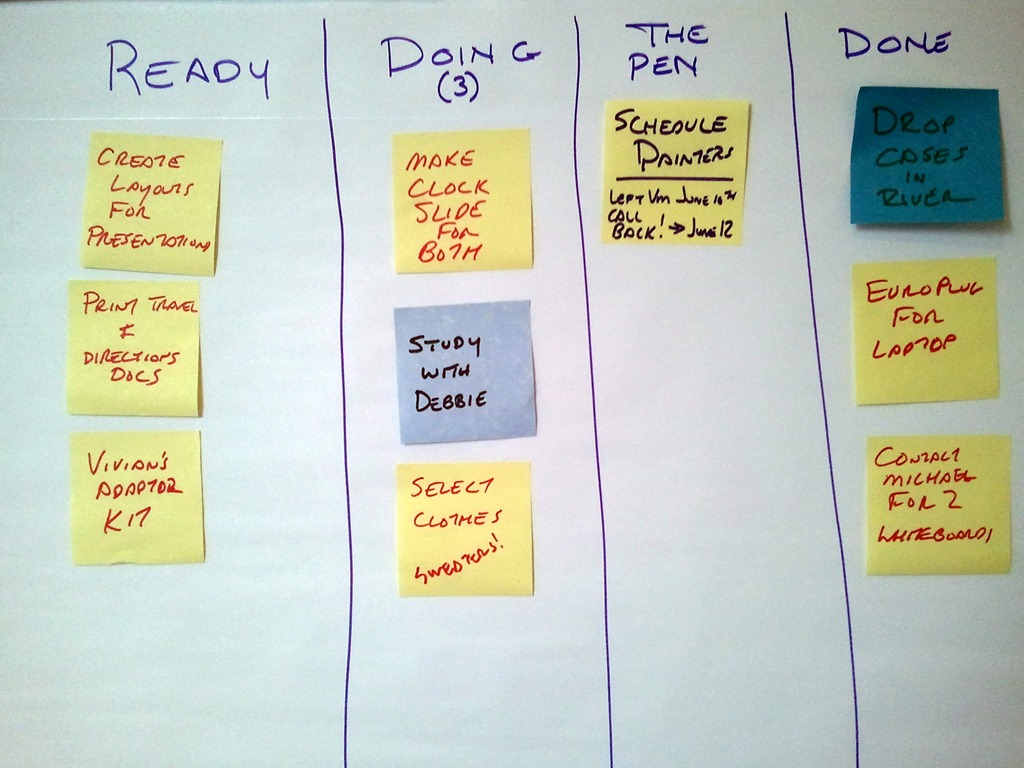
See? I could list everything in downtown Seattle (which would take me quite a while) and in the end you’d have no idea how anything related to anything else.You’d have a list with no context.This is why people who counsel others on to-do lists tell them to rewrite the list daily. To-do lists quickly become stale and irrelevant.If we visualize the work, like we visualize a map, that re-writing is unnecessary.With a Personal Kanban we want to build a map of our work. We want to visualize the trade-offs, the options, the completion rate, even the relative joy in a particular task. We want to be able to see these dimensions to our work – not merely a list of it.Here we see the basic Personal Kanban. While a normal to-do list is only two dimensions (work by length), the Personal Kanban map is multidimensional.Dimensions:Dimension 1 - Topography (the layout of our work)The Value Stream – This is the steps you take to create your work. That can be any steps you really take. This simple example includes four steps: Ready, Doing, The Pen and Done.Ready – This is a graphical representation of the to-do list.Doing – What work is currently in-flight. In a to-do list there are only two states. Not completed and complete. This column clearly shows the completing of your work.The Pen – What work is currently blocked as we wait for others? This work is important to clearly see because it is both something that you cannot act on and yet still something you must keep track of.Done – Work that has really been completed. We don’t draw a line through it. We don’t kill it. We keep it, look at it, remember it.This topography shows us the landscape over which our work travels. We see where we are, where we are going, and where we’ve been. We even see some pitfalls along the way.Dimension 2 – Movement (how we do our work)Movement happens when something in one location ends up in another location. When we see movement, we can see how things actually live. In the Personal Kanban, we are seeing Pull, Constraints, Flow, Bottlenecks.Pull – We “pull” work in a Personal Kanban when we have capacity to actually complete it. This is as opposed to work being “pushed” on us by others and overloading us. When rivers have water pushed into them – that creates a flood with sometimes horrific results. When we have capacity, we can do work thoughtfully and get that work done.Constraints – We limit our work-in-progress to a few things at a time. Note the (3) in the Doing column. We can only have three things in-flight at a time. This constraint is our capacity. When we finish something we can now “pull” a new task. This creates Flow.Flow – As work is pulled and completed, we build a rhythm in our work called cadence. The flow of our work can have three effects.
Flow shows us how long it really takes us to complete our work.
Flow shows us cadence, letting us set a pattern to our work.
Flow actually feels good … when you get in the zone while working, that both calms our fears and excites our creativity.
Bottlenecks – When things don’t flow, they get stuck. (makes sense…) Whether they are stuck in the Pen or in your Doing column, they are visible and impede completion. Since you can see it, you can do something about it.Dimension 3 – Depth (what are we really doing?)Dimension 3 lets us know what our work really means. What options are we selecting? Where is our work coming from? Who are we collaborating with? What do we enjoy?The Work Itself – We see the tickets, each representing a task or other item of value.The type of work – different colored stickies can represent different types of work. Projects, urgency, clients, or areas of our lives (home, work, personal growth).The age of the ticket – some people place dots on tickets for each day they are in doing to keep track of how long they were stuck thereCycle time – some people record date / time started and date / time completed to get an idea of how long tasks actually take to complete.Options – When we pull, we are now moving a task into Doing – which is a limited space. We want to choose carefully what task we start next. This now means that we are carefully exercising an option to do work. The board shows us the options we’ve completed, the options we have, and the options we are doing. This helps us choose better options as we learn more about how we work.
Closing
There are many more elements to the map of our work, but this gives us a taste of how the to-do list’s single dimension view of life is reversed by Personal Kanban. For more on how this works, see the various posts in Personal Kanban 101.For more on how Lean works, see Lean Muppets.
Kaizen Camp: Seattle 2012
lean camp 2011

harold speaking
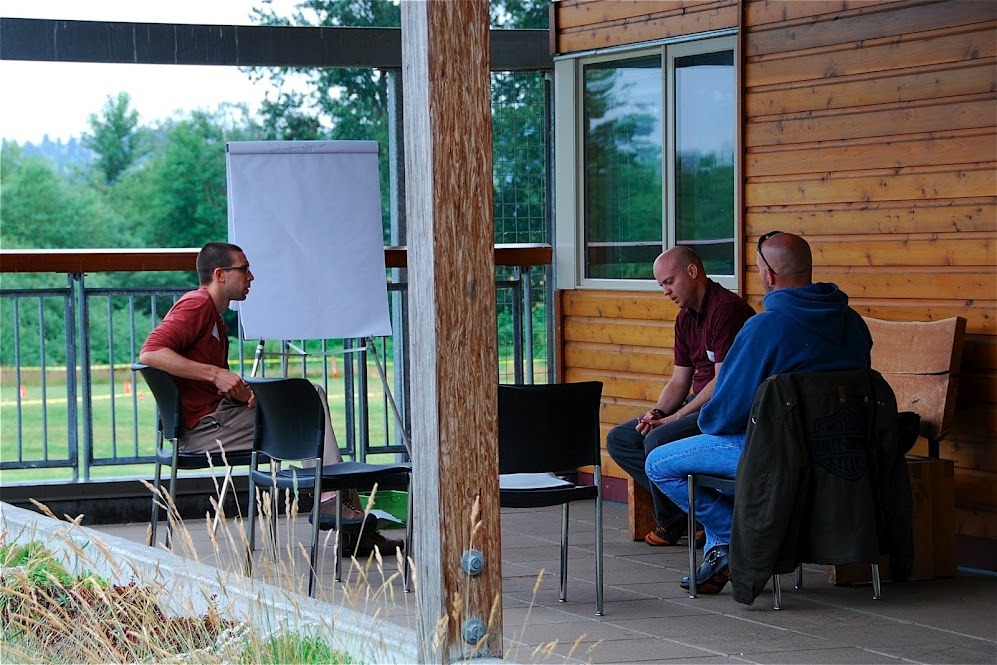
Following last year’s excellent “Seattle Lean Camp,” we are now nearing Kaizen Camp: Seattle 2012. (We did have a name change, so as not to confuse us with another set of camps with the same name.)Kaizen Camp is July 24-25, again at the beautiful Center for Urban Horticulture. Yet again, we have award-winning food trucks catering the event (both with vegetarian options), so no boring food! Already the event is nearly half full, with attendees from software, government, health care, manufacturing, education, and more.The diversity of voices and ideas is unparalleled – which is exactly what we were aiming for. Lean ideals and principles will be discussed. People sharing their success stories as well as their challenges. Different disciplines working together to create new ideas and explore continuous improvement.Last year we were blessed with great conversation, learning, food, and near gender parity. Judging by the buzz so far, this year promises to be even better.What to expect:
Great sessions
Conversations with other smart people
Learning about what is working
Strategizing about sticky problems
Exploring ways to create better working environments, systems, processes, and policies
What you will be spared:
Dull speakers
Bad boxed lunches
Canned presentations
Being silent while others talk at you
Sales pitches from consultants pretending to be speakers
Cost and SponsorsKaizen Camp: Seattle is $79 early bird and $99 late bird. With all this learning, two awesome meals, a full day of snacks, and a T-shirt from Nordstrom, that’s a steal. We couldn’t do this without our sponsors:
Nordstrom Innovation Labs
Modus Cooperandi
University of Washington
University of Washington – Bothell
LeanKit Kanban
Just Close It!

tabs
Recently I noticed that I have a bad habit.I will go through a Pomodoro which includes a lot of research or interacting with multiple web tools. These all end up becoming tabs in Chrome. After three or four Pomodori, I can’t find anything because I have too many tabs open. This causes frustration and creates multi-tasking situations, even when I’m focusing.The tabs actual create visual clutter despite my attempts to find clarity.So, today I instituted a rule … when I’m done with a tab – I close it.That’s it. It’s pretty much that simple.
Rules, Motivation, & Systems Thinking: Lean Muppets Post 10
It’s a horse! It’s a cow! It’s a cotton ball!
Okay, we’ve reached the 10th episode of Lean Muppets, and the last one, I’m sorry to say. Over the last six weeks, I’ve had great conversations that started with, “You know where Fozzie ….” and ended with deep thoughts about lean. I’m taking that as a sign of success.So in this final installment we find Kermit as a middle manager. He has empowered his staff to provide value by employing an elegant system.His system is “get employee to guess what is in a box and reward them by getting what is in the box.”The payoff of receiving the thing in the box is a fiscal payoff. We call this an extrinsic reward – or a reward that has an external value to the recipient. For example, if I pay you a salary, that is an extrinsic reward. You will value it, perhaps even need it, but it’s value is a market value. If I pay you $90,000 a year to work at an awesome job, you might consider it. If I paid you, $500 a year, you would likely slap me – regardless of how awesome the job is.This is opposed to an intrinsic motivator. This type of motivation appeals to what is inside of us – what we love. I don’t have to pay you to go see a movie with me. Nor should I have to pay you to read a book. You do these things because you like movies or you want to learn. These intrinsic motivators can outweigh or exacerbate discrepancies in external motivators. So, if you could make $110,000 a year in a crappy job or $90,000 in an awesome one … the better lifestyle and less stress might make $90,000 more attractive.In this video, Kermit has set up a system with an extrinsic reward and no intrinsic rewards at all. Kermit feels that the reward of what is in the box is enough to buy his employees’ time. Unfortunately for him, his employee quickly surmises that the contents of the box doesn’t match with the currency he trades in. Cookie Monster solely deals in cookies.The moment Cookie Monster states that he doesn’t want to participate, Kermit exercises positional power and lays down some rules.Rule 1: You Must Guess What is in the BoxAt first Cookie Monster negotiates. The rule now places them in an adversarial role. Kermit is laying down the law, Cookie Monster responds with “Reactance.” Cookie Monster says, “I don’t like being told what to do, you’re going to have to sweeten the pot. Given that I only trade in Cookies, I demand you give me a Cookie.”Getting the system to work is very important to Kermit, so he gives in and says if Cookie Monster guesses what’s in the box, he will give him a cookie.Rule 2: You Must Guess Using CluesCookie Monster still doesn’t care one lick about Kermit’s system, he just wants a Cookie. So he starts guessing what is in the box. “A horse! A cow! A pogo stick! A Cotton Ball!”But that’s not good enough for President K. the Frog, he now tells Cookie Monster that he needs to logically guess with clues.Kermit gives him two clues that sound like a Cookie – You can eat it and it is round. So Cookie Monster draws on his vast expertise in cookie systems and comes to the logical conclusion that it is a cookie. That’s Cookie Monster’s world view – that’s where he’s coming from. You can’t make cookie monster eat raw fruit.Rule 3: You Can’t Be Told What It IsFinally Kermit gives up and tells him that it is an orange. He breaks his own system. When he does that, the unwilling participants in the system hold him to his own rules.Because Cookie Monster never really understood why the system was there, or what it was doing, he also couldn’t tell when it broke down. Cookie Monster lacked systemic clarity.Kermit was so caught up in the result he wanted from his system, he never taught anyone why the system was there in the first place.
What This Means For Lean
When people don’t understand a system and are forced to participate in it, they spend a lot of time trying to learn and negotiate the rules. They first must learn “how” to negotiate their system. If the system is complex enough, or if there is no motivation, they may never get around to learning '”why” they are doing those things. If people don’t understand the why, they have no way of knowing if the how is really working. Continuous improvement is likely impossible. Systems will begin to break down. When the systems do break down, rather than fixing them, the Cookie Monsters of the world will complain, lament, and game the breaking system for their personal benefit.And why do they do that? Why do perfectly nice Cookie Monsters game dying systems like this? --> Because the system never respected them either.Build systems that respect those who will be impacted by the system. This is tenth and final (oh no!) in a series of Lean Muppet Posts. For a list of Lean Muppet posts and an explanation of why we did this, look here -> Lean Muppets Introduction