" "

Collaborative Aid: Element #10 of the Kanban

collaboration kanban

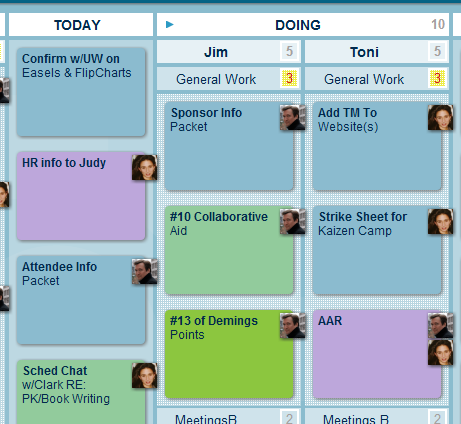
“Hey Tonianne, I see you’ve pulled the ‘Strike sheet for Kaizen Camp’ ticket. I took some notes from our meeting the other day, they are in the ‘Kaizen Clean Up’ mind map. Just take a look at that, it should be almost everything you need.”“Thank you Jim, it is such a pleasure to work with a helpful, conscientious, and wickedly funny man as yourself.”We seldom work alone.Our best work is done through collaboration.The kanban’s strength here is unprecedented. Since the board is broadcasting in real-time, help also arrives in real-time.Of course, while it would be great if I were all those things the not-so-realistic reply from Tonianne states, we all naturally tend to provide simple assistance when it is easy to do so. The assistance I provided to Toni in the above exchange took me only seconds to provide - so it was very easy.However, the results are stunning. I leveraged my previous work, she saved a few hours of re-inventing the wheel. In the end, the ticket moved much faster.Only because I knew what she had pulled when she pulled it.When I talk about collaboration, people like to bring up the recent book “Quiet” which talks about how we should make room for introverts. A prominent point in the book is that society tends to focus on collaboration, while introverts like to work alone.After 25 years of working on projects of all sizes, I can safely say that introverts make the best collaborators.And here’s why.Collaboration does not mean working together as a group 100% of the time while talking non-stop and demanding constant feedback and decision making.Webster’s definition is simply this: to work jointly with others or together especially in an intellectual endeavorYou cannot work for a company and work alone. Everything we do in an organization is in concert with others. If we are doing something and someone else is doing something and we know about it and we put those pieces together later to make a whole - that is collaboration.I built my initial mind-map, Toni is writing a document, we had a very brief - but universally beneficial - exchange where I shared some information with her. We are collaborating.To be sure, there are more intense forms of collaboration. We can also see on the image above that Toni and I are both working on the AAR for a client. In that project, we are pair writing. We will both be in the document writing at the same time and talking or otherwise communicating while doing it.But for this post, I want to focus on that simple, human courtesy. I notice you have pulled work, I have helpful information, I give you that information, and we both move on.If a team understands in real-time what the other team members are doing, these exchanges become common, rapid, and even anticipated. The time savings is enormous.This is #10 in a 13 part series on the elements of kanban, read them all!

Conversation Starter / Conversation Avoider: Element #9 of the Kanban

“What’s wrong with this picture?”“What are you going to do to get that completed?”“Would you like help?”“Are you blocked?”“Why did this happen this way?”“I totally didn’t expect that, did you?”The kanban is a conversation starter. There are patterns that show up in normal working that create conversations that lead to action.When we work with others, our primary means of processing is conversation. It is true, we can waste our times with the wrong conversations, with conversations about things we should already know, or with conversations about trivia or politics. But ruling out conversations is simply foolish.Without a visual control, many of our conversations center around status. “Are you going to meet your deadline?” “What did you do yesterday?” “What are you doing today?” “What have you completed?” “Are you blocked?”If you have an active kanban, most of these status conversations can be avoided. The board already gives anyone who looks at it that information and more. Anyone who needs it can get pertinent information at a glance.Beyond that, we have our shared story (element one) which is broadcast by the information radiator (element two) which is impacted by the nature of the game (three) and impacted by real-time events (four) and so on through all the elements we’ve covered this far. With eight elements under our belts, we can see that there is tremendous context displayed on the kanban. That context is informing us, teaching us, and making us question our assumptions.When that happens, we need some conversations.Teams we work with are encouraged to have daily meetings called “stand up meetings.” These are 15 minute discussions where everyone stands up. We want the meeting to be somewhat uncomfortable so that it will be short and people can get to work. Before the advent of the kanban, the format was to have everyone ritualistically answer three questions, “What did you do yesterday?” “What are you going to do today?” and “Are you blocked or need help?”After the kanban, all three questions were redundant - the board already answered them. At that point, the stand up meetings became 15 minute strategy sessions about how to attack the day, parcel out upcoming work, or swarm on a problem. All of these conversations are informed by the kanban - it shows exceptions to daily operations (things out of the ordinary) and that sparks conversations.This is post #9 in a 13 post series on elements of kanban.

Metacognitive Tool: Element #8 of the Kanban

double loop learning

METACOGNITIVE TOOL is one nice chunk of jargon.Metacognition is “learning about learning.” When we have a tool for it, that tool teaches us about how we learn. When we have some understanding about that, we can start to look for new ways to use the tool to learn more effectively.This is where something called “double-loop learning” comes in.When we use the kanban in our daily work we are employing several real-time techniques and strategies to get work done. “I’m going to make my tasks so they’ll take less than a few hours to complete.” “Today I’m going to work entirely on the City of Pelentagagagua proposal.” “I will do the work for my lawyer after I get this thing out of the way for my boss.”But while we are working, we are basing those decisions on a variety of assumptions. The kanban shows us, in real-time, the impacts of our assumptions. If we begin with an assumption that our office work is more important than getting things done for the family, after a while we’ll end up with a lot of aging family tickets and a DONE column filled with work tasks.When we see this, we’ll see that there is a cost to that assumption. That cost is a lot of pent up work for the house and likely an angry spouse.Other assumptions we might be making is that one client is more important than another, that if we do large tasks first we’ll get more done, or that if we deliver product at two-week intervals we’ll have a more predictable delivery schedule.We can use the real results from the kanban to question these basic assumptions, then alter our assumptions and see the results of that.As we do this, we learn:

  • the results of our actions (single-loop);

  • the effects of our basic assumptions (double-loop); and

  • how that understanding impacts how we work, how we create experiments, and how we react to change (metacognition).

Grounding Object-Element #7 of the Kanban

We discussed the Planning Fallacy in Number Five, but that’s just the tip of the cognitive bias iceberg. The fact is that we are subject to well over a hundred named cognitive biases  like:

So, you can follow the links to get to definitions and evidence for those biases. These biases alter our decision making in sometimes subtle and sometimes gross ways. Largely this is due to us using what Daniel Kahneman calls System 1 thinking.If you’re eating an ice cream cone and the ball of ice cream starts to shift, you will see that, quickly understand with your ice cream expertise that your ice cream is in danger of falling to the ground, and turn the cone to gently nudge it back into place by licking.System 1 is our rapid-processing brain. We tend to make snap judgments based on limited evidence and act immediately. Most of the time, this serves us well. As we move through life, we gain experience and that turns into the basis for future fast thinking.If we had no experience, we would have panicked, grabbing the ice cream with our hands and trying to replace it as it melted and shifted around. Then it would have fallen on the ground. Total ice cream rookie mistake.But system 1 has its dark side. We also tend to make decisions rapidly when its not warranted. We see something has gone wrong and blame the first person we see. We don’t stop a policy long after it’s outlived its usefulness. We see bad things on television before work and are pessimistic the rest of the day. We interpret all data in ways that support our ideas.In this case, our system 1 thinking is processing things too quickly. It is actively ignoring vital information that would lead to much better decisions. This is when we should be engaging system 2, which is our more thoughtful, methodical brain. The problem is system 2 needs to be “turned on”. It’s like a laptop in our heads that requires booting before it will do anything.We live most of our lives in system 1, so much so that we neglect system 2 - often to our detriment.Therefore, we require something to force us to wake up and … well … think. We need triggers that will engage system 2. This is what I would called “grounding.” Something that brings us down, launches our thoughtfulness, and promotes good decision making.Kanban and Personal Kanban, through the context discussed in number six can help ground us - to let us know when we need to question our decisions. Visual cues that come from patterns in work flow, bottlenecks, changes in work item types, changes in the mood of participants, and anything else we can see, helps.It also helps that the kanban is shared and public. While this can lead to group think or other group blindnesses, you still stand a greater chance that someone’s system 2 thinking will be engaged and they will speak up.This doesn’t end our battle with cognitive bias, unfortunately nothing will do that, but it does help mitigate their impacts.This is #7 in a 13 part series on the elements of kanban.

The Options Engine-Element #6 of the Kanban

There is a tension in business between market forces and our freedom of choice. Customers (be they people who buy our products at work or be they people like our families) are people who have needs and we must fulfill them in one way or another in order to be successful. But, we are also our customer, with our own needs to fulfill. Thus, our backlog is filled with options. Things we can do for any number of people, including ourselves, to provide them (and us) with value.When we look at our backlog we find ourselves floating in a sea of potential value. We can do them all, but … which ones SHOULD we do first? In a busy world, what do I do next has become an existential question.We have options.So, a few things about options:1. They have potential - each item in your backlog should have some potential value that will only be realized if the task is completed2. They are relative - each item in your backlog has value relative to the other items in your backlog.3. They expire - each item in your backlog has value and that value expires at some point. My “buy mom a Christmas present” sticky that I place in my backlog on September 1st will expire on the 25th of December. Buying a present on the 26th, after Christmas has passed, is worthless.4. They have context - potential, relative value, and expiry are all contextual. If I get chest pains in right after finishing a task, I won’t be sitting around working on the “Write Memo on Timesheet Policy” sticky. I’m going to head to the hospital. Whether that particular task is the one your team is waiting for or that your wife is excited about or that your customer won’t pay you until they receive - that’s all context.5. Many options = many possibilities - One thing we try to do when making a plan is limit our options. We start off by coming up with a plan that represents the least-cost, highest value path to a successful completion. But context rears its head. Often after starting a project we learn important things that may well change those well-laid plans. Therefore, it behooves us at the start of a project to keep as many options open. This might mean that we explore two or three different options for the same solution, ultimately settling on the one that yields the best results.So all those things in the READY column are options. We have a choice to do them or not to do them. We examine their context, their expiration, their potential, and we relate them to each other - then we make a decision. Then... we exercise an option.When we understand our options, we understand our own potential, our own context. We understand that sometimes we are exercising our free will, and sometimes we are realizing someone else’s. Sometimes we will do those things for our spouse or our colleagues or our client when we’d rather be doing something else.Kanban and Personal Kanban are our options engine - it shows us what the options are, how they relate to each other, their contexts, and their expirations.This is post #6 in a 13 part series on the elements of kanban, if you'd like to really understand what makes kanban tick, check the rest of them out.

" "