" "

Do The Right Small Thing

171463865_36ee36f70e_q

When you look at your Personal Kanban, do you have tasks like “Do the Dishes” or are they more like “Build a House”?

If they’re more like the latter, ask yourself why.

Good Things Are Completed In Small Packages

Lean thinking asks us, in industry speak, reduce our batch sizes. This is their way of saying we should find tasks that can be completed quickly, effectively, and without many surprises.

We are more likely, whether at work or at home, to complete small tasks than large ones. Why?

They’re Small – First off, small tasks are simply that. They’re small. We can therefore complete them in less time.

They’re Understandable – Small tasks are easy to grasp. We can easily envision what needs to be done, how much uninterrupted time it should take, and what the end state will look like.

They are Stable – If a small task is something we can get done quickly, it means the chance of interruption is less and the potential number of complications is low. With most of our work, interruptions actually provide the most complication. That complication adds instability to our estimates.

They are not Scary – Large tasks, because we know full well that they are instable, are frightening. They evoke our fear response,  making us procrastinate, making us spend more time planning how to mitigate risk, and distracting us while actually doing the work. Small tasks, because we understand them and they are stable are much less scary.

We are Confident – A small, stable, and understandable task is something we can promise to someone else and feel confident about the promise.

We can Knock Them Out – Think about how good a day feels when you move a lot of tickets off your Personal Kanban. Now, think of days where nothing moving. Sluggish movement on the Personal Kanban makes us feel sluggish as well.

Small Deliveries Make a Big Delivery

When  we start a large project (and there certainly are large projects) we need to look at that project and figure out what the units of value are in it. Is this project something that has to be done all at once? Are there elements of this project that can be delivered quickly to provide value along the way? What do my customers really want from this project? What is the likelihood of interruptions causing me to shelve this project for long periods of time? Can I come back to this project and remember where I was?

If we can divide the project into smaller pieces of deliverable interim value, then we can can start enjoying some of the benefits of the big task – even if is has yet to be fully realized.

Say you have a big project that is: renovate the basement. This involves moving everything out of the basement, ripping out the walls, moving plumbing, putting in new walls, putting in floors, doing new electrical, painting, getting new furniture, and then enjoying the basement.

Many people look at that task and say, “That’s big, I’d like to do that, but I don’t have time.”

There are smaller tasks there, however. The first might be, “Go through basement and donate all unused or unwanted items.” (For some of us, even this is a big task).  After that might come a task of “Get a new sofa” or even “Draw up basement plans”. Each of these provides immediate value and may well change the outcome for the larger project. Say you get rid of the clutter in the basement and find, lo and behold, there’s a lot more room down there now.

Now, instead of gutting the basement, you can do a few coats of paint, a few simple repairs, and you have a much more livable space.

Throughput of the Small

In my own life, I had a huge office with people working in it every day for 10 years. I also had a home studio where I had been both working and writing for 10 years. When I closed the office, I was left with 10 years of combined office and home paperwork and other junk.

I set aside a plan where each day I needed to take out one wastebasket worth of recycling. Over the course of a few months (I travel a lot), I was able to work my way through the mountain of combined personal, Modus, and Gray Hill history. If I had sat down and done that large task all in one sitting, it would have left me unable to write or work for clients. It would have been boring and, likely, I would have lost interest mid-way through and started just picking up huge piles of paper and shredding it without looking at it.

Using a small task throughput model like this, where I do a little a time, I could keep focus, work my way to completion, and not have to worry about the huge daunting task.
Pomodoro and Kanban for Greater Household Throughput

Better Kanban

Pomodoro splits for cleanliness

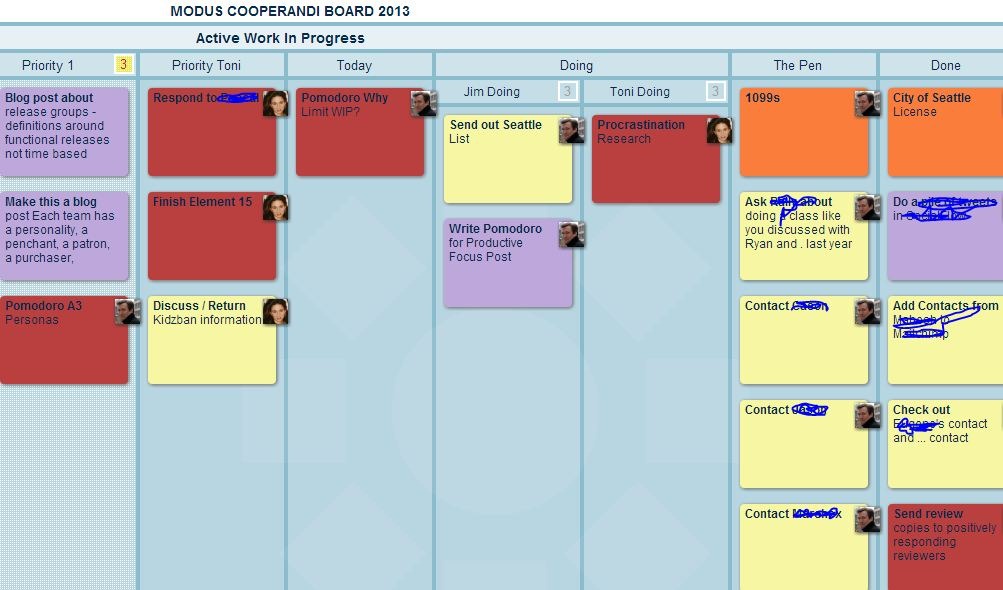
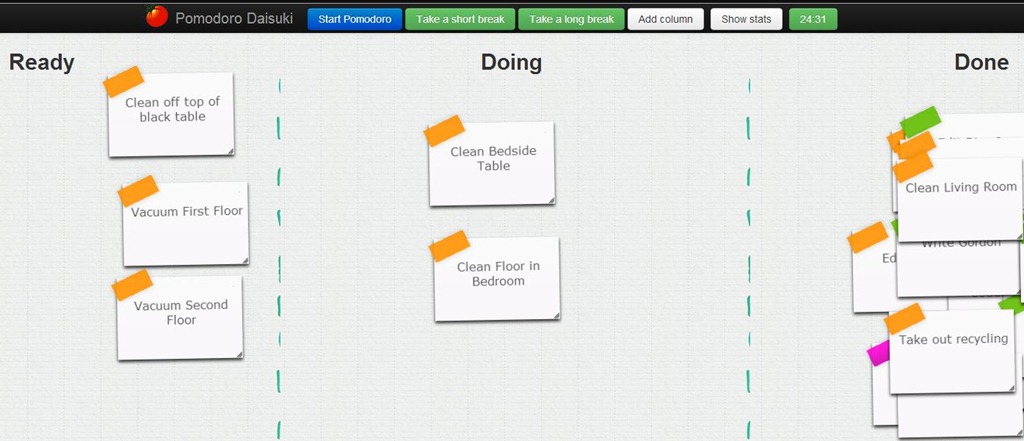
We’ve written before about the Pomodoro technique, which is (at its most simple) dividing your work into 25 minute chunks and having a bit of rest and recap at either end.I use the Pomodoro Daisuki plugin for Chrome for this. Pomodoro Daisuki is a hybrid Personal Kanban / Pomodoro app that lets you build quick and disposable Personal Kanbans to quickly get stuff done.But … it doesn’t stop there.We use LeanKit to manage work for Modus and Personal Kanban. That Personal Kanban looks like this:But I, like some people (not others, I know) tend to relax while cleaning things. So, I noticed that during my Pomodoro breaks I was usually cleaning bits of the house.So, in Pomodoro Daisuki, I built this second “attack the house” Personal Kanban. Nothing here is pressing. There is no “need” to get these done. I’d just like a cleaner house and this lets me see what could be focused on during the break. For me, I have a few minutes, and at the end of this rather mindless task I get the gift of a slightly cleaner house.Note that all of these are pretty tiny tasks – maybe 5 minutes long if I really slow down. But I’ve noticed that keeping this up and using it means that I work my way around to tasks I would ordinarily forget about. For example, “Change filter in the fridge” is in that done pile somewhere. That was a three minute task that results in clean water and a healthy fridge.Another thing I should note is that if I don’t feel like cleaning – I don’t clean. This isn’t a board to force me to clean. It’s a board to help me engage in productive, rewarding, and somewhat enjoyable stuff during my break.One last point … note that we are using two tools for two different purposes. Examine what your needs are and use the right tool!

Small New Years Projects (Cabana Kaizen)

clip_image002

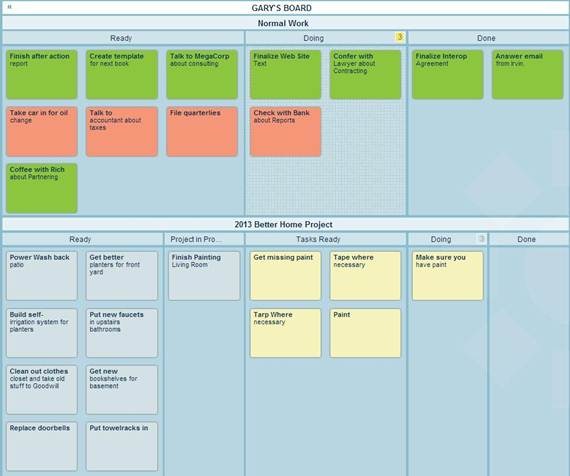
For those of us who might be sitting in a world of clutter, where a million small tasks have become one daunting one - I DON’T KNOW WHERE TO START! - the only way out of that jungle is through.Since every journey begins with a single step - we can only begin by simply beginning. But that first step is usually the hardest.Homes are especially plagued by little tasks that never seem to get done. They mount up and all seem to be equally important or equally unimportant. Prioritization is difficult, and procrastination ensues.So, I propose the over-all New Year’s Resolution - This year, each month my house will be a little better.To do this, you can create a Personal Kanban for this specific purpose - or a swimlane on your existing board. They would look something like this:The steps here:1. Come up with 12 small, but noticeable projects2. Start with the smallest one3. Do one a month.That really wasn’t too difficult, was it?You’ll find, as I have, that keeping a board like this compels you (in a good way) to want to do many more than 12 of these small projects.Two things are important here:First, start small and stay small. Make incremental improvements that you and others can see. Don’t rebuild the house or put in new floors right away. Again, like in the last post, we are forming habits here. For Gary, the first task he’s taking on is finishing one that has been sitting uncompleted. Before making it a set of tasks - it was part of that daunting sea of blue tickets. Now, that project is alone. It’s manageable. And better yet, the cards are atomic - meaning each car is actionable on its own and in relative short time. If Gary is sitting at his desk in his home office working and wants to take a short break - he can go line up the cans of paint, judge how old they are and what’s needed and move the card. Having moved that one card, he’s now one step closer to getting that bit of existential overhead removed from his life forever.Second, keep that Personal Kanban visible! If you can’t see the Personal Kanban, it can’t remind you and it can’t reward you. If Gary doesn’t see that list of projects he won’t feel any more compelled to complete them than he did before the board. And if he completes tasks he can see that there is progress and will be more likely to continue that progress.We humans are very good at procrastinating - use the board to undermine this natural behavior and get the work done. Completed projects mean a prettier home and a better life. (And yes, relaxing can also be a goal on the kanban - it’s not about work, it’s about life.)

The Kaizen Resolution

clip_image002

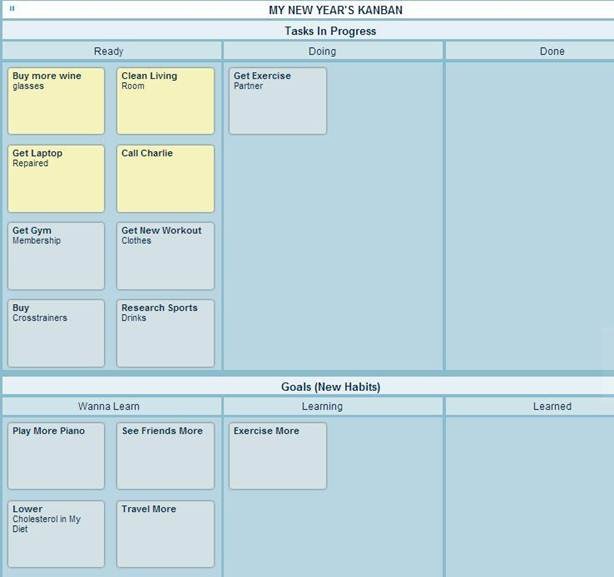
If you are a typical New Year’s resolver, you’ve just taken on a large, daunting, personal transformation project. You want to lose weight or be nicer or play for the Celtics. Good for you!But if you are also typical you (a) haven’t been too successful at this resolution in the past and have recycled it (b) have good intentions but no plan and (c) are doing this entirely alone.We mentioned my 10,000 steps rule. I have lost track of it after a few years of doing really well, some years of going pretty good, and lately a few years of saying “Oh today I actually did it”. During the years I did really well, I was using an on-line tool called Walker Tracker and, together with my friends like Ed Vielmetti and Prentiss Riddle I walked the equivalent of Seattle to Phoenix by way of San Diego.When we all drifted away from the tool, I lost the community and, therefore, focus.This year, I am resolving the more amorphous “be healthier.” This involves three things: eat better, exercise more, and see friends. These are also amorphous. I cannot treat these like projects, but I can treat them as the focus of my Kaizen events. None of these things require undue coordination, but they do require focus.What is Kaizen? Kaizen, in its essence, is continuous improvement. It is an internal drive to constantly be making things better. I want to do okay this week, a little better next week, a little better the week after that.What I don’t want is to over-commit to something far outside my routine. Business does this all the time. They call it a “re-org” - meaning they are radically reorganizing the processes, structure, and culture of the company. They usually fail.Why? Because they’ve done so much change at once they shocked the system. In 1998, after a decade of being a vegetarian, I decided to start eating meat again. How did I do this? Well, I ate half a chicken. It was delicious. It nearly destroyed me - rather than introducing small amounts of meat into my system, I shocked it with a large amount of change it literally could not digest.Don’t do that.With Kaizen we want to make small incremental changes. In this case, we want to pick up new habits that benefit our New Year’s goals. For this, we can use our Personal Kanban. Let’s say that for these habits, we do two things:1. Remind ourselves of the habits2. Invent small, obtainable projects to get you there.So, we have a habits swim lane. Note that we’ve identified a bunch of habits we’d like to achieve this year in the ready column, but right now we’re just working on a few. While those blue habits are “in progress”, we have blue actions in our working kanban.So we see that we have in our swimlane “exercise more”. (Fitting that it’s in a swim lane). So here’s where life gets interesting. Our first task is to find an exercise buddy - someone with whom we can create some social pressure and some support to actually do this exercising. We find Jill, who's totally ready to exercise - but we find that she’s into hot yoga and not treadmills at the gym.After some discussion, we agree to go with her to hot yoga.If you had pre-decided that the only way for you to lose weight was with treadmills at the gym, you would have bought a lot of new clothes and shoes and a gym membership. Now, you are looking at the best yoga studio. You had patience, and looked for the best options.Remember, your New Year’s Resolution is a goal. It is an end state you would like to achieve. There are many paths to your end-state. If you over-commit to one particular path, you greatly reduce your chances of success. Flexibility - especially in something as fuzzy as a New Year’s Resolution - is vital.Set yourself up for success. Build habits naturally. Don’t force change, but embrace it.

Two Personal Kanban Resolution Ideas

Happy 2013!Most people I know don’t even make New Year’s Resolutions anymore, and when they do - they are perfunctory and amorphous. I will lose weight, I will exercise more, I will grow wings and fly like a bat.But these are all as unlikely as they are amorphous, and they are unlikely because they are amorphous. I, for example, have had a long standing goal to walk 10,000 steps. This can sometimes (or quite often) be a challenge in Seattle when it’s often drizzly and cold. In July, I crush my goal! But I can’t have a yearly goal in one month.When we make resolutions that are difficult to achieve, we do really well at them for a while and then something happens - the weather changes or we get sick or we go on a trip. That breaks the flow of the resolution and we stop doing it. We try to do it from time to time, but that’s not quite the same.I’ve seen people be very successful at small New Year’s Resolutions like “this year I will clean the garage” because these resolutions are easy to grasp, schedule for, and complete.We can only complete our New Year’s goals if they are (a) a small project that we can focus on and complete or (b) a new habit we can intelligently weave into our daily lives. So here at Personal Kanban we have two recommendations we’ll talk about today, one is the Kaizen Resolution, the other is Small New Years Projects.And if you are wondering, I waited until after the first to write this because I figured that about now people would be like ... well, I made the resolution .. now what?

" "