" "

Kidzban Around the Web #1

Highly Visible Family Kidzban

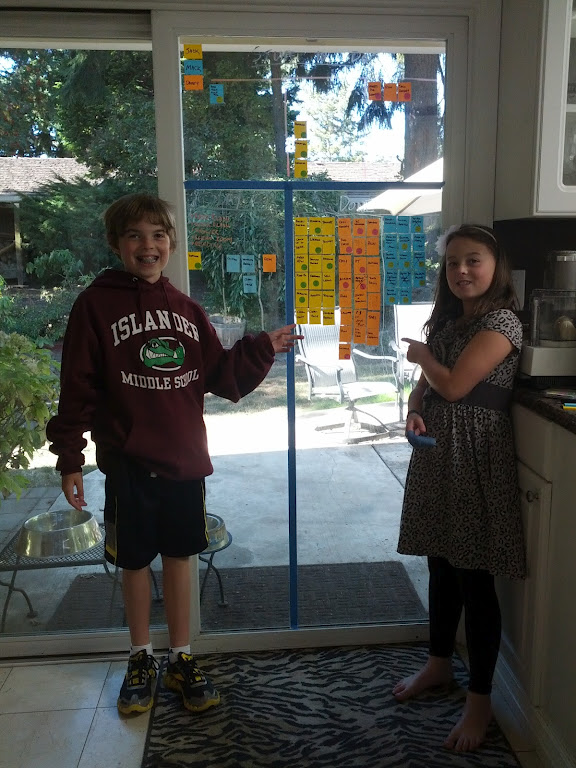
Around the web people are sharing their experiences with Kidzban.  This is the first post of the series - Kidzban Around the Web.With families becoming busier and busier it can be overwhelming keeping up with everything we need to accomplish in each day.Steve Hamilton tackled this problem with his Kidzban.   Steve's wife was away for 3 weeks, and while she was away he wanted to keep track of their two children's activities so he decided to set up a Kanban board on the sliding glass door. Steve explains "This is the single most visible space in the entire house — it is the first thing you see when you walk in the front door."Each Sunday they planned out the coming week - homework, activities, practices, etc. The cards were color coded for each child. Every night they would spend a couple minutes planning the next day. That's when they would move the cards from the top section into the today section.

Steve went on to add "We are now one full week in and so far it has been smooth sailing. No missed homework, no missed practices, good meals each night and the house is reasonably clean!"

Please head over to Steve's Blog to read his Kidzban post in it's entirety.Photo credit: Steve's Blog.There often are things we don't get done before we go to bed each night. Tim Wise came up with a perfect solution for his 6 year old son with his Kiddie Kanban: The Going to Bed Kanban Board.Tim begins by noting "My 6 year old loves responsibility. He loves being able to know what he has to do and getting it done himself.  He does not love when his dad tries to bark commands."They decided to write everything that needs to get done before bed on sticky notes and put them on the wall.  A few tasks were - change clothes, take a shower/bath, read a book, brush teeth, learning new prayers, etc.  His son mentioned "This is like a Todo list for bed." So they labeled the first column TODO. He also said, "We need to be able to tell when I am done." So they then added a Done column. They added the Doing column so they could see what was being worked on.  After the notes went up his son began rearranging them putting them in order. Tim mentioned to his son that was prioritization.Tim finishes up by stating "We said some prayers after reading together, and we learned a new one together. 'Thank you for today. Amen'  So we accomplished learn some new prayers along the way. Unfortunately, we never fit in the bath, so I guess we'll be stinky together tomorrow."You can read the entire Kiddie Kanban: The Going to Bed Kanban Board post on the Agile Dude Blog.This is the first post in the series - Kidzban Around the Web.  You can read the second post here.

The ABC's of Personal Kanban in the Classroom

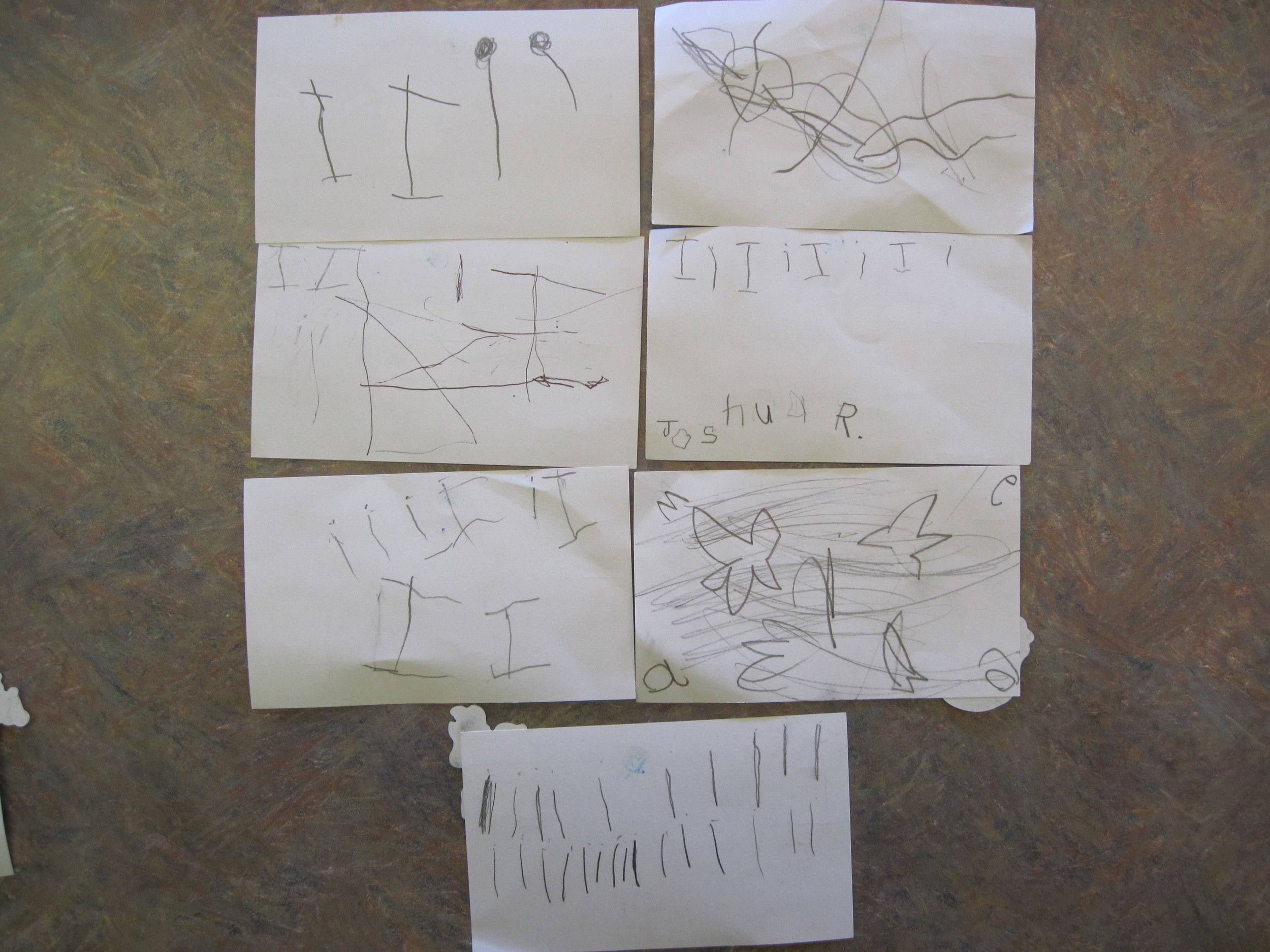
Personal Kanban in the classroom is one area that I am highly passionate about.  Why? I have seen it in action, first-hand in the preschool classroom.  As a teacher it is exciting when your students are excited about learning.The first Personal Kanban we introduced at preschool was an ABC's Kanban.  We used this for 26 weeks, each week introducing a new letter for the students to learn.

Preschool ABC's Kanban

 When we began on our evolving classroom journey we had just a few simple goals:

  • We wanted to the classroom Personal Kanban to easily understood by parents and the teachers alike.

  • We wanted the students to excel at what had traditionally been a very unappealing and difficult part of the preschool classroom activity-learning to write the letters. We wanted to excite the children about learning not think of it as a chore.

Using this Kanban with our students we learned that theexcitement from the children grew every week with each letter they completed on their task card. Students were excited to share their work with other children in the classroom.  Students wanted to collaborate on the chalkboard writing their letters, teaching other studentshow to write letters. The students were waiting at the board before their name is called to come over with their task card, in anticipation of receiving a sticker reward for a job well done.  We had a completely engaged classroom environment.We had many, many retrospective talks about the board, we had more Kaizen moments than I can list. It was like standing back watching a puzzle magically come together piece by piece every week.Week after week students began going above and beyond, even turning their task cards over to more work!

Preschool alphabet learning task cards

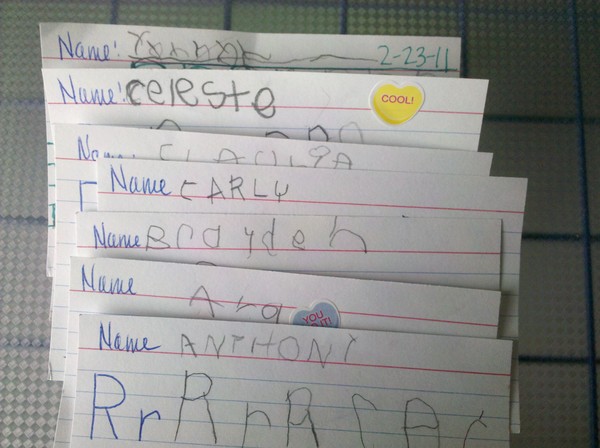
We realized we didn't have to write the students names on the cards anymore because they began to write their names on their own on the cards.

Examples of student written names ABC's Kanban

We were amazed by our ABC's Kanban and how much the students embraced their learning experience. When we were wrapping up our parent-teacher conferences, when speaking with the parents I heard the following statements, “My child loved working on her task card it made her feel important.”“To have all the cards for my child to be able to look back and see all the letters he learned, I wasn’t just telling him, I was showing him, he was able to see all he’s learned.” And finally one parent remarked to me “He was so excited to get into class to show you his card, week after week his excitement grew, he’s been so proud of his work.” The 4 & 5 year old preschool class continues to use this ABC's Kanban successfully.

This an updated post that originally appeared on the Nothing is Out of Reach blog.

Kanban: A Universe of Options for Life's Planning & Organizing Challenges #5

This is the 5th post in a guest series, Kanban: A Universe of Options for Life's Planning & Organizing Challenges by Nadja Schnetzler.

There are all kinds of kanban boards I have created and used in different situations. Here are a few images and short explanations:

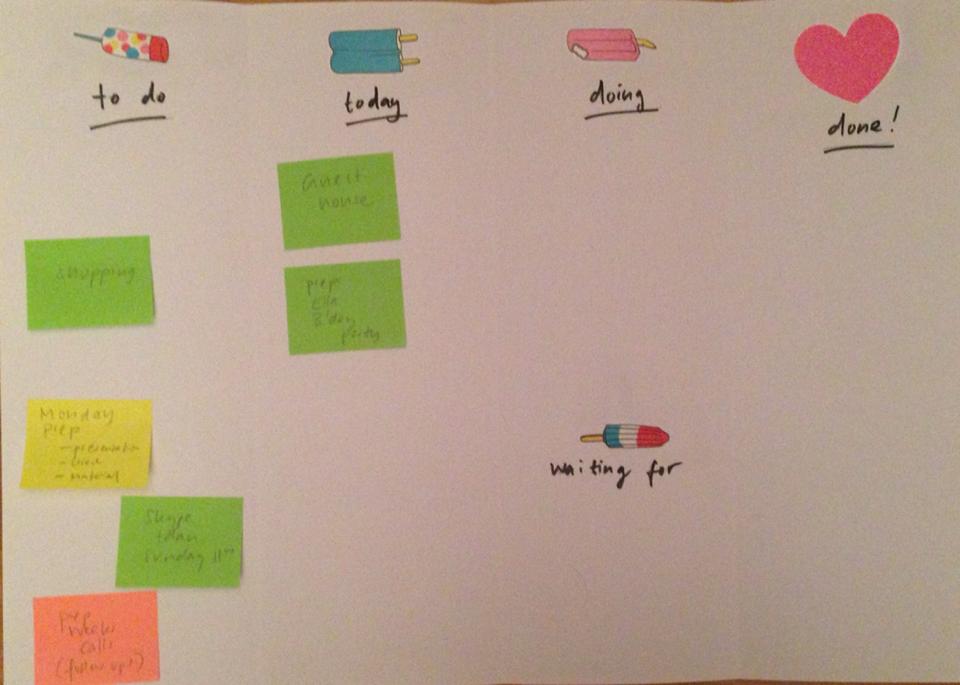
Summer themed Personal Kanban

A kanban for summer

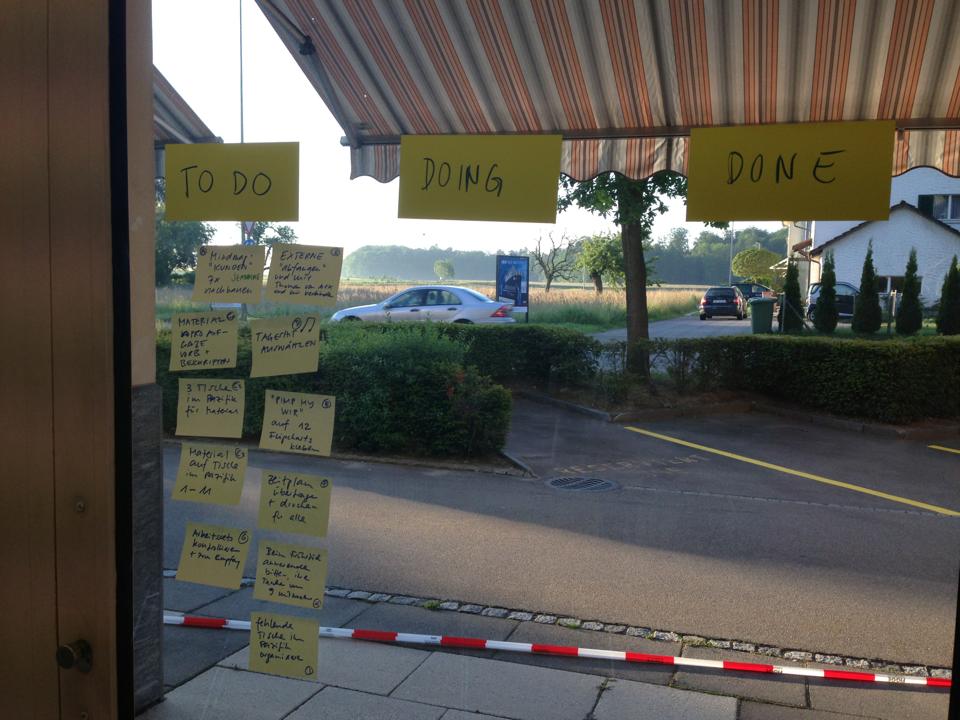
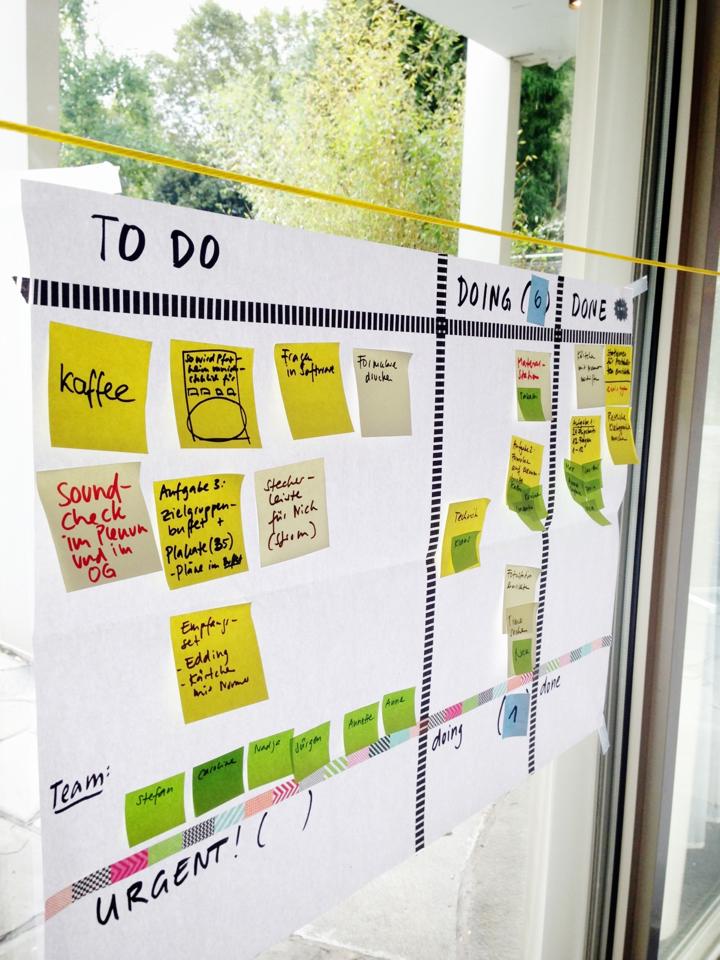
Makeshift window kanban

A makeshift kanban board on a window for a team who had to prepare an event in short time and had no method to do it in a good way.

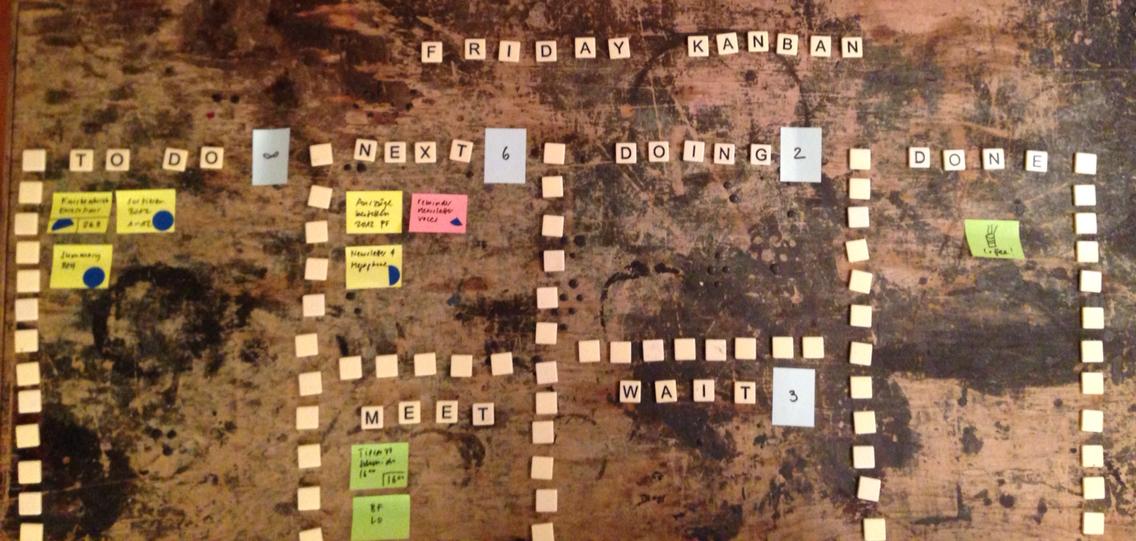
coffee table kanban made with scrabble tiles

A kanban board made of scrabble tiles on the table of my living room.

Organizing quickly with a new team Kanban

A kanban board for a project team with people who have never worked together before and had to get organized in a few hours.

Digital vs. Analog

I am an incredibly digital person. I spend most of my day in front of a computer, tablet or smartphone, and I love to spend free time online, too, researching ideas, reading or just stumbling through the web. So, most people are somewhat perplex that I do not use an online kanban board. I have tried out several of the online kanban software available, and some of them are really good, but nothing, really nothing beats an analog kanban board made from paper and pencil or drawn on a blackboard or whiteboard. I think the reason is that the feeling of transporting the tasks through the board is never quite the same on an online board as on the "real" version.

Remote teams

I have done a fair amount of work with remote teams in the past and this is the only use case where an online board beats the offline version. It's great to see how team members are collaborating over distance by using a digital kanban board, and it’s great to see postits move. Every meeting starts around the kanban board over skype, and the discussions are very similar to teams that stand in front of a «real» kanban.

All in all, my journey with kanban has been immensely beneficial so far, and I am looking forward to all the new things I will learn with kanban over the next years, in all contexts and aspects of life.

Nadja Schnetzler was born in Switzerland and spent her childhood in Mexico City. After graduating from High School, she was a founding member of BrainStore, the first Idea Factory in the world. She has a bachelors degree in journalism from renowned “Ringier School of Journalism”. Over the last 25 years, Nadja has led over 600 innovation projects for companies like Nestlé, Siemens, the Swiss Railways, Kraft Foods, BMW, Save the Children, the United Nations or Amnesty International. She is the author of the book “The Ideamachine” (Wiley) and a sought-after speaker and lecturer at various universities.In 2012, Nadja founded «Word and Deed» with the aim at inspiring organisations, companies, teams and individuals. Word and Deed works in the areas of communication, innovation and collaboration. Kanban has become one of the most important agents of change for Nadja and her clients.Nadja lives in Switzerland with her husband and her two teenage kids. She enjoys listening to and playing baroque music (with her violin) and has an open house for people from all walks of life.This is the final post in the guest series by Nadja Schnetzler - Kanban: A Universe of Options for Life's Planning & Organizing Challenges.  You can read the previous post here.

Kanban: A Universe of Options for Life's Planning & Organizing Challenges #4

This is the 4th post in a guest series, Kanban: A Universe of Options for Life's Planning & Organizing Challenges by Nadja Schnetzler.

Here are a few kanban boards that were created in trainings with individuals and teams:

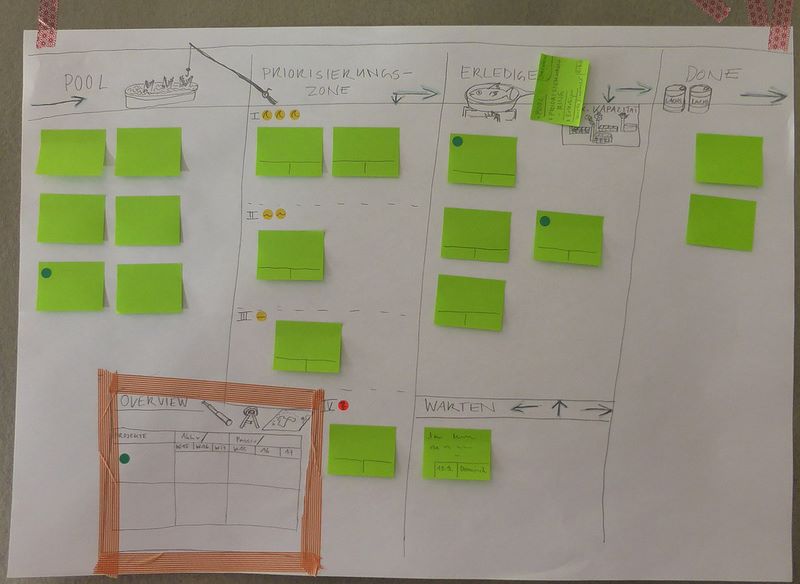
Using fish to be descriptive on the kanban

See the neat illustrations using fish?

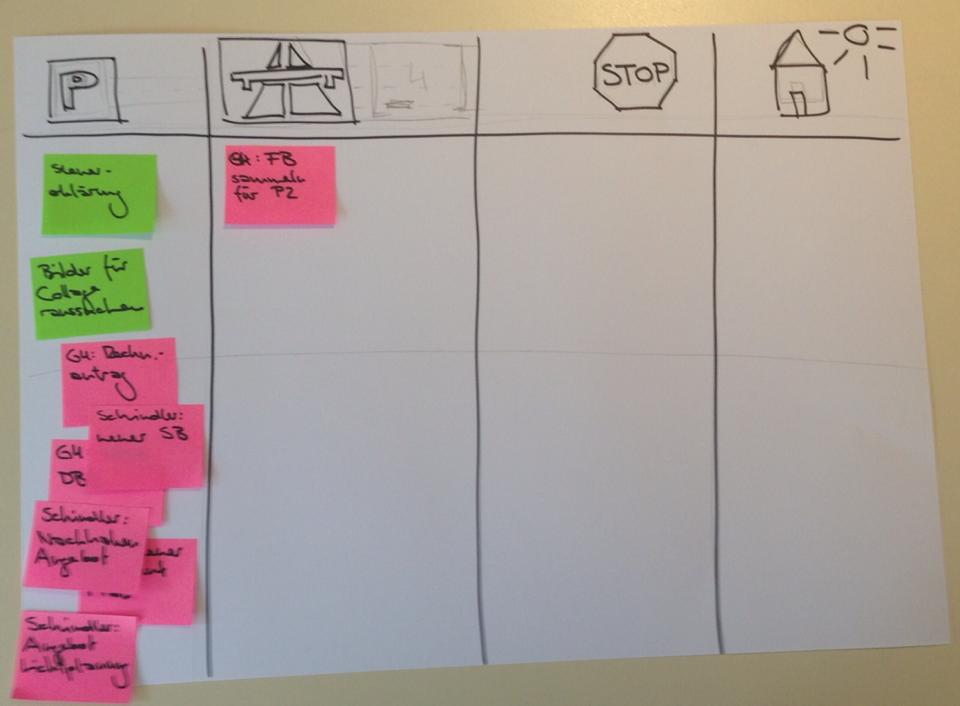
Using street signs to design a kanban

This participant visualized everything with street symbols

Variety of Kanban Boards

A participant explaining his solution out of 10 different kanban boards

Using kanban boards in very different contexts

I have used kanban boards in many shapes and forms for the most different situations over the last years. It’s amazing how adaptable the concept is. Here are a few examples of kanban boards I have created, used, encountered and encouraged.

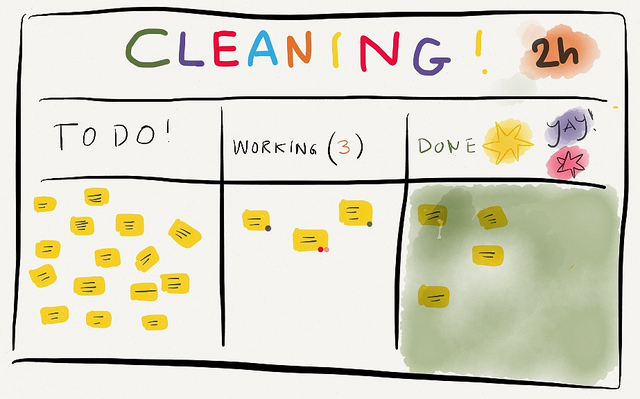
The Cleaning Party kanban board

In our family, we have a ritual on Saturdays called „the cleaning party“. It means that we gather as a family (2 adults and 2 young teens) collect all the tasks that come to our minds related to our household, and then work for two hours on those tasks. We have used a kanban board for this activity now for three years, and the fact that everyone can pull the tasks that work best for him or her is great. We have also introduced the role of the facilitator. This person has an overview, calls for breaks, gives out little treats during the cleaning party and makes sure we debrief when the party comes to a close.

Turning cleaning into a party kanban board

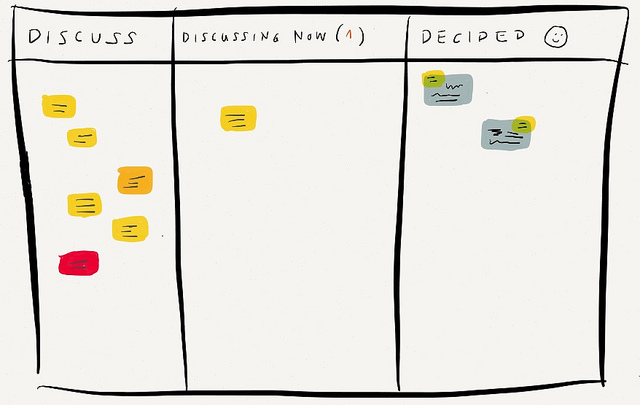
The family conference kanban board

For our “family conference”, a weekly meeting where we discuss important family matters and issues, we also have created a kanban board. It is used as a discussion board to organize the discussion topics and to see what we are focusing on in the discussion right now. Everyone can contribute discussion topics on postits, and then, in turn, each family member picks a postit and this item is discussed. Whatever we decide during our discussion is noted on a bigger stickie and then pulled into the "decided" column. I really love the way this system helps my children to focus on a topic, to use tactics in picking topics and in respecting the other family members.

Family conference Kanban board

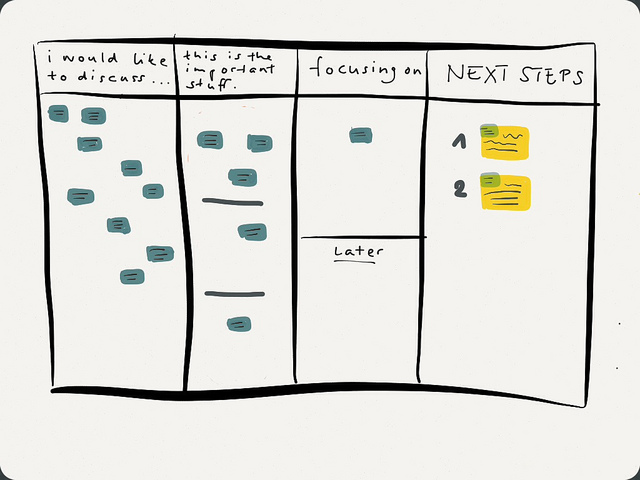
The coaching meeting kanban board

When I meet people for personal coaching, mainly people who are in some kind of change process, I also use a kanban board to work with them. A board helps to collect the possible discussion topics (based on some questions I ask the participant during our first few minutes of the meeting). Then, it's time to decide which of the collected topics should first be discussed. This means pulling the stickies from the first column into the second. I use three layers in the second column to show that again, the postits can be prioritized further.

Then we decide which topic we should discuss first. This one wanders into the "focus" column. Sometimes, when discussing an issue we realize that to really discuss it we need additional information, in which case the postit goes to the "later" section. And finally, when we feel we have discussed a topic at length, we put it into the "Next Steps" column, where we later formulate a plan of what to do now based on all the discussed items.

The beautiful thing of a coaching kanban board is that we can just continue where we left in the next meeting, and we have all the information at hand.

The coaching Kanban board

The portable kanban board

I have a portable version of my kanban board because I travel a lot. It's a large paper with my usuall columns, folded down to a portable size, and reinforced with tape, When I travel, I take the stickies from my board at home and stick them onto my portable board. When I come home, I "synchronize" the boards. It's super easy. I use small size stickies on all my boards so that they also fit my transportable version.

A portable Kanban

My portable kanban board

Nadja Schnetzler was born in Switzerland and spent her childhood in Mexico City. After graduating from High School, she was a founding member of BrainStore, the first Idea Factory in the world. She has a bachelors degree in journalism from renowned “Ringier School of Journalism”. Over the last 25 years, Nadja has led over 600 innovation projects for companies like Nestlé, Siemens, the Swiss Railways, Kraft Foods, BMW, Save the Children, the United Nations or Amnesty International. She is the author of the book “The Ideamachine” (Wiley) and a sought-after speaker and lecturer at various universities.In 2012, Nadja founded «Word and Deed» with the aim at inspiring organisations, companies, teams and individuals. Word and Deed works in the areas of communication, innovation and collaboration. Kanban has become one of the most important agents of change for Nadja and her clients.Nadja lives in Switzerland with her husband and her two teenage kids. She enjoys listening to and playing baroque music (with her violin) and has an open house for people from all walks of life.This is the 4th post in the guest series by Nadja Schnetzler – Kanban: A Universe of Options for Life’s Planning & Organizing Challenges. You can read the previous post here.

Kanban: A Universe of Options for Life’s Planning & Organizing Challenges #3

This is the third post in a guest series, Kanban: A Universe of Options for Life’s Planning & Organizing Challenges by Nadja Schnetzler.

In my practice, the following board has presented itself as the best and most simple way for me to work in a good flow:

6 columns:To do: Holds the backlog and has no limitation.Next: The tasks that I have chosen to be most relevant from the backlog at this point.Meet: A column that holds all the meetings of today and helps me define the WIP limit for the „doing“ column.Doing: The column with all active tasks (WIP limit 1 to 3 if I work alone).Waiting for: A column that holds tasks that are not „done“ because something is open (waiting for an answer by a client  for instance). WIP limitation here is three, forcing me to act on open tasks when the WIP limit is reached.Done: Tasks that are finished.

I use four colors: yellow for normal tasks, red for urgent tasks, green for private tasks and blue for meetings.

My stickies can look very simple on light days and weeks and pretty complex on heavy days and weeks.

 A stickie always contains:- A (to me) crystal clear description of the task at hand- A deadline (only if there really IS a deadline)

A stickie CAN contain additional information during heavy weeks:- estimate of time to complete the task or size of the task ( I go with S, M, L, XL)- project name or color (making sure that I work on a good mix of things, not neglecting clients in my portfolio)- Priority (1,2,3 points)

Sticky note task for a light day

A «light day» stickie

Heavy work day task example

A stickie for heavy days

Whatever works!

I think it’s very important that tools are here for people and not that people become slaves of their tools. So, when using kanban and when talking and passing on my humble knowledge, I always find it important to keep an open mind about everything. If I do not feel like using my board today, for instance, I don’t.

It hardly ever happens, but in some cases I just want to do a good old fashioned to do list that I can check off, or on other days I just do not want to have the feeling that I need to plan everything meticulously. Also, in terms of how to design a kanban board, the postits or how to have conversations around the board, I usually go with „whatever works!“ If a tool works for people, that is fine.

If people start working for the tool, it’s not! In many cases, people notice immediately if something is not working with their board. They notice that tasks do not flow, and they start doing something about it or they come back and ask what they could do. And then we can inspect and adapt. I generally do not tell people „this won’t work“ when they create something that is deviating from kanban „as we know it“. I encourage them to experiment, to explore and to try out. After all, my main interest since 25 years is innovation, is doing things differently, and looking at „old problems“ in new ways.

About the author:

Nadja Schnetzler was born in Switzerland and spent her childhood in Mexico City. After graduating from High School, she was a founding member of BrainStore, the first Idea Factory in the world. She has a bachelors degree in journalism from renowned “Ringier School of Journalism”. Over the last 25 years, Nadja has led over 600 innovation projects for companies like Nestlé, Siemens, the Swiss Railways, Kraft Foods, BMW, Save the Children, the United Nations or Amnesty International.

She is the author of the book “The Ideamachine” (Wiley) and a sought-after speaker and lecturer at various universities.In 2012, Nadja founded «Word and Deed» with the aim at inspiring organisations, companies, teams and individuals. Word and Deed works in the areas of communication, innovation and collaboration. Kanban has become one of the most important agents of change for Nadja and her clients.Nadja lives in Switzerland with her husband and her two teenage kids. She enjoys listening to and playing baroque music (with her violin) and has an open house for people from all walks of life.This is the third post in the guest series by Nadja Schnetzler – Kanban: A Universe of Options for Life’s Planning & Organizing Challenges. You can read the previous post here.

" "