" "

Categorizing Your Backlog

post 2

Your backlog is hope. Your backlog is pain.  

Your backlog holds all the projects, tasks, demands, desires, and expectations you have and the world has for you.The problem is, today’s apparent emergencies are tomorrow’s waste-of-my-time.If we are focused on completion, we don’t want to complete tasks.We want to complete products.If you find you are completing tasks, but not products ... try making your backlog explicitly show what you need to do to complete the products those tasks make up.
Unorganized Backlog

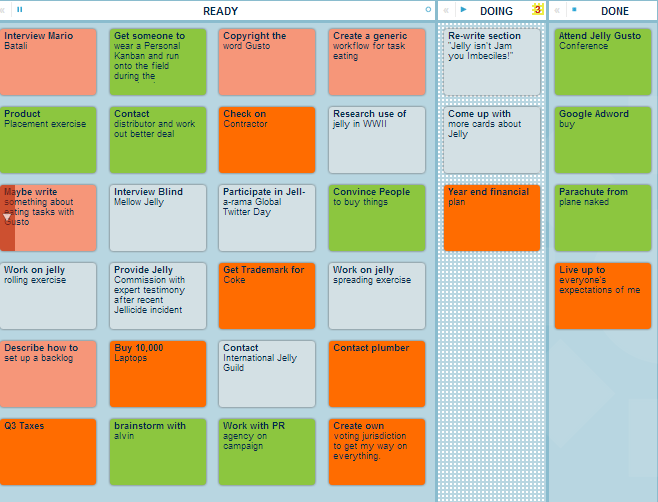
This board is a typical cluttered backlog. You might be able to see that tasks belong to specific projects, but they are jumbled and incoherent. While each of these tasks might be options we can exercise, the complexity of our decision of what to pull next is directly related to the number of tasks in the READY column and our inability to quickly see what each task is.So .. let’s try to build an explicit BACKLOG before the READY column:

Explicit Backlog

Here we see a board with a categorized backlog. We hold work in the backlog until it’s READY to be done. Only then can we move it into the READY column. Note here that the READY column is limited to seven tasks.So now we’ve split out our work and we can see very clearly what projects we have, how much work is in each, and what we are currently spending our time on.This board is much easier to interpret.In this example, we can see that we are split between marketing, general work, and course creation.This is the second post in the series - Are You Just Doing Things?  You can read the first post here.Written in Mesa, Arizona

Are You Just Doing Things?

bp1

I’ll bet you have a lot of things to do. 

Of course you do.We all do.A Personal Kanban anti-pattern that I’m seeing is that people are filling their kanbans with things to do and then...doing them.They are becoming productivity machines. And that’s...really bad.Look, there’s a limitless amount of things to do and you can become super efficient and do much more of them than you ever dreamed possible. And if you do that, soon you will burn out.So I ask you, Why not figure out which work is important?This happened to us recently at Modus. We had our board which we’d been using for a year. The backlog was filling up with tasks that could be done, but didn’t necessarily need to be done.At client sites and in classes, we frequently use our own board as an example. And our board clearly showed this anti-pattern.So we did a few things that I will recommend today:1. Categorize the Backlog - We divided our backlog into sequestered categories of projects. This helped us see where projects were in their completion and what areas of work were taking up most of our time.2. Clean Up the Backlog - Clean up the backlog by deleting old tasks that have aged out or that people want to care about but don’t really care about.3. Pick Dominant and Secondary Projects - One project at any given time should be your main focus. There will always be immediate, context-specific, daily tasks you need to do - but one project should be focused on and completed. Secondary projects are those which need to be done, but are either not the immediate focus or are supporting that focus.4. Clean Up the Done Column - Done columns can fill up, especially when we are hyper-productive. Soon we have our boards laden with stickies covering each other and we don’t know what we did, when we did it, or why we did it that way. Dirty done columns are worse than to-do lists.What you might notice in these four steps is that we didn’t prioritize our tasks, we didn’t make big plans, we altered the board to flow better and our the relationship to the work to be more focused.In the next four posts, I’ll talk more about each one in depth.Written in Mesa, Arizona

Personal Kanban for a Well Oiled Machine

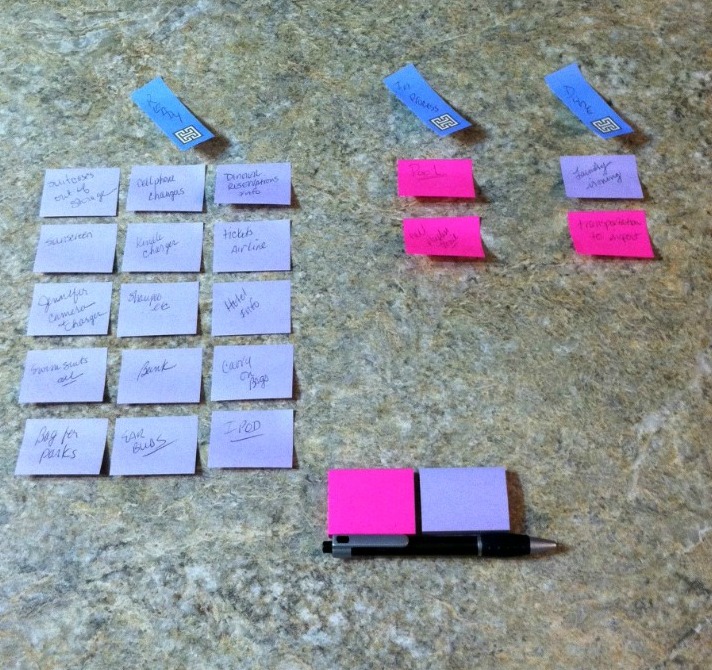
It is no small secret that you can’t do everything yourself. A machine’s gears only work well with all the parts of the machine when they are well oiled. I like to think that my family works in this way. Why? Because we use Personal Kanban to keep our well-oiled machine running.Here are a few ways my family has used Personal Kanban.When I am entertaining, making a special recipe or meal, getting ready for an event, or going on a trip, I will make a kitchen counter kanban.

Kitchen Counter Kanban

When cooking or baking, as I add an ingredient to my dish I will move the post-it into the appropriate column. Often when I am baking, I easily lose track of what I have added to the recipe, this helps me not to lose track.  I have also added tasks corresponding with the meal, such as setting the table, chilling the wine, etc.  When we are getting ready to travel I will put everything right on the counter that I need to do both for myself and my family in regards to packing, confirming reservations and acquiring tickets.

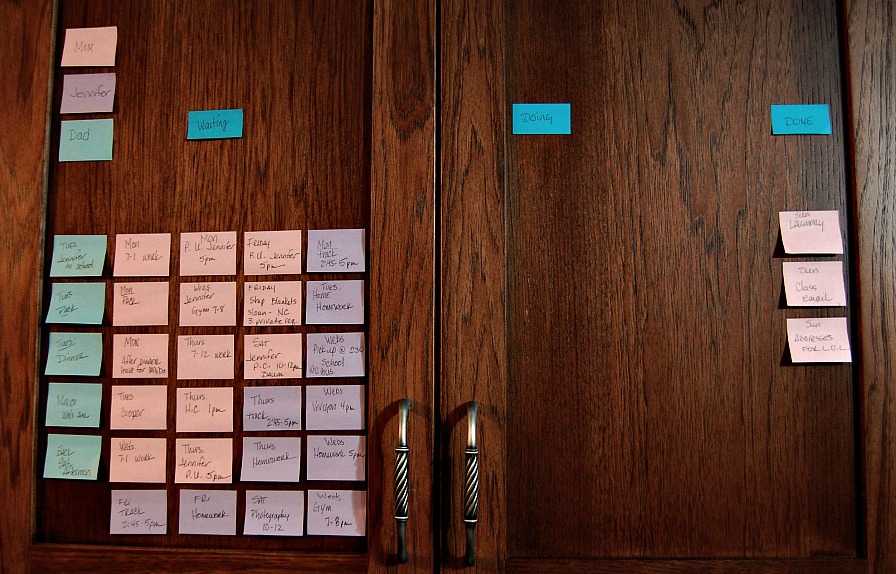
When using a Kanban that involves my whole family when setting it up I take this approach -  I ask each member of my family what color post-it's they want their tasks to be on. This is because I wanted each of them to be able to take one glance at the board and know exactly what each of us is doing at any given time, and I wanted them to be a color that makes them happy.  In the past I have liked to use the refrigerator, but the post-its sometimes wouldn’t stick to the door, so I decided on the cabinet that is most used, the dish cabinet. (No one can eat without going into this cabinet!)

Family Kanban on the kitchen cabinet

My husband chose the blue, my daughter the purple and I was the pink color.  I added the color post-it each of us chose with our names at the top above the waiting lanes.  This worked out great because I didn’t need to add names to the individual tasks, just what each task was, and we all knew immediately whose task it was. I even decided to add the day the task was going on, that way when I filled the waiting lane I could put every task up in chronological order, it made it easier to wade through.

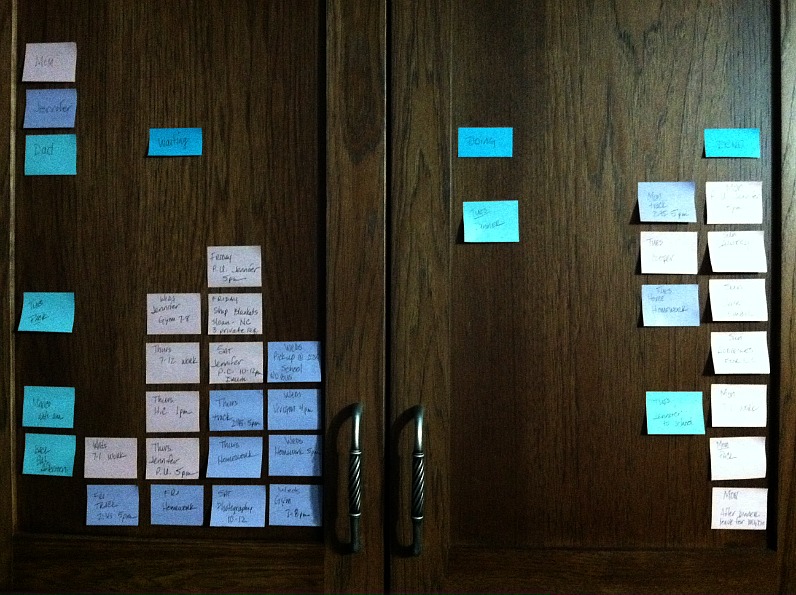
Work flow on the family kanban

By Tuesday we were already in a good flow. What I love most about doing a family kanban is the fact that it involves everyone. While I was away my daughter and husband moved their tasks and kept each other in check. It’s like I have a safety net in place, it ensures that we are working together as a family (even if one of us is traveling). I’m not worried that my daughter won’t get to her activities on time. I know it’s getting accomplished.

Each time we use a new kanban in our home we learn and evolve as a family.  It adds to our family happiness factor.  In the past my daughter has even left her appreciation for our family Kanban right in the middle of the board.

Happiness on the family Kanban

I sleep better at night when I’m traveling knowing my family members have the visual reminders of important tasks that can’t get overlooked. This is also something that even though we are busy, going in all different directions, we work on together as a family all week long. Each kanban board is a direct reflection of our family, where we are all at together in our lives, and it brings us closer together.This post originally appeared on the Nothing is Out of Reach Blog.

Completing Projects and Building Confidence with Kidzban

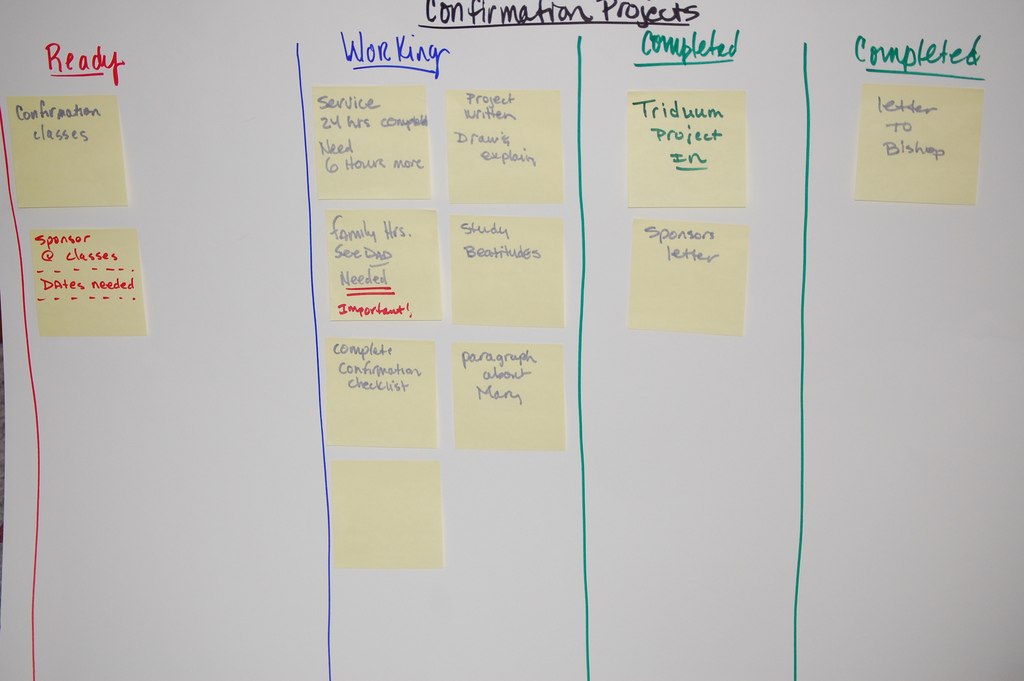
When I first started using Personal Kanban the one thing that excited me immediately was how much I wanted to use it with my daughter and at home with my family.And so my journey began.  At the time my daughter was 11 and continuing her religious education preparing to become confirmed.  There was so much she needed to get done before being able to complete the process and become confirmed that anytime we even mentioned the subject she became clearly overwhelmed.  That's when I decided to introduce her to Personal Kanban.  We set up a Confirmation kidzban.

kidzban to complete religious education projects

She was so excited to be able to visualize all her work that immediately she felt a sense of relief.  Once we got the tasks all up on the board she realized most of the tasks were actually waiting for actions from others.  "Oh that's not so much work." she said.  While it appears to be a lot of WIP, some of those tasks were actually waiting on action from a parent.  Her first use of a Kanban was a complete success. She has completed her religious education and did receive her confirmation.

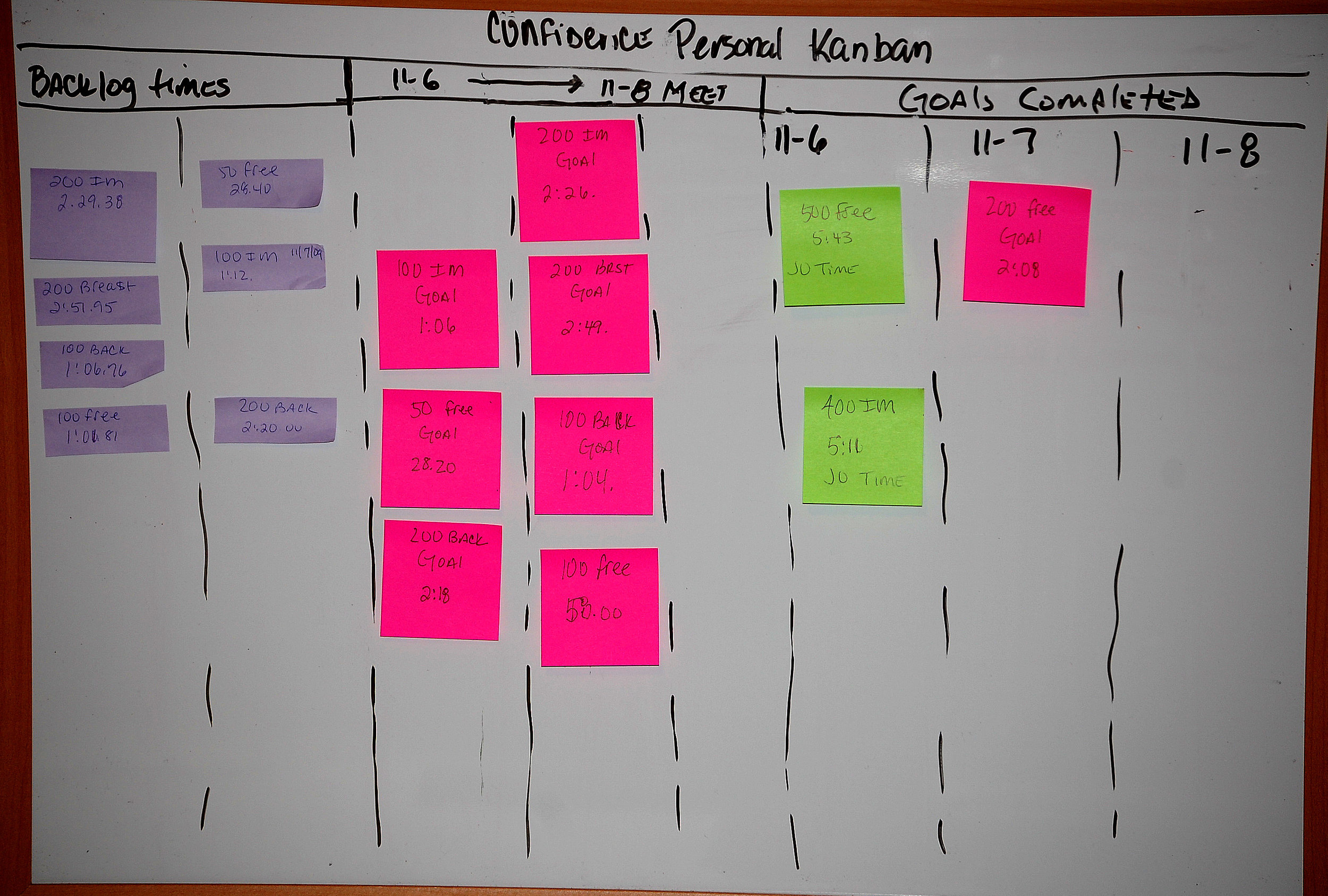
When my daughter was a little older she was a competitive swimmer.  When you swim for a long time you hit many peaks and valleys.  One season my daughter was feeling incredibly defeated in the water.  Although practicing very hard day in and day out she was not seeing the results she wanted in the water.  She was losing confidence FAST!  So I thought about it and at the time I was experimenting with using Kanban for many projects so I thought why not? Let's see if a kanban can gain her some confidence back in the pool.   We sat down and talked about the times she wanted to achieve in the water, what her times were at that point, and what times she needed in order to qualify for the Junior Olympics.  We wrote her goal times on post-it's, and set up the Confidence kidzban.

Using Personal Kanban to build confidence

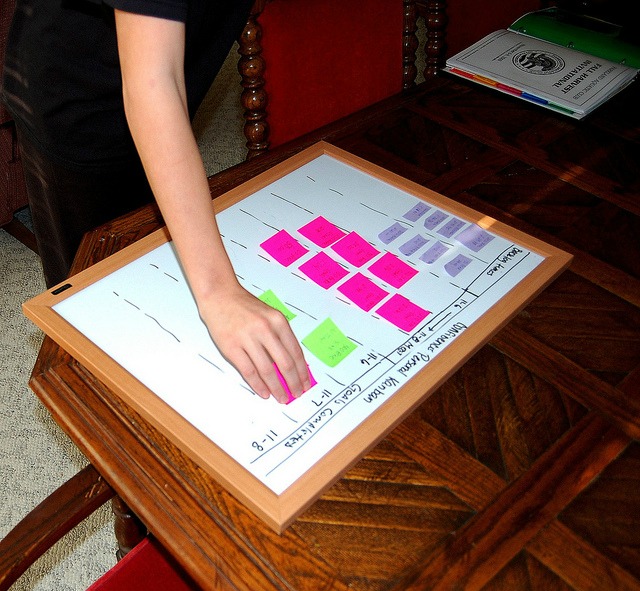
The Personal Kanban consisted of 3 major swim lanes, a BACKLOG of times, those being the times she was going into the meet with, her seed times.  The WIP lane was the goal times she set for each event.  The COMPLETED lane was called Goal Times Completed. When she had achieved the goals she set in the WIP lane they would be moved over. Having the times visualized on a board before we left for the meet was huge for her.  When she posted the times up on the board she began to see the differences and began to believe yes this is totally something I can achieve.   Not only because she hit some of her goals, but also because when we looked at the board after moving the first two events of the meet over to the completed swim lane, it felt tangible to her.  She could actually look at the board and see her goals being met.

moving goals over on the confidence kanban

After the second day of swimming we still had success, and even though she only completed one goal on her Personal Kanban board she was extremely proud of her work in the pool on this afternoon. The board has caused her to realize that confidence isn’t only about achieving those goals, it’s about seeing her work in progress. Along the way her confidence will get stronger and stronger with each goal that is met.  The main goal of this Personal Kanban was not just about achieving all new times, a very difficult task for any level competitive swimmer. It was also about giving a 12-year-old athlete her confidence back. According to her, even though all goals were not met and moved into the completed lane YET, they will be. Can you apply Personal Kanban to help confidence?  Ask my 12 year old and she will tell you, yes you can.

This is an updated post that originally appeared on the Nothing is Out of Reach blog.

Personal Kanban at NYC's Agile Learning Center

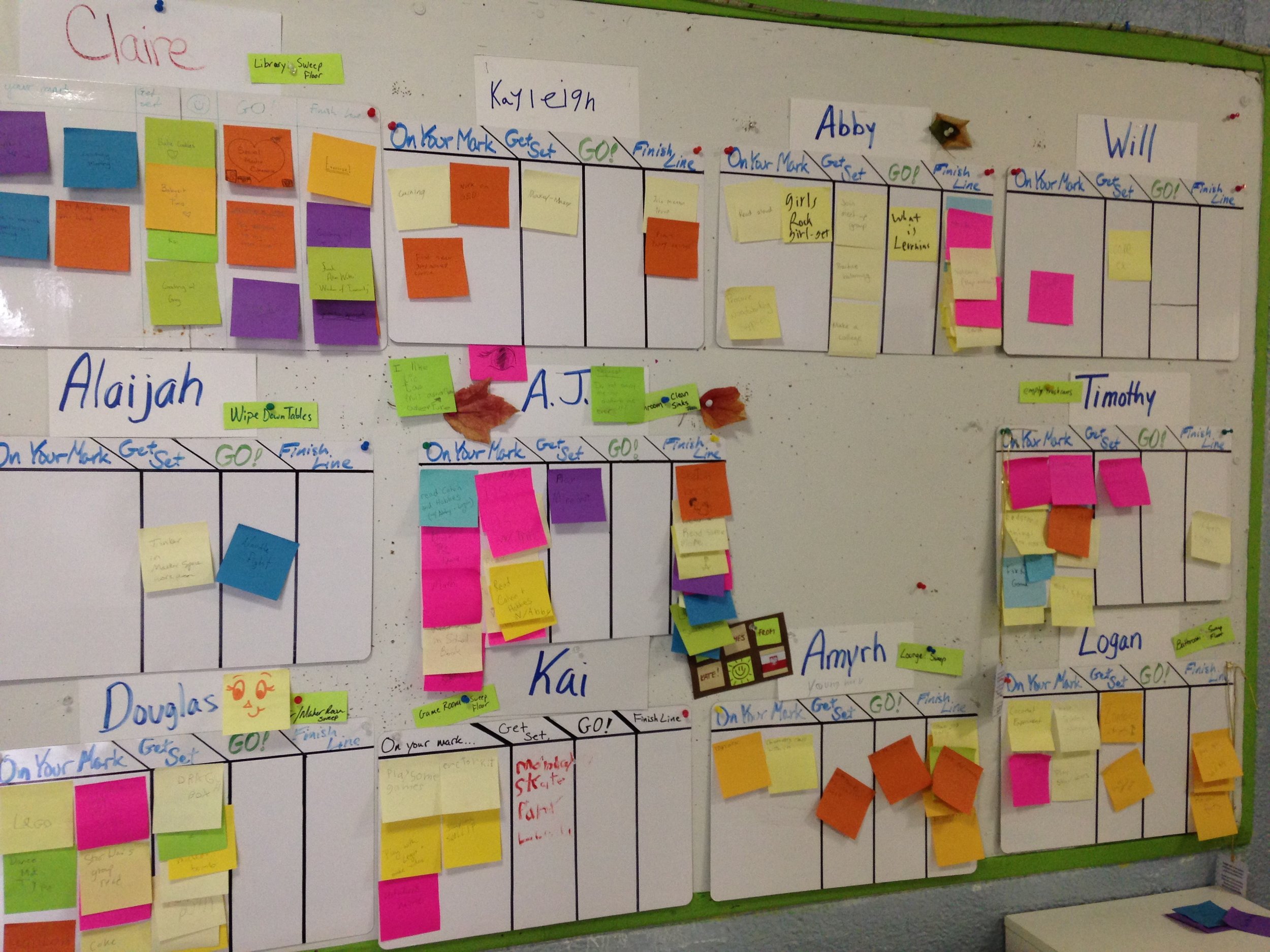
The Agile Learning Center at Manhattan Free School is designed to put young people in the driver’s seat of their learning and living – giving them the same opportunity and responsibility that we have as adults – to create their own lives.Each morning, we begin with a standup meeting. Everyone takes a turn stating their intentions for the day and making requests for any support they may need. At the end of the day, we come back for another standup meeting to reflect. Did we fulfill our intentions? If so, how? If not – why? What might we do differently tomorrow based on our awareness of today?This daily cycle of creation and reflection produces a powerful feedback loop, providing us clear information about the choices we make and the results of those choices. Between the bookends of this daily cycle, kanban boards are used to support mindfulness in our decision-making process.After morning standup, we use kanban boards to make our intentions visible. Speaking intentions is a start, but making them visible in physical space takes our awareness and commitment to the next level. Now we have a self-created roadmap for what’s possible.

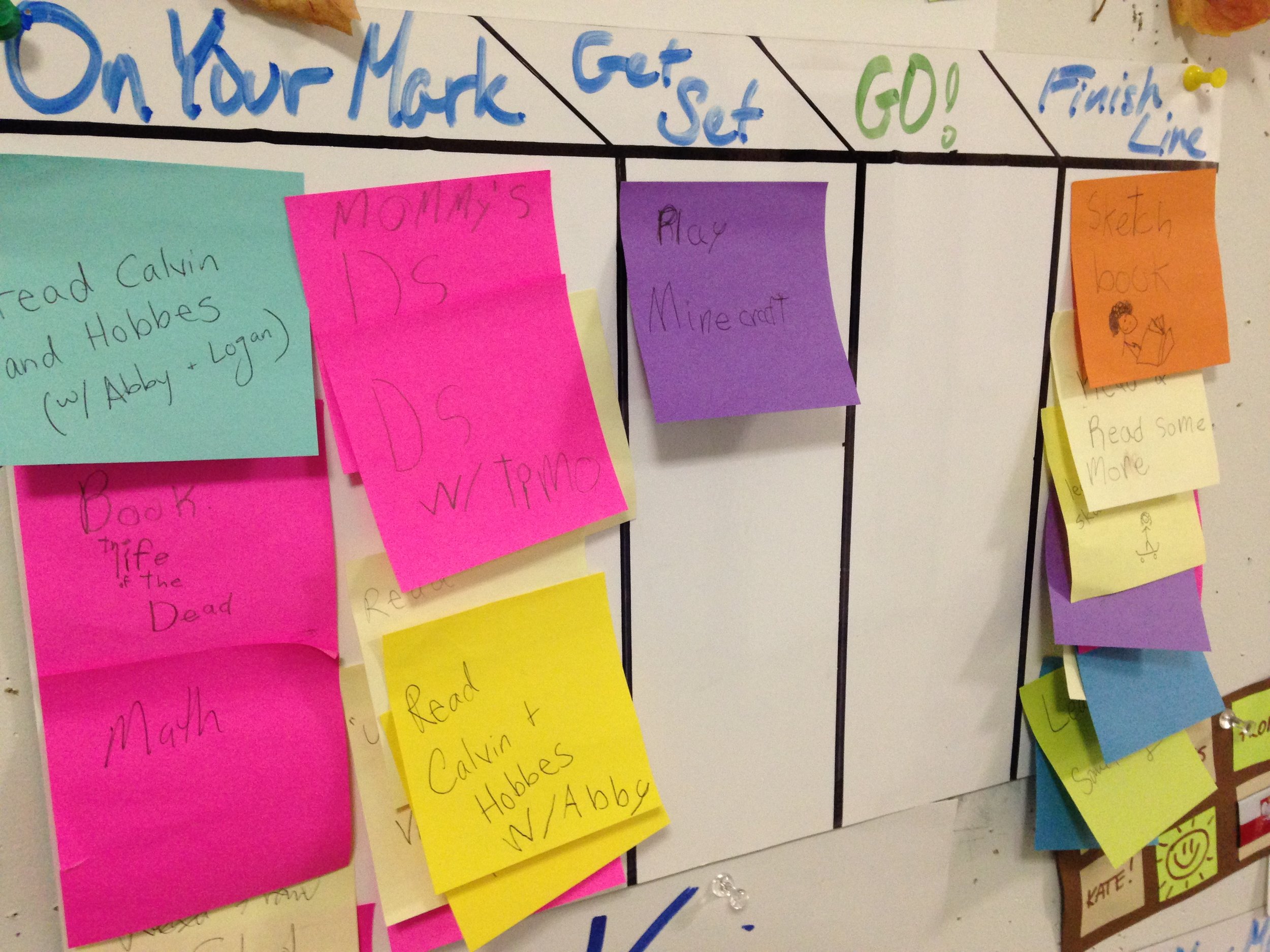
A student kanban

From there, students practice prioritizing by surveying the possibilities for their day and moving things into READY or “Get Set”. What do I really want to do today? Who could I work or play with? What will nurture my body, mind, and spirit? A nine year-old may not be using these words or asking these specific questions, but the kanban process has them considering all of these factors in their own way.Next, we get to experience the power of making what’s possible a reality by pulling the selected intention into DOING or “Go”. ACTION! Deep engagement ensues. When we take the time to make conscious choices, we tend to be more focused, present, and committed to our actions, because we are taking ownership over the whole process.

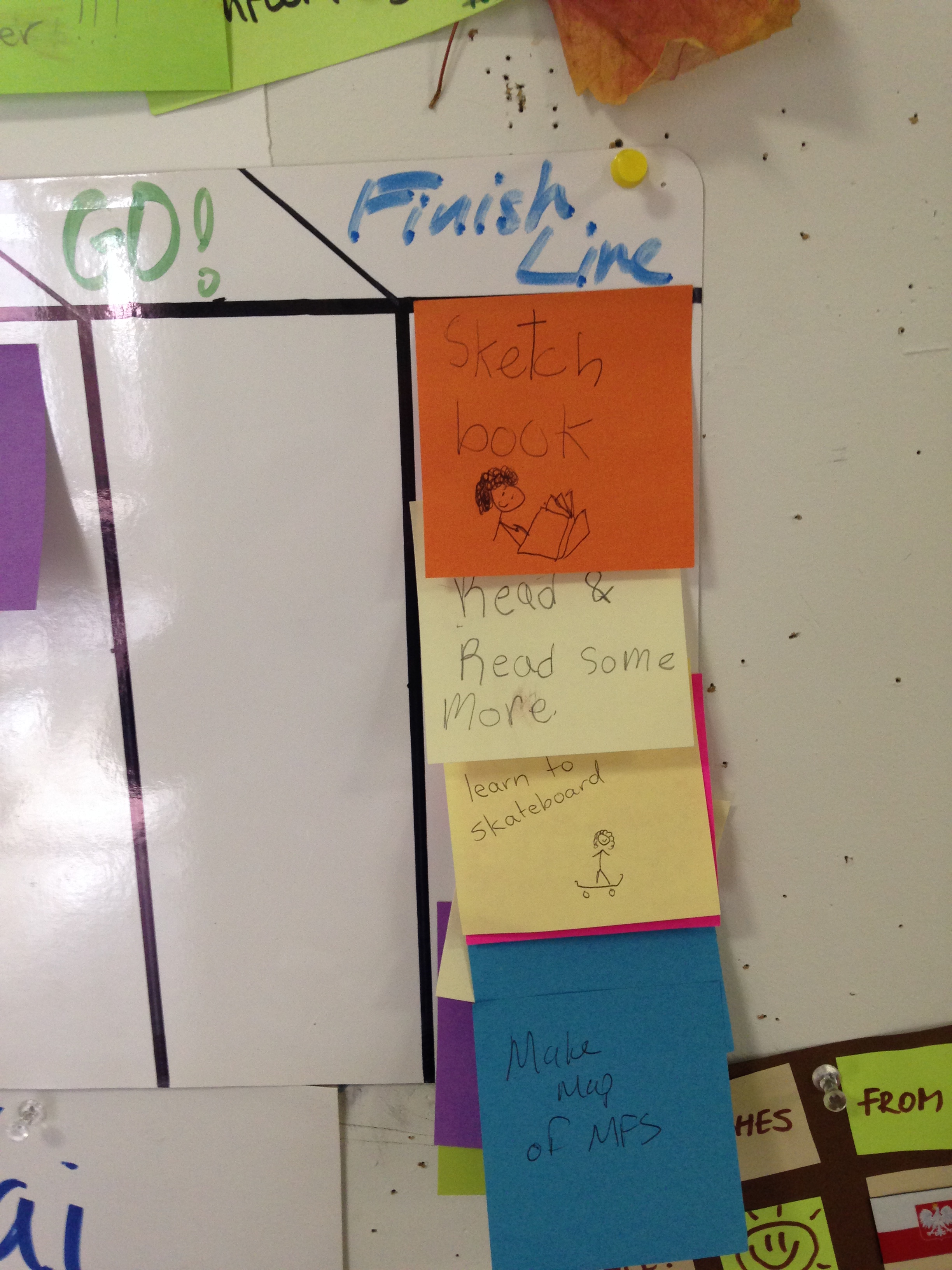
Finish line on the student Kanban

When an intention is fulfilled, a task completed, or a curiosity explored, we come back to move the story across the finish line. Crossing the finish line does not mean that the story is over and done with. However, it does mark what we have created, and gives us the opportunity to reflect, assess, and constantly improve.

Wall of student kanbans

The kanban board is an extremely effective tool for breaking through our automatic thinking – informing ourselves of the past, visualizing the future, and bringing our attention to the present.Agile Learning Centers is an open-sourced education model for the 21st Century. Learn more about the very first Agile Learning Center at AgileLearn.org

" "